
| From | American Immigration Council, This Week in Immigration <[email protected]> |
| Subject | Can Renee Good’s Family Sue the ICE Agent Who Killed Her? |
| Date | January 11, 2026 3:02 PM |
Links have been removed from this email. Learn more in the FAQ.
Links have been removed from this email. Learn more in the FAQ.
[link removed] [[link removed]]
Latest Analysis
[link removed] [[link removed]]
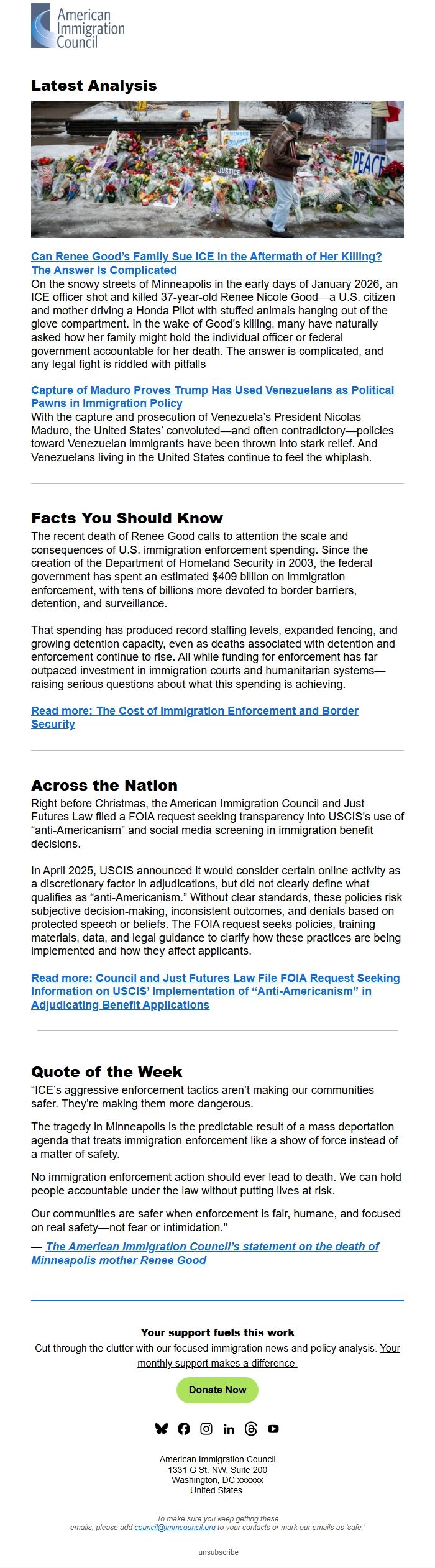
Can Renee Good’s Family Sue ICE in the Aftermath of Her Killing? The Answer Is Complicated [[link removed]]
On the snowy streets of Minneapolis in the early days of January 2026, an ICE officer shot and killed 37-year-old Renee Nicole Good—a U.S. citizen and mother driving a Honda Pilot with stuffed animals hanging out of the glove compartment. In the wake of Good’s killing, many have naturally asked how her family might hold the individual officer or federal government accountable for her death. The answer is complicated, and any legal fight is riddled with pitfalls
Capture of Maduro Proves Trump Has Used Venezuelans as Political Pawns in Immigration Policy [[link removed]]
With the capture and prosecution of Venezuela’s President Nicolas Maduro, the United States’ convoluted—and often contradictory—policies toward Venezuelan immigrants have been thrown into stark relief. And Venezuelans living in the United States continue to feel the whiplash.
Facts You Should Know
The recent death of Renee Good calls to attention the scale and consequences of U.S. immigration enforcement spending. Since the creation of the Department of Homeland Security in 2003, the federal government has spent an estimated $409 billion on immigration enforcement, with tens of billions more devoted to border barriers, detention, and surveillance.
That spending has produced record staffing levels, expanded fencing, and growing detention capacity, even as deaths associated with detention and enforcement continue to rise. All while funding for enforcement has far outpaced investment in immigration courts and humanitarian systems—raising serious questions about what this spending is achieving.
Read more: The Cost of Immigration Enforcement and Border Security [[link removed]]
Across the Nation
Right before Christmas, the American Immigration Council and Just Futures Law filed a FOIA request seeking transparency into USCIS’s use of “anti-Americanism” and social media screening in immigration benefit decisions.
In April 2025, USCIS announced it would consider certain online activity as a discretionary factor in adjudications, but did not clearly define what qualifies as “anti-Americanism.” Without clear standards, these policies risk subjective decision-making, inconsistent outcomes, and denials based on protected speech or beliefs. The FOIA request seeks policies, training materials, data, and legal guidance to clarify how these practices are being implemented and how they affect applicants.
Read more: Council and Just Futures Law File FOIA Request Seeking Information on USCIS’ Implementation of “Anti-Americanism” in Adjudicating Benefit Applications [[link removed]]
Quote of the Week
“ICE’s aggressive enforcement tactics aren’t making our communities safer. They’re making them more dangerous.
The tragedy in Minneapolis is the predictable result of a mass deportation agenda that treats immigration enforcement like a show of force instead of a matter of safety.
No immigration enforcement action should ever lead to death. We can hold people accountable under the law without putting lives at risk.
Our communities are safer when enforcement is fair, humane, and focused on real safety—not fear or intimidation."
— The American Immigration Council’s statement on the death of Minneapolis mother Renee Good [[link removed]]
Your support fuels this work
Cut through the clutter with our focused immigration news and policy analysis. Your monthly support makes a difference.
Donate Now [[link removed]]
[link removed] [[link removed]] [link removed] [[link removed]] [link removed] [[link removed]] [link removed] [[link removed]] [link removed] [[link removed]] [link removed] [[link removed]]
American Immigration Council
1331 G St. NW, Suite 200
Washington, DC xxxxxx
United States
To make sure you keep getting these
emails, please add [email protected] [[email protected]] to your contacts or mark our emails as 'safe.'
unsubscribe: [link removed]
Latest Analysis
[link removed] [[link removed]]
Can Renee Good’s Family Sue ICE in the Aftermath of Her Killing? The Answer Is Complicated [[link removed]]
On the snowy streets of Minneapolis in the early days of January 2026, an ICE officer shot and killed 37-year-old Renee Nicole Good—a U.S. citizen and mother driving a Honda Pilot with stuffed animals hanging out of the glove compartment. In the wake of Good’s killing, many have naturally asked how her family might hold the individual officer or federal government accountable for her death. The answer is complicated, and any legal fight is riddled with pitfalls
Capture of Maduro Proves Trump Has Used Venezuelans as Political Pawns in Immigration Policy [[link removed]]
With the capture and prosecution of Venezuela’s President Nicolas Maduro, the United States’ convoluted—and often contradictory—policies toward Venezuelan immigrants have been thrown into stark relief. And Venezuelans living in the United States continue to feel the whiplash.
Facts You Should Know
The recent death of Renee Good calls to attention the scale and consequences of U.S. immigration enforcement spending. Since the creation of the Department of Homeland Security in 2003, the federal government has spent an estimated $409 billion on immigration enforcement, with tens of billions more devoted to border barriers, detention, and surveillance.
That spending has produced record staffing levels, expanded fencing, and growing detention capacity, even as deaths associated with detention and enforcement continue to rise. All while funding for enforcement has far outpaced investment in immigration courts and humanitarian systems—raising serious questions about what this spending is achieving.
Read more: The Cost of Immigration Enforcement and Border Security [[link removed]]
Across the Nation
Right before Christmas, the American Immigration Council and Just Futures Law filed a FOIA request seeking transparency into USCIS’s use of “anti-Americanism” and social media screening in immigration benefit decisions.
In April 2025, USCIS announced it would consider certain online activity as a discretionary factor in adjudications, but did not clearly define what qualifies as “anti-Americanism.” Without clear standards, these policies risk subjective decision-making, inconsistent outcomes, and denials based on protected speech or beliefs. The FOIA request seeks policies, training materials, data, and legal guidance to clarify how these practices are being implemented and how they affect applicants.
Read more: Council and Just Futures Law File FOIA Request Seeking Information on USCIS’ Implementation of “Anti-Americanism” in Adjudicating Benefit Applications [[link removed]]
Quote of the Week
“ICE’s aggressive enforcement tactics aren’t making our communities safer. They’re making them more dangerous.
The tragedy in Minneapolis is the predictable result of a mass deportation agenda that treats immigration enforcement like a show of force instead of a matter of safety.
No immigration enforcement action should ever lead to death. We can hold people accountable under the law without putting lives at risk.
Our communities are safer when enforcement is fair, humane, and focused on real safety—not fear or intimidation."
— The American Immigration Council’s statement on the death of Minneapolis mother Renee Good [[link removed]]
Your support fuels this work
Cut through the clutter with our focused immigration news and policy analysis. Your monthly support makes a difference.
Donate Now [[link removed]]
[link removed] [[link removed]] [link removed] [[link removed]] [link removed] [[link removed]] [link removed] [[link removed]] [link removed] [[link removed]] [link removed] [[link removed]]
American Immigration Council
1331 G St. NW, Suite 200
Washington, DC xxxxxx
United States
To make sure you keep getting these
emails, please add [email protected] [[email protected]] to your contacts or mark our emails as 'safe.'
unsubscribe: [link removed]
Message Analysis
- Sender: American Immigration Council
- Political Party: n/a
- Country: United States
- State/Locality: n/a
- Office: n/a
-
Email Providers:
- EveryAction