|  | Know better. Do better. |  | Climate.
Change.News from the ground, in a warming world |
|
| | Credits where they're due?When you, or the company you work for, buy forest carbon credits to compensate for your planet-heating emissions, do you really know what you're getting?
This week, after months of digging, the Context climate team shines a light on a complex land ownership battle affecting one of the biggest carbon projects in the Amazon rainforest.
We found that a corporate-led conservation project has sold carbon credits from publicly owned land without state authorization, highlighting concerns about the credibility of offsets from areas with disputed land ownership.
The credits - purchased by multinational and Brazilian businesses - are certified by leading standards body Verra, which has launched a review of the project off the back of reporting by our Brazil-based correspondent Andre Cabette Fabio.
The landmark case of the Jari Pará REDD+ project adds to growing fears that financial assets - from carbon credits to NFTs - are being created and sold internationally, based on Amazon land ownership that is contested or has been ruled invalid by government authorities.
Ibraim Rocha, a Pará state attorney who led the push for the main Jari Pará land parcel to be declared public in 2018, said it shows "we have still not faced up to the problem of land-grabbing in the Amazon".
"Carbon credits are making it more complicated," he added.  Macaws sit on a tree at the Amazon rainforest in Manaus, Amazonas State, Brazil October 26, 2022. REUTERS/Bruno Kelly |
Recycling 'green' mineralsAnother type of natural asset seen as key to cutting greenhouse gas emissions to net zero by mid-century is the metals and minerals needed to create clean energy from wind turbines, electric cars
and more.
The challenge is to mine and process those resources - a large proportion of them found in the Global South - in ways that break with the destructive extractive model of the past and avoid damaging the environment, while sharing the economic benefits more fairly.
Part of the answer is to find ways to recycle and reuse traditional metals like steel and copper and new ones such as lithium and "rare earth" elements. Companies like European Metal Recycling (EMR), near the English city of Birmingham, aim to seize the opportunity.
In Europe, for example, 40% to 75% of clean-energy-related metals could be sourced through recycling by 2050 if the continent boosts investment in it and makes it more efficient, according to industry group Eurometaux.
"The need to move the world to net zero and 'nature positive' is effectively going to require something like the green industrial revolution," EMR's chief executive Chris Sheppard told our reporter Jack Graham, who visited the facility to see how it all works. 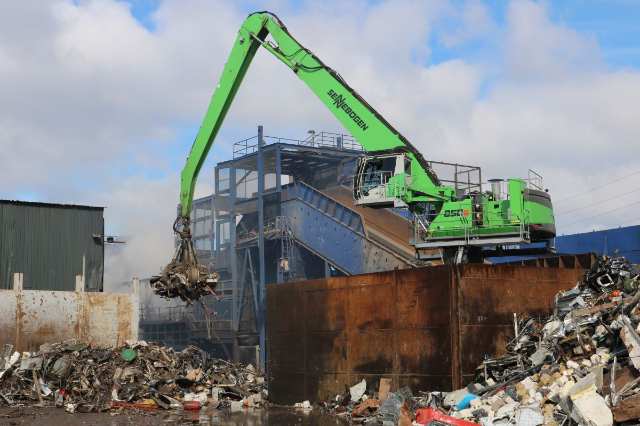 An electric material handler lifts scrap into a shredder at a European
Metal Recycling plant in Birmingham, Britain. March 10, 2023. Thomson Reuters Foundation/Jack Graham |
Energy migrationDemand for products that use such minerals, meanwhile, will only rise in line with growing demand from emerging markets like India, which is set to overtake China as the world's most populous nation next month.
To mark that milestone, we’ve been running a series of features looking at the implications for everthing from women's participation in the workforce to how a more modern energy mix is fuelling migration from the South Asian nation's coal-rich regions to manufacturing hubs in cities.
Our India correspondents talked to people like Shashikant Midha, 26, from Dhanbad, where coal mines are shutting down and "despair" is setting in.
Now living in southern India, more than 1,700 km from home, and working long hours on a car-assembly line, Midha belongs to the swelling ranks of young Indians left with little choice but to seek work in cities, where they struggle to find secure, well-paid employment and see little future for themselves.
See you next week,
Megan |
|
| | Here's what experts say on how close we are to missing the 1.5 degrees Celsius target on global warming, and what happens if so | As the world warms up and the population rises, water shortages are a growing problem | A forest conservation project that sold carbon credits is
under review after Context revealed its offsets came from publicly-owned land | As demand surges for metals such as lithium, recycling could cut the impact of mining on people and nature | Countries like Colombia should plan to provide for communities whose livelihoods were previously tied to fossil fuels | |
| | | | | | |
|