
Know better. Do better.
|  | Climate. Change.News from the ground, in a warming world |
|
| By Laurie Goering | Climate Change Editor |
|

| Goodbye Frontlines. Hello Climate. Change.We've changed our name! But don't worry - we're still focused on the human impacts of climate change, with stories reported from the frontlines. And don't miss our revamped website: Context.
|
Looking ahead to 1.5CCOP27 is now just a month away, with key issues like "loss and damage" from climate change rising to the top of the agenda.
But we're looking even further ahead this week - and in coming weeks - to how life around the world could be different at 1.5 degrees Celsius of warming.
That's a mark scientists say is fast approaching with global temperatures already above 1.2C of warming.
We'll take you from India to Sweden and Brazil to Egypt, to look at what's happening with everything from new pressures on farmers to the impacts of faster sea level rise. 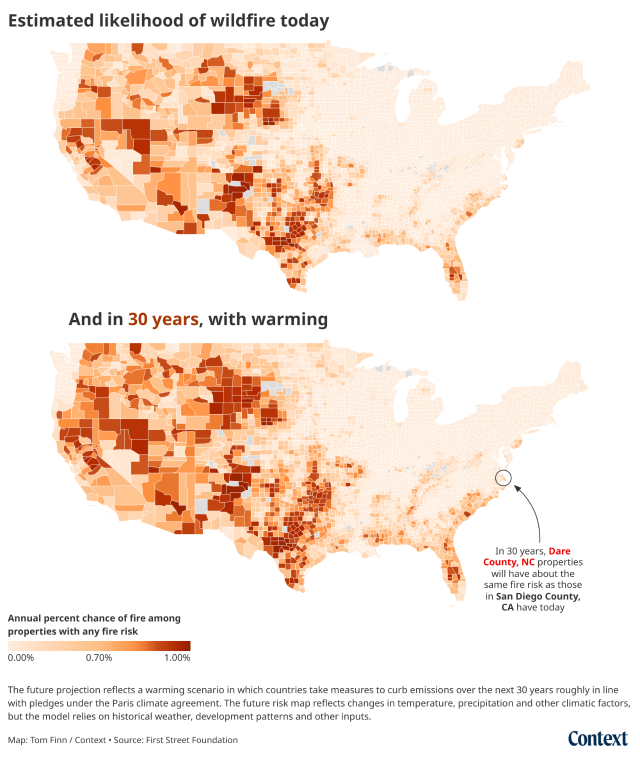 . |
Rising wildfire threatIn the first of our series, we look at an unexpected new risk for the U.S. East Coast: wildfires.
North Carolina already faces sea level rise and worsening storms, flooding and erosion, but global warming is spurring a surging fire threat as well.
Last year it saw more wildfires than any state in the country except California and Texas. It and South Carolina have some of the largest numbers of blaze-threatened properties, behind only California and New Mexico, according to First Street Foundation, a non-profit that maps climate risks.
"Wildfire risk is increasing so much faster than even flood risk is across the U.S.," said Ed Kearns, the group's chief data officer. "And it's likely to affect areas that aren't thought of as wildfire-prone areas right now, but will be soon."
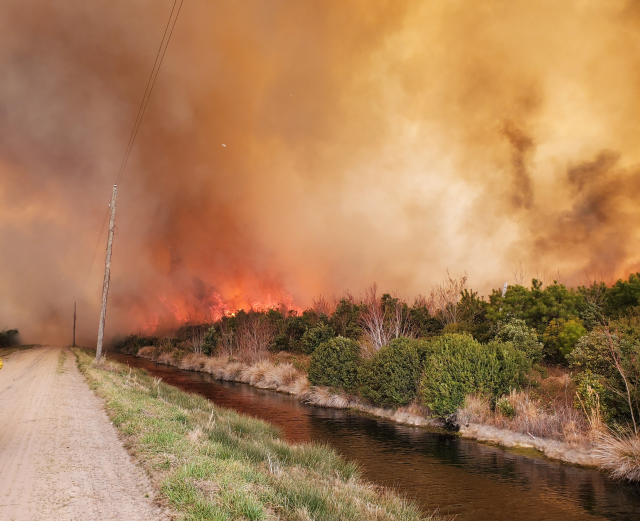 The Jackson Road Fire, which originated at a military bombing range in Dare County, North Carolina, burned through more than 1,000 acres of land in March 2022. Thomson Reuters Foundation/Handout via North Carolina Forest Service. |
'Competing catastrophes'?That's a challenge for authorities there already battling other climate-fuelled risks.
"We spend so much time talking about floods," admitted Ben Cahoon, the mayor of quiet beachfront Nags Head, North Carolina, one of the communities facing new risks. "We probably should be a little more attentive to (fire), talk to our citizens a little bit more about it than we do."
But residents, so far, aren't particularly worried.
"I've been here 37 years," Bryan Whitehurst, a seafood market co-owner in Nags Head, told our correspondent David Sherfinski. "There's been fires, but nothing they haven't been able to put out."
.png/640w)
School principal Indira Mahat shows the level that recent floods rose to in a slum on the outskirts of Kathmandu, Nepal, September 8, 2022. Thomson Reuters Foundation/Athar Parvaiz
|
North Carolina is hardly the only place facing growing threats.
Calls are mounting for Pakistan to put in place much stronger crisis planning after floods that covered a third of the country left authorities struggling to provide medical and other aid.
Across South Asia, the urban poor are at particular - and growing risk - from floods as populations grow and families are pushed onto more precarious land, reports Athar Parvaiz.
Looking for a bit of good news? You might soon be able to buy milk produced without the methane-belching cow - though whether it's really lower carbon (or affordable) remains to be seen. Check out our video below!
See you next week!
Laurie |
| |
|


