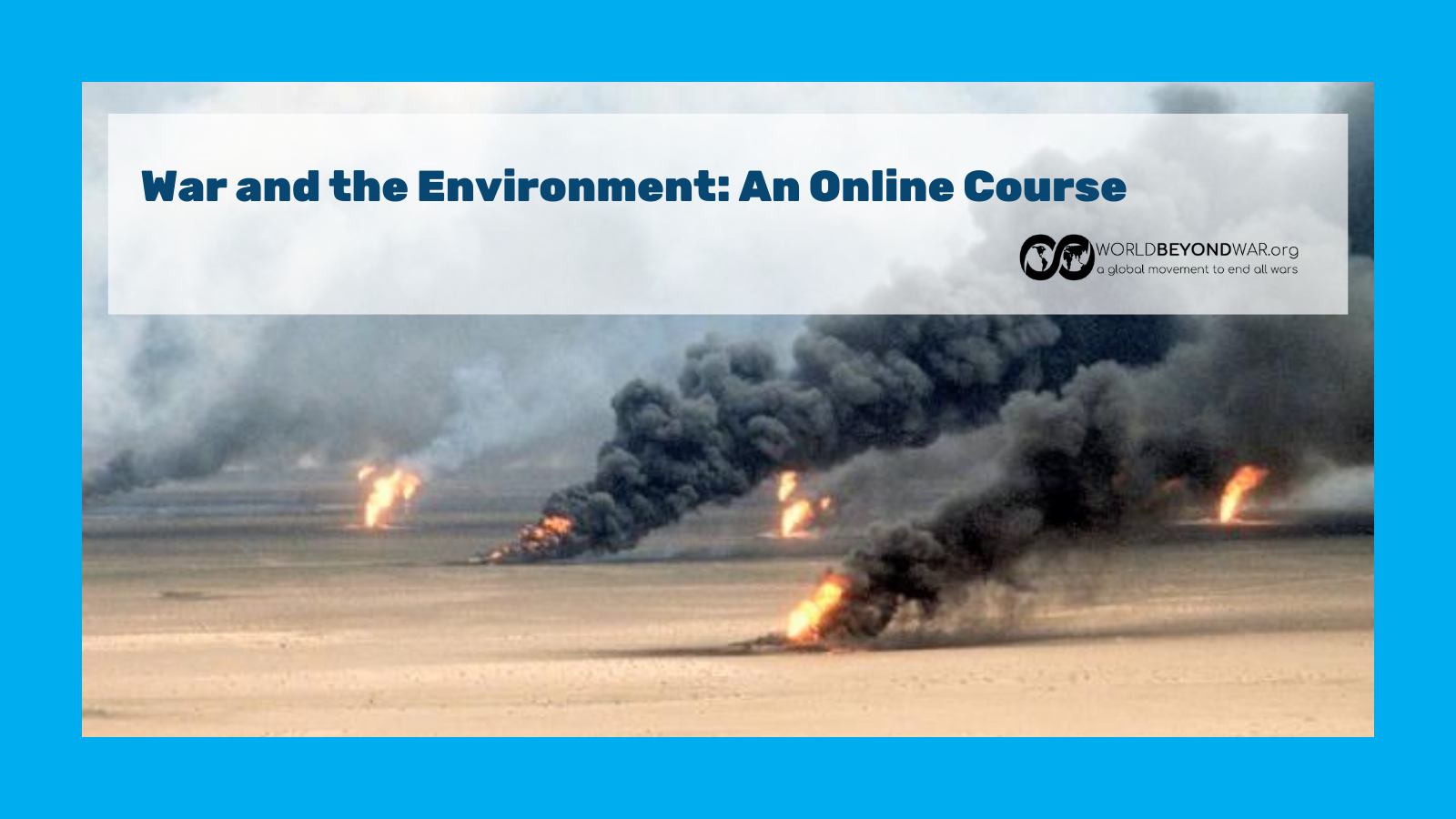
War and the Environment: Jan 17 - Feb 27, 2022
Learn more and register.
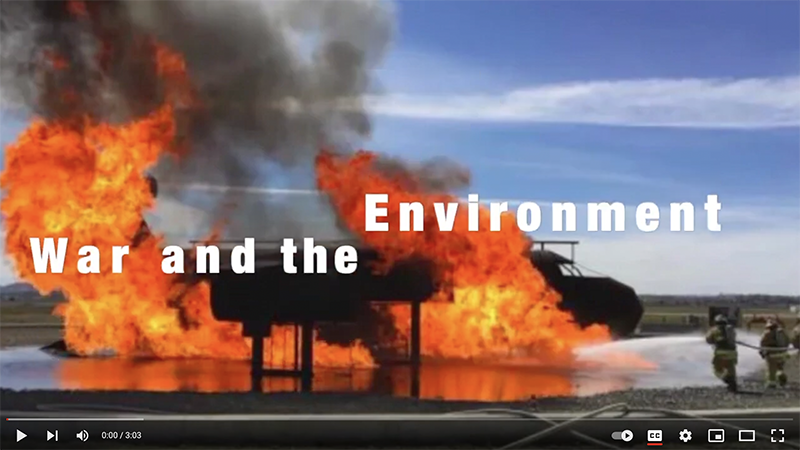
Watch this video about the course:
This course is 100% online and interactions are not live or
scheduled, so you can take part whenever works for you. Weekly
content
includes a mix of text, images, video, and audio. Instructors and
students utilize online discussion forums to go over each week's
content, as well as to provide feedback on optional assignment
submissions.
The course also
includes three 1-hour optional zoom calls which are designed to
facilitate a more interactive and real-time learning experience.
Week 1: Where Wars Happen and Why, January 17-23
Facilitator: Tim Pluta
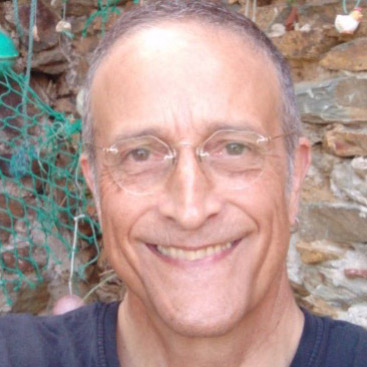
Tim describes his path to peace activism as a slow realization that
this is a part of what he ought to be doing in life. After standing up
to a bully as a young teen, then getting beaten up and asking his
attacker if he felt better, having a gun pushed up his nose as an
exchange student in a foreign country and talking his way out of the
situation, and getting out of the military as a Conscientious Objector,
Tim found that the U.S. invasion of Iraq in 2003 finally convinced him
that one of his focuses in life would be peace activism. From helping to
organize peace rallies, speaking and marching at conferences around the
world, co-founding two chapters of Veterans For Peace, the Veterans
Global Peace Network, and a World BEYOND War chapter, Tim says that he
delights in being invited to help facilitate the first week of World
BEYOND War's War and the Environment, and looks forward to learning. Tim
represented World BEYOND War in Glasgow Scotland during COP26.
Week 2: What Wars Do to the Earth, January 24-30
Facilitator: Rukmini Iyer
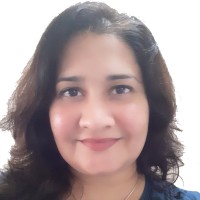
Rukmini Iyer is a seasoned leadership development facilitator, coach and
peacebuilder with over 20 years of professional experience around the
world. She is currently based in Mumbai, India. After working in
mid-management and leadership roles for around 8 years in India and
Singapore with renowned organizations, Rukmini set up Exult! Solutions
in 2008 with an intention to meld her interests in
organization/leadership development and peacebuilding and to create a
space for individual and systemic explorations into how we can co-create
a world that works for all. The firm is structured as a for-profit
venture that consciously redirects a significant part of its earnings
and resources to allow for projects in the peacebuilding and social
development spaces. Rukmini concurrently works on a range of
geo-diverse corporate projects that include organizational development
and culture change interventions, competency mapping and assessment
centres, leadership and management development journeys, coaching,
capacity building, and instructional design.
Week 3: What Imperial Militaries Do to the Earth Back Home, January 31-February 6
Facilitator: Eva Czermak

Eva Czermak, MD, E.MA. is a trained physician, has a Master’s degree
in Human Rights and is Rotary Peace Fellow besides being a trained
mediator. In the last 20 years she has mainly worked as medical doctor
with marginalized groups such as refugees, migrants, homeless people,
people with substance abuse problems and without health insurance, 9 of
those years as manager of an NGO. Currently she works for the Austrian
ombudsman and for Caritas’ aid projects in Burundi. Other experiences
include participation in dialogue projects in the US, international
experience in the development and humanitarian fields (Burundi and
Sudan) and several training activities in the medical, communication and
human rights fields.
Week 4: What Nuclear Weapons Have Done and Could Do, February 7-13
Facilitator: Emma Pike
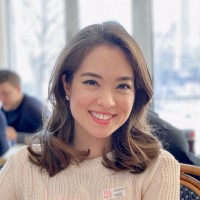
Emma Pike is an energetic individual driven by her firm belief in
education as the surest means for building a more peaceful and equitable
world for all. Her years of experience in research and academia are
supplemented by her more recent experience as a classroom teacher. She
has
had the privilege of conducting her research in the three unique
environments of the United States, Japan, and the United Kingdom. She is
especially passionate about the interconnected topics of peace
education and global citizenship education. As an educator, she believes
that her most
important job is to see the vast potential in each of her students, and
to guide them in the discovery of this potential. While acquiring the
practical literacy, numeracy, and reasoning skills that they will need
in life, she wants her students to become active citizens, each in their
unique way, who go into the world with the confidence that they have the
power to be change-makers. Every child has a super power. As a teacher,
it is her job, she says, to believe this and help each student bring
their super
power to shine. What does it mean to be a global citizen? What
does it mean to educate for global citizenship? In our globalized world,
in which each of our lives is supported by all others in both seen and
unseen ways, these questions represent more than academic curiosity.
They are an inquiry into how the largest community that all humans share
- the global community - can pave a path of respect for life,
celebration of diversity, environmental sustainability, global justice
and equity, and harmonious interdependence into the 21st century and
beyond.
Week 5: How This Horror Is Hidden and Maintained, February 14-20
Facilitator: Deniz Vural

Deniz Vural is based in Istanbul, Turkey. She is a life-long learner
who graduated with a degree in Marine
Engineering, focusing on environmental sustainability, followed by a
Master's in Geosciences, studying climate change,
but also how to transfer this knowledge to a wider public. She has
worked since 2015 on various projects and activities on the polar
regions, the
effects of the climate crisis, and possible steps to be taken to
diminish individual footprints (i.e. carbon, water, ecological etc.).
Vural has traveled virtually around the Arctic circle to study the
deepest unknown, frozen
ground, permafrost. She now focuses on permafrost research, particularly
investigating thermokarst lakes, which are also known as ice-rich
permafrost, and the relationship between
waterbody differentiation and changes in the Arctic ecosystems. She is
also leading the Education and Outreach leg under the Polar Research
Institute at the The Scientific and Technological Research Council of
Turkey and is both learning and teaching different disciplines such as
ecological gardening and capacity building workshops.
Week 6: What Can Be Done, February 21-27
Facilitators: Greta Zarro and Rachel Small

Greta Zarro is World BEYOND War Organizing Director. She has a
background in issue-based community organizing. Her experience includes
volunteer recruitment and engagement, event organizing, coalition
building, legislative and media outreach, and public speaking. Greta
graduated as valedictorian from St. Michael’s College with a bachelor’s
degree in Sociology/Anthropology. She previously worked as New York
Organizer for leading non-profit Food & Water Watch. There, she
campaigned on issues related to fracking, genetically engineered foods,
climate change, and the corporate control of our common resources. Greta
and her partner run Unadilla Community Farm, a non-profit organic farm
and permaculture education center in Upstate New York. Greta can be
reached at [email protected].

Rachel Small is World BEYOND WAR Canada Organizer. She is a community
organizer based in Toronto, Canada, on Dish with One Spoon and Treaty
13 Indigenous territory. She has organized within local and
international social/environmental justice movements for over a decade,
with a special focus on working in solidarity with communities harmed by
Canadian extractive industry projects in Latin America. She has also
worked on campaigns and mobilizations around climate justice,
decolonization, anti-racism, disability justice, and food sovereignty.
She currently organizes in Toronto with the Mining Injustice Solidarity
Network and has a Masters in Environmental Studies from York University.
She has a background in art-based activism and has facilitated projects
in community mural-making, independent publishing and media, spoken
word, guerilla theatre, and communal cooking with people of all ages
across Canada. She lives downtown with her partner, kid, and friend, and
can often be found at a protest or direct action, gardening, spray
painting, and playing softball. Rachel can be reached at [email protected]
LEARN MORE AND RESERVE YOUR SPOT.
Or you can sign up for the following four courses in one discounted package!
War and The Environment, Jan 17 - Feb 27, 2022
War Abolition 101, Apr 18 - May 29, 2022
Leaving WWII Behind, June 19 - July 31, 2022
War Abolition 201, Oct 10 - Nov 20, 2022
LEARN MORE AND SIGN UP FOR FOUR COURSES HERE.
World BEYOND War is a global network of volunteers, chapters, and affiliated organizations advocating for the abolition of the institution of war.
Donate to support our people-powered movement for peace.






Opt-in to mobile updates. Manage email preferences. Privacy policy.
Should giant war-profiteering corporations decide what emails you don't want to read? We don't think so either. So, please stop our emails from going into "junk" or "spam" by "white listing," marking as "safe," or filtering to "never send to spam."
World BEYOND War | 513 E Main St #1484 | Charlottesville, VA 22902 USA
World BEYOND War | 450, 4-2 Donald Street | Winnipeg, MB R3L 0K5 Canada
