| Unsubscribe |
Dear Reader,
Elon Musk just dropped another bombshell...
He's going after your cell phone provider.
For months, Elon kept these plans under wraps.
But late last week, he finally showed his hand.
SpaceX agreed to buy a huge chunk of the airwaves your phone uses to call and get online, reportedly for $8 billion in cash.
Elon took to X calling it "very big deal" and "the last critical piece" for complete phone coverage in America.
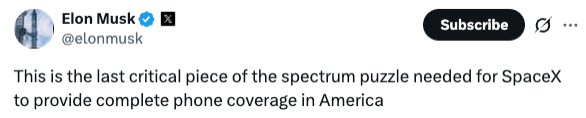
Wall Street panicked. Within hours, shares of AT&T, Verizon, and T-Mobile started falling.
But almost no one is explaining what happens next, or what it could mean for your money.
(I'm revealing the #1 stock at the heart of this story for free, here.)
I've tracked this story for months, and it's playing out exactly as I predicted.
Next, I believe Elon could launch a new device that kills the iPhone... and hands early investors his biggest payday yet. Potentially 50 times their money.
Love him or hate him, you don't want to miss this.
Best,
Josh Baylin
Frmr. Bloomberg Reporter, Frmr. SAC Capital
Senior Tech Expert, Stansberry Research
P.S. This isn't my first big mobile prediction, by the way.
In 2004, three years before the iPhone, I told Congress a smartphone was coming that would change our lives forever. Anyone who put $1,500 into Apple back then could be sitting on about $1.2 million today.
A few years later at SAC Capital, I told my former boss, billionaire Steve Cohen, that Apple wouldn't sell 1 million iPhones, as every other analyst predicted... but 1 billion.
I was laughed out of the room. But I was right both times.
Here's my next big call, and details on where to put your money now.
MarketBeat Week in Review – 09/28 - 10/02
Reported by MarketBeat Staff. Article Posted: 10/3/2026.

Key Points
- A weaker-than-expected September jobs report lowered the odds of an October rate hike to 20%, sparking a sharp stock market rally.
- Lower oil prices and falling 10-year Treasury yields added to risk-on sentiment, with the economy and consumer still showing resilience.
- MarketBeat analysts covered a wide range of stocks this week, including CarMax, Netflix, Apple, McDonald's, Six Flags, Broadcom, and Starbucks, ahead of earnings season.
- Special Report: One Company Spared After Renewable Credits Get Cut.
Stocks spiked sharply higher after a weaker-than-expected September jobs report lowered expectations for an October interest rate hike. As of Oct. 2, the CME FedWatch tool puts the odds of a hike at about 20%, down from roughly 55% after the last FOMC meeting. It's another case of bad news being good news.
However, lower oil prices and a decline in the 10-year Treasury note's yield also contributed to the risk-on sentiment. The takeaway for investors is that, despite some pockets of weakness, the economy and consumers continue to show resilience.
Forbes calls this a "golden era" for retirement income (Ad)
Forbes recently called a new category of exchange-traded income funds a 'golden era,' and Bloomberg noted the eye-popping yields are fueling a boom among everyday investors. Three years ago, barely a dozen of these funds existed - today there are more than 100, holding over $140 billion.
These funds trade on the NYSE and NASDAQ and are built to generate monthly income. Some investors are targeting $5,000 a month with roughly one-tenth of the nest egg Wall Street says you need.
Watch the short briefing to see how this income approach worksHard as it is to believe, we're entering the final quarter of 2026. The bullish sentiment could carry into the next earnings season, which starts in a couple of weeks. Earnings will provide the next signal. MarketBeat analysts will be tracking the stocks and stories moving the market. Here are some of the most popular articles from this week.
Articles by Thomas Hughes
Ahead of October, Thomas Hughes highlighted five stocks with strong tailwinds and bullish chart setups. Third-quarter earnings could be the catalyst for each one.
CarMax (NYSE: KMX) delivered a strong fiscal second quarter and plans to resume share buybacks. Hughes explained why that's an important signal that the turnaround is gaining traction. He also explained why analysts still haven't caught up.
Plenty of stocks have high short interest, but Hughes explained why days to cover is the metric that matters and why two heavily shorted stocks may need only the right catalyst to trigger a squeeze.
Articles by Sam Quirke
On the surface, it looked contradictory. Deutsche Bank upgraded Netflix (NASDAQ: NFLX) to Buy while cutting its price target. Sam Quirke explained why both moves make sense and what investors should watch when the company reports in three weeks.
Apple (NASDAQ: AAPL) was hit with a $5.7 billion patent verdict. Quirke wrote that the one-time payment isn't the real concern. He explained the bigger risk and why the pullback may be a buying opportunity.
McDonald's (NYSE: MCD) is trading near four-year lows. The company is also introducing a data-driven pricing recommendation tool for franchisees. Quirke weighed whether the potential margin upside is worth the risk.
Articles by Chris Markoch
Six Flags Entertainment (NYSE: FUN) launched a buy-now-pay-later option for season passes. Meanwhile, an activist investor is pushing the company to explore a sale. Chris Markoch explained why the timing is telling and what investors should watch next.
Data center REITs have benefited from the AI hype, but Markoch wrote that office REITs may get the rent hikes. He highlighted three office REITs whose fundamentals lag the market's perception.
Oracle (NYSE: ORCL) issued a force majeure notice on a major data center project, and CoreWeave (NASDAQ: CRWV) stock got a lift. Markoch explained why two analysts came to opposite conclusions about the stock in the same week.
Articles by Ryan Hasson
Not long ago, AI looked like a threat to cybersecurity companies. Ryan Hasson explained why it has become a tailwind instead and why two cybersecurity leaders are breaking out.
Two of the biggest names in tech have booked big gains on their Anthropic stakes, but those profits exist only on paper. Hasson explained how an Anthropic IPO could put them to the test.
After a painful summer, Rocket Lab (NASDAQ: RKLB) is bouncing off its lows. Hasson highlighted three catalysts behind the rebound, including buying from a well-known investor.
Articles by Leo Miller
Why would companies spend big on buybacks while their share prices are sliding? Leo Miller looked at three struggling stocks and what their buyback announcements may signal.
Meta Platforms (NASDAQ: META) wants its Muse AI agent to take on e-commerce. Miller explained why Walmart (NASDAQ: WMT) is on board, but Amazon isn't playing along.
Broadcom (NASDAQ: AVGO) has a $161 billion commitment from Anthropic. Miller asked the question that matters for Broadcom's AI growth story: Can Anthropic afford it?
Articles by Nathan Reiff
Nuclear, missile and aerospace demand is driving momentum in the defense sector. Nathan Reiff highlighted three defense plays riding that wave.
AI uncertainty is rising, but not every chip investment is losing steam. Reiff pointed to three semiconductor ETFs that still have momentum.
The 10-year Treasury yield recently reached its highest level since 2007. Reiff explained what that means for income investors and highlighted three bond ETFs to watch.
Articles by Dan Schmidt
Fertilizer prices keep climbing, yet some of the stocks that benefit still trade at a discount. Dan Schmidt highlighted three fertilizer stocks riding natural gas spreads.
Fervo Energy (NASDAQ: FRVO) hit a major geothermal milestone, but Schmidt explained why profitability is still years away and whether the milestone will matter for the stock.
Articles by Jeffrey Neal Johnson
Starbucks (NASDAQ: SBUX) is closing 250 stores, and analysts are downgrading the stock. Jeffrey Neal Johnson explained what the closures mean for the company's turnaround.
Taiwan Semiconductor (NYSE: TSM) is pushing ahead with 2-nanometer chips. Johnson explained why the company is pricing out the competition and why that signals a durable chip demand cycle.
Boeing (NYSE: BA) won the F/A-XX fighter contract over Northrop Grumman (NYSE: NOC). Johnson explained why the victory could open the door to decades of defense revenue.
Articles by Peter Frank
O'Reilly Automotive (NASDAQ: ORLY) has a strong business, but the stock price doesn't show it. Peter Frank explained why the slump may be hiding a stronger company and why the valuation is part of the story.
First Watch Restaurant Group (NASDAQ: FWRG) was trading near its 52-week low when Frank examined the stock, while its consensus price target implied roughly 84% upside at the time. Frank explained why the company's growth story is meeting a reality check.
The AI Buildout Needs Power It Cannot Get: 4 Energy Stocks Already Have It
Reported by Bridget Bennett. Article Posted: 10/4/2026.
Key Points
- Stansberry Research analyst Gabe Marshank argues the AI data center buildout cannot earn its cost of capital once compute pricing resets, putting neocloud business models like CoreWeave, Nebius Group and IREN at risk
- Atlas Energy Solutions and Liberty Energy are building behind-the-meter power that lets data centers skip a five to seven year grid interconnect wait
- Ormat Technologies and Fervo Energy anchor an enhanced geothermal story where the open question is engineering execution, not demand
- Special Report: One Company Spared After Renewable Credits Get Cut.
Every valuation in the AI infrastructure trade rests on one quiet assumption: compute will remain scarce enough to keep prices high. That assumption is already showing cracks, and most investors haven't repriced for it.
Gabe Marshank, lead analyst of Market Maven at Stansberry Research, is not an AI skeptic. He uses the technology daily and calls the product brilliant. His argument is narrower and harder to dismiss. The technology works. The business model behind the buildout may not. And if he's right, the capital chasing data centers is headed somewhere very different from the capital chasing power.
The Return-on-Capital Math Behind a $4.5 Trillion Buildout
Federal Reserve Reveals Disturbing New Plan To Control Your Money (Ad)
Docket No. OP-1670 is drawing attention for what it reveals about the Federal Reserve's next move. Buried on page 84 is a plan that could expand oversight of checking accounts, purchases, and money transfers across the country.
Martin D. Weiss, PhD, founder of Weiss Ratings, breaks down what this document means and why it could roll out as soon as this summer.
Watch the video to learn how this plan could affect youMarshank puts the data center buildout at roughly $4.5 trillion by 2030. Based on his numbers, the compute layer would need to generate nearly $1.7 trillion in annual revenue to earn an adequate return on that capital.
For scale, he pegs the existing platform economy—Alphabet (NASDAQ: GOOGL), Microsoft (NASDAQ: MSFT), Amazon.com (NASDAQ: AMZN), Meta Platforms (NASDAQ: META) and Oracle (NYSE: ORCL), excluding consumer products—at roughly $1 trillion in revenue today. In other words, the industry would have to grow from a standing start to $1.7 trillion in four years just to break even on the spending.
That matters because the market is treating capital expenditure as if it were value created. Marshank has seen this movie before. He points to the biodiesel buildout, when plants were valued at multiples of the money invested in them until commodity economics caught up and the equity went to zero.
AI Compute Pricing Is Already Rolling Over
His core claim is that data centers produce a commodity: AI compute. Supply of that commodity is set to rise enormously, and capitalism is likely to do what it always does when supply surges.
The key detail is that compute doesn't sit idle. Operating costs run near 3% of a data center's total capital cost, so the machines run regardless. Pricing becomes the clearing mechanism: AI compute is sold at whatever price the market will bear, much as an airline sells the last seat at whatever price travelers are willing to pay rather than flying it empty.
Marshank tracks published rate cards. By his count, prices were about $3.50 per kilowatt in 2022, climbed to roughly $4 to $4.25 as AI demand took off, and are now beginning to correct even as demand headlines remain loud. Long-term contracts muddy the picture with de-escalators and discounts to list price, but he's convinced prices are headed lower.
The comparison he keeps returning to is the bandwidth bubble of 1996 to 2001. Capital went into the ground, supply came online, pricing collapsed by roughly 90%, and Level 3, Global Crossing and WorldCom blew up on revenue that never matched their models.
Neocloud Stocks and the Missing Moat
This is where he gets blunt about neocloud stocks. He sees returns turning negative at CoreWeave (NASDAQ: CRWV), Nebius Group (NASDAQ: NBIS) and IREN Limited (NASDAQ: IREN), and he struggles to identify what differentiates them.
His framing is straightforward: the business model is spending itself. If a neocloud can commit $50 billion and Alphabet can commit far more, scale alone isn't a moat. He notes that IREN's $9.7 billion GPU cloud agreement with Microsoft, disclosed in a securities filing, implied returns he would describe as merely adequate in the hottest market anyone has seen.
The risk, in his telling, is simple. The capital was spent on the belief that rising volume would lift revenue. If volume rises while pricing falls, revenue never covers expenses.
Behind-the-Meter Power Offers a Shortcut Around the Grid
The bullish half of his case sits in energy, where the AI bottleneck is real and physical. Two names come straight out of the oil patch: Atlas Energy Solutions (NYSE: AESI) and Liberty Energy (NYSE: LBRT).
Both are building behind-the-meter power, meaning on-site generation that sidesteps the five- to seven-year wait in the utility interconnection queue.
The U.S. grid is slow to absorb new sources because every addition has to be balanced.
Pressure pumping taught these companies how to deploy enormous amounts of horsepower on short notice. Pointing that expertise at a data center is the same skill set with a better customer.
Geothermal Stocks Trade on an Engineering Question
Liberty Energy also moved into geothermal under founder Chris Wright, now U.S. energy secretary. Marshank calls geothermal the most overlooked energy source in the world, and his two names are Ormat Technologies (NYSE: ORA) and Fervo Energy (NASDAQ: FRVO).
Ormat brings decades of legacy assets. Fervo is the pure play, applying horizontal drilling and multistage completions to create enhanced geothermal systems. Its Cape Station project in Beaver County, Utah, is permitted for up to 2 gigawatts, and Google has signed a 396-megawatt power purchase agreement there, with an option for roughly 600 megawatts more, as part of a broader 3-gigawatt framework running through 2033.
The stock trades below its $27 May IPO price, pressured by interconnection delays that pushed revenue recognition to the right. Marshank shrugs at that. The real question, he says, is engineering: whether a closed-loop system can retain the water it pumps underground. If it does, the upside is large. If water starts leaking from the wells, that's the sell signal.
Compare that timeline with nuclear, on which he was early and right years ago. New nuclear takes at least five to seven years in the United States. Geothermal proof points could arrive within two.
What Should Actually Change Your Mind
Marshank doesn't use stop-losses, and he doesn't trade on headlines. Macro inputs are among the most efficiently priced information in the market, so an edge is far easier to find in a single security than in the bond market. His horizon runs three to five years, looking for three- to five-times outcomes.
The risk is that pricing in geothermal and distributed power disappoints in the same way he expects compute pricing to disappoint. The upside is that both rely on physical scarcity rather than on a commodity whose supply is multiplying.
His discipline is worth borrowing regardless of whether you buy the call: decide in advance what would make you sell, then watch that—not the tape. Because if your only exit plan is to panic after a 50% drawdown, you may as well panic now. For investors who want to run that kind of screen themselves, Marshank's team has built an AI-powered research tool for finding asymmetric setups at Stansberry Research.
This email is a sponsored email for Stansberry Research, a third-party advertiser of The Early Bird and MarketBeat.
This ad is sent on behalf of Stansberry Research, 1125 N Charles St, Baltimore, MD 21201. If you would like to optout from receiving offers from Stansberry Research please click here.
If you have questions or concerns about your account, feel free to email MarketBeat's South Dakota based support team at [email protected].
If you no longer wish to receive email from The Early Bird, you can unsubscribe.
© 2006-2026 MarketBeat Media, LLC.
345 North Reid Place, Sixth Floor, Sioux Falls, SD 57103-7078. United States of America..