| Unsubscribe |
Dear Reader,
President Trump once fought with one of America's closest allies over it.
Wall Street's biggest names have poured billions of dollars into it.
Palantir signed a massive AI deal with it.
Yet the company at the center of this isn't some trillion-dollar tech giant.
In fact, I guarantee you've never heard of it.
So why are three of the most powerful forces in America converging on this one obscure company?
Because it recently found a revolutionary solution to the AI energy crunch.
Forget buying overhyped chipmakers at 40 times earnings.
This pure-play AI energy pioneer is cheap, extremely profitable and hardly anyone on Main Street knows it exists yet.
This is a fast-moving story.
And the implications for early investors could be enormous.
So be sure to secure access to the name and stock ticker at the link below today.
Yours in smart speculation,
Stephen Prior, Publisher
Monument Traders Alliance
First Watch’s Growth Story Meets a Reality Check
Written by Peter Frank. Published: 10/1/2026.

Key Points
- First Watch shares trade near a 52-week low despite strong revenue growth, rising debt, and thin profit margins raising investor concerns.
- Wall Street rates the stock a Moderate Buy with roughly 84% consensus upside, though recent trading has not reflected that optimism.
- Investors should watch the Nov. 3 earnings report and Nov. 12 Investor Day for signs of improved margins, traffic, and cash flow.
- Special Report: One Company Spared After Renewable Credits Get Cut.
First Watch Restaurant Group (NASDAQ: FWRG) has shown that Americans are willing to wait for a table to eat banana-brittle French toast and blueberry-lemon cornbread.
With 665 restaurants across 33 states, management calls the daytime-dining chain the fastest-growing full-service restaurant brand in the country. The stock, however, is telling a different story.
Are you leaving Social Security money on the table? (Ad)
Most retirement plans still have gaps in them... The quiet ones that don't show up until it's too late to fix.
A tax strategy quietly costing you thousands every year… Social Security timing that leaves real money on the table… An estate plan that's years out of date… An income strategy that could be working twice as hard…
These aren't small details. For most, it can be the difference between a retirement that works… and one that slowly unravels. One conversation with the right person can surface exactly what's missing — and give you a clear picture of where you actually stand.
Take the free 2-minute quiz to see where your plan stands.The restaurants are busy, new units are generating strong returns, and the menu is resonating. But the shares have been sold hard and are trading near a 52-week low.
For First Watch, growth at all costs may no longer be on the table. Paying down debt might be the order of the day.
For investors, the question is whether this is a growth story on sale or a company struggling to keep up with its expansion.
Investors Face a Crucial Stretch
The timing matters. First Watch is heading into an important stretch. The company is expected to report third-quarter results in early November and then host an Investor Day in Boston on Nov. 12, where management said it would provide a detailed look at its long-term vision and growth plans.
Meanwhile, the backdrop for restaurant stocks grew tougher when the Fed recently raised interest rates for the first time in three years. That move is a double-edged sword for First Watch: Higher rates increase borrowing costs, while consumers may reconsider their discretionary spending.
Revenue Growth Remains Strong
On the surface, the second quarter, reported Aug. 4, looked healthy. Total revenue jumped 15.2% to $354.7 million, exceeding expectations, and same-restaurant sales rose 3.4%. That growth came from price increases, a richer menu mix and dozens of new restaurants.
Although traffic slipped slightly, it improved throughout the quarter and turned positive in June, according to CEO Chris Tomasso. He said First Watch outperformed both casual dining and the broader restaurant industry.
Profitability, however, is where things get messier. Net income was only $2.34 million, while earnings per share of 4 cents, although up from the year-ago period, missed the 5-cent consensus estimate. There was also an unexpected twist: The company’s beef dishes were so popular that they drove food costs up by nearly 100 basis points.
As a result, management trimmed its 2026 adjusted EBITDA forecast even as it nudged its revenue-growth guidance higher.
First Watch Keeps Expanding
Looking further out, the company, which expects to open 60 to 62 new restaurants this year, said it plans to open about 50 company-owned restaurants annually starting in 2027. First Watch is also targeting 10% to 13% annual revenue growth and 11% to 14% adjusted EBITDA growth, with positive free cash flow beginning that year.
The long-term bull case rests on runway and unit economics. Management sees room to roughly triple today’s footprint in the continental United States, and the newest class of restaurants is targeting attractive returns on construction costs.
Brand awareness is another growth lever. Management has said awareness has climbed sharply since the company’s initial public offering five years ago. First Watch is also getting creative with its marketing, including a fall promotion with the reality show "The Traitors: New Blood.”
Wall Street Sees Significant Upside
Although the stock has slid 33% year-to-date, Wall Street generally likes what it sees. Of the 11 analysts following the stock, one has tagged it a Strong Buy, eight call it a Buy, and one each rates it a Hold and a Sell. Overall, the stock is rated a Moderate Buy.
The consensus 12-month target price of $18.56 represents roughly 84% upside. The highest price target is $22 per share, while the lowest is $14.
This optimism has not shown up on the recent chart, however. Shares are trading at a little over $10 each, just above their 52-week low.
Debt and Valuation Raise Concerns
The most important risk is the collision between the balance sheet and a thin profit margin.
First Watch’s long-term debt rose meaningfully in fiscal 2025 and has remained relatively flat since then. Management has said that the current balance sheet does not support share buybacks or opportunistic acquisitions. With the Fed now raising rates, every dollar of debt-funded growth becomes more expensive.
Valuation is a second sticking point. Analysts expect earnings to grow more than 86% next year, but that growth starts from a smaller base. A forward price-to-earnings ratio of 67 brings the investment question into stark relief.
Competition is also fierce. First Watch competes for the breakfast and brunch dollar against IHOP owner Dine Brands Global (NYSE: DIN), Cracker Barrel Old Country Store (NASDAQ: CBRL) and a long list of local cafes.
Traffic also remains fragile. Some of the weakness comes from new restaurants drawing guests away from nearby locations, a trade-off management says it plans for. However, it means same-store numbers can disappoint even when the expansion is working.
Investors Need to See Results
First Watch is undoubtedly a strong brand, but it is in a transition year. The restaurants are busy, new units are generating strong returns, and the menu is resonating. Until the company proves that growth can come with fatter profits and a lighter debt load, however, the stock is likely to be treated as a show-me story rather than a high-flier.
Investors should keep a close eye on the Nov. 3 earnings report and the Nov. 12 Investor Day. If First Watch shows positive traffic, steadier margins and a credible path to free cash flow, today’s beaten-down share price could come to look like an opportunity for patient, long-term investors.
Microsoft Is Almost Back to $555—Now the Hard Part Begins
By Chris Markoch. First Published: 10/9/2026.
Key Points
- Microsoft shares have surged about 37% this quarter to around $530, nearing their 52-week high of $553.72 after a strong earnings beat.
- Investors who bought near the October 2025 peak are approaching breakeven, which could trigger selling pressure as the disposition effect and "get-evenitis" take hold.
- Microsoft's upcoming fiscal Q1 2027 earnings, expected around Oct. 28, must clear higher expectations, including roughly 45% Azure growth, to justify the stock's recent rally.
- Special Report: One Company Spared After Renewable Credits Get Cut.
Microsoft Corporation (NASDAQ: MSFT) stock is closing in on familiar territory. Shares traded near $530 this week, putting MSFT within 5% of its 52-week high of $553.72.
That's a remarkable turnaround. Microsoft gained about 37% in the third quarter of 2026, its best quarterly performance since 1998. In late June, shares were trading around $372.
There's a two day window Wall Street would rather you never noticed (Ad)
Every Friday at 4 PM, most of Wall Street's billion dollar accounts step away until Monday morning.
But small stock news - contract wins, FDA approvals, buyout rumors - doesn't take weekends off.
Millionaire trader Tim Sykes calls this the Weekend Gap and recorded a free video breaking down how he trades it.
Watch the free video before this week's window opensBut the easy part of this rally may be over. The next leg will depend less on Microsoft's business and more on investor psychology.
MSFT peaked near $555 in October 2025 before falling for roughly eight months. At the bottom, a $10,000 investment made at the peak was worth about $6,510. Many of those investors are finally close to breaking even.
That creates a different kind of test for MSFT stock. Investors tend to sell winners too early and hold losers too long. When a losing position finally gets back to even, the urge to sell can be overwhelming.
Microsoft's fundamentals have earned this rally. Now the stock has to work through a wall of breakeven sellers, and it has to do so heading into an earnings report where expectations are much higher than they were three months ago.
Q4 Turned a Pariah Into Wall Street's Darling
It's hard to overstate how quickly the narrative changed. Heading into July, the story around Microsoft was capital expenditures (CapEx) fatigue. Investors questioned whether its massive AI spending would ever generate an adequate return.
Then Microsoft reported fiscal fourth-quarter 2026 results on July 29. Revenue came in at $90 billion, up nearly 18% year over year. Azure crossed $100 billion in annual revenue for the first time, while earnings per share (EPS) of $4.74 topped the $4.24 consensus estimate.
The stock jumped about 15% the next day, marking Microsoft's biggest single-day gain since 2008.
Analysts have followed the price higher. Stifel upgraded MSFT to Buy in late September. On Oct. 5, Melius Research upgraded the stock to Buy with a $665 price target, while Scotiabank raised its target to $615 from $510.
This is the same company, with largely the same AI strategy, that investors were avoiding in the spring. What changed was perception. In other words, the numbers gave investors permission to believe again.
Why $555 Is a Psychological Level, Not Just a Technical One
Most investors will see $553.72 as resistance on a chart. That's true, but it misses the behavioral story behind the number.
Think about who owns MSFT at that level. Many bought during the AI enthusiasm of late 2025. Some added on the way down, convinced the sell-off was overdone. Others simply held through a drawdown of roughly 35%.
Behavioral economists call the tendency to sell winners and hold losers the disposition effect. A related bias, sometimes called "get-evenitis," keeps investors anchored to their purchase price. Once a stock gets back there, the relief of avoiding a loss often outweighs the hope of further gains.
That doesn't mean Microsoft can't break through. It means the stock needs a reason to absorb that supply. Momentum alone may not be enough; a fresh catalyst usually does the job. For Microsoft, that catalyst is its Q1 earnings report for fiscal year 2027 (FY2027).
Earnings Will Have to Clear a Higher Bar
Microsoft hasn't confirmed its next earnings date, but the report date is estimated for Oct. 28. The headline number will be Azure growth. Management guided for growth of about 45% in the quarter.
Three months ago, a number like that would have looked like upside. Now it's closer to the baseline. With the stock up nearly 40% in a quarter, investors may want more than a match.
There's also some fine print behind last quarter's beat. The $4.74 EPS figure included a $3.2 billion gain on Microsoft's Anthropic stake. That's a real gain, but it isn't a repeatable operating result.
Spending remains part of the debate, too. Quarterly capital expenditures roughly doubled year over year, and free cash flow fell about 23%. Management also expects CapEx to grow again in fiscal 2027.
None of this breaks the bull case. CFO Amy Hood said in July that demand still exceeds available capacity. But it does mean the stock has less room for a merely good quarter.
Chasing MSFT at $530 Is a Different Trade
For long-term investors, Microsoft's story looks stronger than it did six months ago. Its AI investments are showing up in revenue, and Wall Street sentiment has turned firmly bullish.
But buying MSFT at $530 isn't the same trade as buying it at $372. At roughly 30x trailing earnings, the stock is priced for steady execution, leaving less room for error.
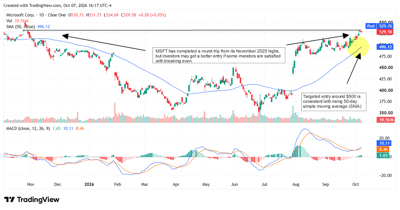
Investors who want exposure may be better served by scaling in. A pullback toward $500, where the stock consolidated in late September, would offer a more comfortable entry. A decisive close above $553.72 on strong volume would confirm a breakout.
If MSFT stalls near its old high, don't read it as a verdict on the business. It may simply be breakeven investors heading for the exits. Once they're gone, the path higher could get a lot easier.
This message is a paid advertisement from Monument Traders Alliance, a third-party advertiser of MarketBeat. Why was I sent this email message?.
This ad is sent on behalf of The Oxford Club. 105 W Monument St, Baltimore, Maryland 21201. If you would like to optout from receiving offers from The Oxford Club please click here
If you need help with your subscription, please feel free to contact our U.S. based support team at [email protected].
If you would no longer like to receive promotional emails from MarketBeat advertisers, you can unsubscribe or manage your mailing preferences here.
© 2006-2026 MarketBeat Media, LLC.
345 North Reid Place, Suite 620, Sioux Falls, S.D. 57103-7078. USA..