| Unsubscribe |
Elon's $912 billion bet

He minted countless "Teslanaires"... and turned at least 4,400 SpaceX employees into millionaires overnight. Just before noon on September 24, Elon quietly revealed his next lucrative initiative.
Get the full story, and you could find yourself profiting alongside Elon.
Microsoft's AI Spending Didn't Change—Wall Street's View of It Did
Reported by Chris Markoch. First Published: 10/1/2026.

Key Points
- Microsoft shares rebounded sharply in the third quarter as Azure growth and accelerating Copilot adoption helped change investor sentiment around AI spending.
- Microsoft 365 Copilot surpassed 30 million paid seats in fiscal Q4, while Azure and other cloud services revenue grew 43% year over year.
- Microsoft still faces risks from elevated Treasury yields and heavy AI capital spending, making future usage and monetization trends important to watch.
- Special Report: One Company Spared After Renewable Credits Get Cut.
Microsoft (NASDAQ: MSFT) investors have experienced two different companies in 2026—or at least, they've been told two very different stories about the same one.
In the first half of the year, the story was fear. AI would disrupt software. Copilot was an expensive add-on nobody would pay for. Data center spending looked out of control. Not surprisingly, by late June, MSFT had sunk to roughly $355.
SpaceX minted 4400 millionaires in a single day (Ad)
SpaceX minted 4,400 millionaires in a single day, and Tesla has turned more than 5,000 employees into millionaires. One welder's $10,000 stock package made him a millionaire on IPO day.
Former Wall Street CEO Dylan Jovine says Elon Musk's next venture could outsize everything he's built before. It runs on an obscure AI firm Musk has relied on since 2012, supplying crucial technology to Tesla, Starlink and SpaceX.
See Elon's overlooked AI stock before the October 24 deadlineBut in the second half, the story has been about discipline. Microsoft shares rose more than 36% in the last three months and turned positive for the year. It's a remarkable comeback for a stock that had fallen 20%.
The reason may come as a surprise. The same capital spending that scared investors in the spring has become a selling point. To illustrate that point, CNBC's Jeff Marks now calls Microsoft "one of the few hyperscalers that is living within their means."
So what actually changed? Less than you might think. The business was improving the whole time. What changed was the narrative investors used to interpret it. Here's how the change in sentiment happened and what the chart says about what comes next.
Copilot Growth Was Already Hiding in Plain Sight
Microsoft's fourth quarter of fiscal 2026 ran from April through June—the exact stretch when the stock slid toward its lows.
But the Q4 earnings report showed that during those same three months, Microsoft was delivering results with Copilot, which many investors had considered a major obstacle. Microsoft ended the quarter with 30 million paid Copilot seats, up 10 million in a single quarter and representing the fastest seat growth since Copilot launched. Q4 revenue increased 18% year over year to reach $90 billion.
In other words, customers were buying Copilot at a record pace. At the same time, investors were dumping the stock on fears that nobody would. Investors simply didn't have the data yet.
Same Spending With a Different Sentiment
Spending tells the same story. Earlier this year, Microsoft's data center budget was treated as a liability. Investors questioned whether hyperscalers could generate sufficient returns on their enormous AI investments.
Microsoft didn't slash spending to win investors back. Instead, it brought more capacity online, delivered 43% revenue growth from Azure and other cloud services and remained free cash flow positive.
That's the key point. Capital expenditure (CapEx) didn't change. The return on investment story did. Once investors saw capacity turning into revenue, "reckless" became "disciplined."
Analysts followed the price. Stifel upgraded MSFT from Hold to Buy on Sept. 22, arguing that the company had decisively turned a corner. Then came the Copilot redesign on Sept. 25. On Wednesday, Sept. 30, Piper Sandler raised its price target to $610 from $550 while maintaining an Overweight rating, saying the Copilot narrative had “improved materially” this year.
Those upgrades arrived after the stock had rallied more than 40% off its lows. That's how sentiment changes work. Analyst consensus confirms a move; it rarely starts one.
The Chart Shows a Rally Catching Its Breath
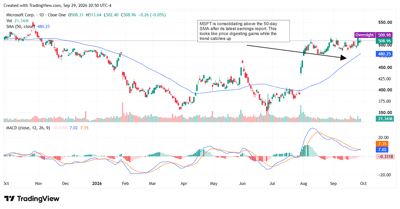
After the post-earnings move, Microsoft has spent about two months trading mostly between $485 and $520. Meanwhile, the 50-day simple moving average has climbed steeply to about $480. That's a constructive setup. Price is digesting its gains while the trend catches up underneath it.
Momentum has cooled, though. The MACD line sits at 7.02, just below its signal line at 7.35. The histogram is only slightly negative. Put simply, the stock isn't overheated. It's resting.
A MACD crossover back above the signal line would suggest that the consolidation is resolving higher. If that happens, the next major test is the 52-week high near $554. On the downside, the rising 50-day average near $480 is the level to watch.
The Risk Now Is Chasing the New Narrative
Sentiment whiplash cuts both ways. Investors who sold near $355 on a bad story can just as easily overpay on a good one.
The macro backdrop deserves respect, too. The 10-year Treasury yield advanced to 5.25%, its highest level since 2007. That puts pressure on big tech valuations.
The next chapter of this story will be written in usage data. Usage will be the metric to watch as Microsoft's more advanced Cowork, Code and Autopilot features shift to usage-based pricing when the company reports again in late October.
MSFT Outlook: Fundamentals Still Matter More Than Sentiment
Microsoft didn't become a great business in August. It was already one in June. The only thing that changed was how investors chose to tell the story.
That's the real lesson for patient investors. Narratives swing quickly, while fundamentals compound quietly. The next time the story around Microsoft turns, check whether the numbers do, too.
Why onsemi’s Synaptics Pivot Could Be a Game Changer
Author: Thomas Hughes. Date Posted: 10/6/2026.
Key Points
- onsemi revised its bid for Synaptics from an all-stock deal worth more to a $5.7 billion all-cash offer, eliminating shareholder dilution.
- The new cash structure makes the deal immediately accretive to earnings at closing, lets onsemi retain full ownership, and offers Synaptics investors $123 per share.
- Synaptics adds wireless connectivity, NPUs, and its Astra AI platform, complementing onsemi's power and sensing portfolio to support physical AI and robotics alongside NVIDIA.
- Special Report: One Company Spared After Renewable Credits Get Cut.
onsemi’s (NASDAQ: ON) all-stock bid to acquire Synaptics (NASDAQ: SYNA) initially depressed onsemi’s share price, but the situation has since changed. The steep decline in onsemi’s share price reduced the value of its all-stock offer, allowing a competing suitor to enter the mix.
Faced with a superior offer, onsemi made a nimble pivot to an all-cash deal, securing its bid and accelerating a major transformation—from component provider to end-to-end physical AI systems original equipment manufacturer (OEM)—on better terms.
Would Your 401k Survive This Wall Street System Shift (Ad)
Wall Street is moving stocks onto blockchain, turning shares into digital tokens while your 401k rides along.
For the first time, the question isn't just whether stocks will fall. It's whether the system underneath them will hold.
Some investors are quietly preparing either way.
Download the free 2026 Wealth Protection Guide to prepare nowWhy is the move so brilliant? Four key reasons: dilution, price tag, accretion and ownership. The original deal was all stock, meaning onsemi would dilute its shares, which ultimately contributed to the share price plunge. The new deal is all cash, eliminating dilution and the associated overhang while improving the equation on price, accretion and ownership.
The price tag is now $5.7 billion, down 18.57% from the initial offer, with the share count unchanged. More importantly, the revised structure is expected to be immediately accretive to earnings upon closing, compared with accretion within 18 months under the original agreement. Finally, there is ownership: onsemi shareholders retain 100% ownership, sharing no part of the business with Synaptics’ investors, who will receive $123 per share—a nearly 35% premium to the 150-week exponential moving average price.
onsemi’s Metamorphosis Is Nearly Complete
onsemi’s transition is significant, and its metamorphosis is nearly complete. While hurdles remain, they appear limited, given the Federal Trade Commission’s Early Termination Notice. The notice effectively indicates that the deal does not raise significant competition concerns and can close more quickly than usual. As it stands, the deal is set to close by the middle of next year, setting the stage for onsemi’s next phase.
What Synaptics brings to onsemi complements its already robust portfolio of power-control and sensing devices, adding wireless connectivity, neural processing units (NPUs) and the Astra AI platform. Product highlights include ultra-low power consumption, edge AI without cloud backup and an easy-to-use open-source framework.
Wireless connectivity spans the range, enabling autonomous machines to access local networks and Wi-Fi. More importantly, Synaptics’ industry-leading NPUs address a critical hurdle—obsolescence—through a dual-brain approach developed in close partnership with Alphabet (NASDAQ: GOOGL).
Synaptics’ contribution handles on-site tasks such as sensing, while Alphabet’s contribution is programmable, allowing the system to adapt to inevitable code changes and upgrades. Together, onsemi and Synaptics cover the four pillars of physical AI—power, sensing, connected compute and control—in a single package, creating a base layer on which developers can build.
onsemi: Critical to NVIDIA’s Long-Term Plans
onsemi is already central to NVIDIA’s (NASDAQ: NVDA) near-term AI plans, providing essential power-delivery technology capable of handling the loads required by data centers, especially next-generation 800VDC architectures. It is also pivoting alongside NVIDIA’s shift toward physical AI and robotics, positioning itself as the muscles and nervous system for NVIDIA’s AI brains. Executives estimate the opportunity at $6 billion by 2030, with onsemi capturing $900 in value per humanoid robot.
Analysts’ trends reflect confidence in the shift, but they moderated their price targets following the initial acquisition announcement. The announcement introduced dilution and execution risks, and only one of those risks has been mitigated. Key details also include the consensus analyst rating and price-target range, which show a 50% buy-side bias within the Moderate Buy rating and room for a robust price recovery. The consensus price target offers minimal upside but is sufficient to trigger a technical reversal, while the high-end target suggests the potential to reach fresh all-time highs.
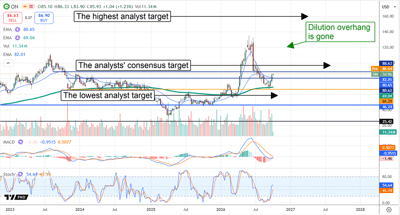
Institutions will be the deciding factor. The group owns nearly 98% of the stock, reflecting strong confidence and underpinning all major sustainable price movements. That includes the early 2026 price plunge, which helped set up today’s opportunity. While selling may continue, the stock no longer has an overhang; instead, it has a catalyst that only needs to be executed to deliver immediate value gains. In this scenario, institutions might not immediately resume accumulating shares, but they are likely to stop selling, freeing up price action.
The only bad news is that buybacks will pause. However, the new structure and onsemi’s balance sheet mean the company can finance the deal largely with cash on hand. Morgan Stanley (NYSE: MS) has agreed to finance the remainder, up to $2.5 billion—an amount onsemi should be able to pay off easily. Executives target a 25% to 30% free cash flow margin, sufficient to pay off the new debt within 18 to 24 months. What will remain is a larger, better-positioned company with greater revenue, cash-generating capacity and capital-return potential.
This email content is a paid advertisement from InvestorPlace, a third-party advertiser of The Early Bird and MarketBeat.
This ad is sent on behalf of InvestorPlace Media at 1125 N. Charles Street, Baltimore, Maryland 21201. If you're not interested in this opportunity, please click here.
If you have questions about your subscription, feel free to email our South Dakota based support team at [email protected].
If you no longer wish to receive email from The Early Bird, you can unsubscribe.
© 2006-2026 MarketBeat Media, LLC. All rights reserved.
345 N Reid Place #620, Sioux Falls, South Dakota 57103. United States..