Hello,
Welcome to our flagship newsletter, MarketBeat Daily Ratings.
We'll deliver the latest "Buy" and "Sell" ratings from Wall Street's top-rated analysts directly to your inbox each morning.
But first, we need you to do two quick things:
1. Hit reply, and send a simple "Yes." Just one word. This tells Google (and other emails providers) that you actually want to get our newsletter.
2. After that, this link to confirm your subscription. That will tell us that you received our welcome email and that we should start sending your daily report.
Confirm your subscription here.
After you have completed these two steps, we would like to gift you a free copy of one of our most popular investing reports: 7 Stocks to Buy and Hold Forever. You can download the report with this link.
Thank you again for subscribing. We look forward to being an important part of your investing journey

Matthew Paulson
Founder and CEO, MarketBeat.
P.S. If you didn’t intend to subscribe, no problem—you can unsubscribe with this link.
(ARReply-161)
Exclusive Content RPM International’s Dividend King Status Just Got StrongerWritten by Thomas Hughes. Originally Published: 10/7/2026. 
Key Points- RPM International shares trade about 30% below 2024 highs at roughly 15 times current-year earnings, suggesting a deep-value buying opportunity.
- The company posted Q1 FY2027 revenue growth of 4.8% to $2.22 billion, alongside an 11.1% rise in operating cash flow and reaffirmed guidance.
- Strong capital returns, including a 2.2% dividend yield and buybacks, combined with heavy institutional buying, support a potential stock price rebound.
- Special Report: Why This Clean Energy Well Escaped the Solar and Wind Cuts.
RPM International’s (NYSE: RPM) earnings report for the first quarter of fiscal year 2027 (FY2027) shows why Dividend Kings make such compelling buy-and-hold stocks.
While macroeconomic headwinds persist and continue to affect activity across industries, RPM International is quietly growing, setting new records and generating robust cash flow.
Forbes recently called a new category of exchange-traded income funds a 'golden era,' and Bloomberg noted the eye-popping yields are fueling a boom among everyday investors. Three years ago, barely a dozen of these funds existed - today there are more than 100, holding over $140 billion.
These funds trade on the NYSE and NASDAQ and are built to generate monthly income. Some investors are targeting $5,000 a month with roughly one-tenth of the nest egg Wall Street says you need. Watch the short briefing to see how this income approach works Cash flow is the critical factor. RPM’s business is as well-entrenched and mature as they come, and its continued strength enables accelerated capital returns.
RPM International looks like not only a good Hold but also a good Buy in 2026, as its stock currently trades at depressed levels.
Down more than 30% from its 2024 highs, RPM shares are trading at rock-bottom levels—approximately 15 times current-year earnings—with significant room to recover. Technical signals show solid support, with a rebound likely in the fourth quarter of 2026.
RPM Builds Leverage for Stock Price, Robust Rebound PossibleRPM’s capital return isn’t substantial, but it is reliable and growing, which matters. The stock yields a historically high 2.2% as of early October, with total capital returned to shareholders up 10% year over year. This includes buybacks, which incrementally reduce the share count each quarter, increasing shareholder leverage and improving the company’s capacity for future distribution increases.
Total capital returned to shareholders was less than 45% of Q1 FY2027 free cash flow, leaving plenty of cash for debt reduction and balance sheet improvements. Balance sheet highlights include reduced total debt, increased liquidity and assets, and improved shareholder equity despite the buybacks. Equity, which measures shareholder value, grew by nearly 14% year over year, setting the stage for a robust price recovery once the market gains traction.
Analyst trends align with the potential for a robust price recovery. While analyst activity in 2026 included several price-target reductions and a slight decline in the consensus target, the market overreacted, creating a deep-value opportunity. Trading at $98 in early October, the stock is about $13, or more than 10%, below analysts’ lowest target, with approximately 30% upside to the consensus target. Initial reactions to RPM’s earnings report were positive, suggesting that the analysts’ price floor may be firm.
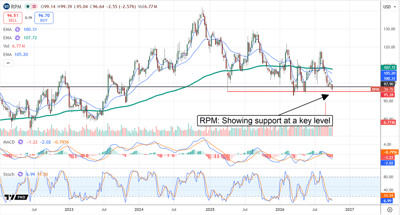
Institutions, which own about 80% of the shares, are likewise bullish on the stock, having bought aggressively in Q2 as the price tested its technical floor. Technically, that floor is near $95, a level tested three times—and now potentially for a fourth—since early 2025. The level coincides with resistance reached and broken during the COVID-19 recovery and subsequent economic surge.
RPM International Outperforms Where It Counts: The Bottom LineRPM International had a good quarter despite the macroeconomic headwinds, with revenue growing 4.8% to $2.22 billion, in line with expectations. Growth came from a mix of organic strength, pricing and acquisitions. The Construction Products Group (CPG) grew a modest 0.8%, while the Consumer Group increased 5.3% and the Performance Coatings Group (PCG) gained 10.2%. All regions grew, although results varied, with particular strength in emerging markets. Executives reported more than 20% growth across emerging markets, driven by infrastructure spending and business investment.
Margin news was also positive. The company offset inflation through price increases and efficiency initiatives, driving an 11.1% increase in cash from operations, more than $200 million in free cash flow after capital expenditures, and a 5.3% increase in adjusted earnings per share. More importantly, management reaffirmed its guidance with a narrower range, expecting mid-single-digit growth to persist throughout the year while margins remain healthy.
RPM International Has a MoatRPM’s moat is easy to see. Customer specifications, selling systems rather than products, and high switching costs keep customers coming back. The company’s products help protect construction, infrastructure and manufacturing investments at a negligible cost compared with the cost of failure. It is better to put a coat of paint on something you can trust than to replace the whole thing.
This year’s catalysts include restructuring and Margin Achievement Program (MAP) gains, strategic acquisitions and government tailwinds. Restructuring and MAP gains are pushing gross margins above 40% while reducing SG&A, enabling accelerated earnings growth. Strategic acquisitions aim to complement the existing portfolio while supporting the streamlining process. Headwinds remain, but they are offset by tailwinds linked to the Infrastructure Investment and Jobs Act, which provides funding for a range of RPM products.
RPM’s risks are macroeconomic and systemic rather than related to its operational quality. They include segment softness, with the CPG segment lagging; cost pressures; execution; and credit. Cost pressures are being mitigated but remain a threat, while execution and credit represent the larger risks. Missteps will be reflected in the stock’s price, as will systemic risks linked to customer credit. Defaults—or even the fear of defaults—could trigger a massive sell-off in the stock. |