| Energy Briefing · The Hill Report Geothermal Kept Its Federal Credit After Wind and Solar Lost Theirs The 2025 tax law cut off two technologies at the end of 2027 and left geothermal on a schedule that runs to 2035 — a difference written into one subsection of the code. Connor Hill · InsightfulWord · October 08 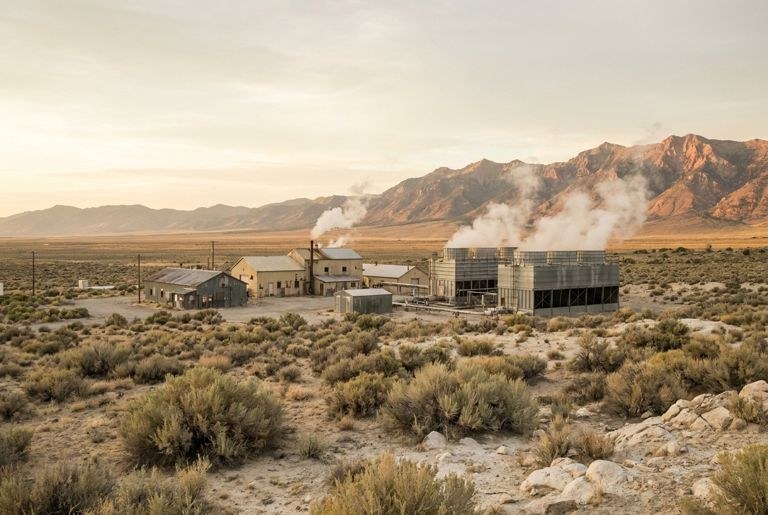 Key points | The clean electricity credits in sections 45Y and 48E now end for wind and solar facilities placed in service after December 31, 2027. Geothermal is not subject to that cutoff. |
| For other technologies, including geothermal, the statute sets a phase-down keyed to when construction begins: full credit through 2033, then 75% in 2034, 50% in 2035 and nothing after. |
| A geothermal plant in Beaver County, Utah declared commercial operation on September 30, with its first unit producing 33 megawatts net. |
| Utility contracts for that plant's later phases were approved by California's utility regulator by resolution, raising the contracted total from 320 to 398 megawatts in June 2025. |
|
Beaver County, Utah has become the place where a technology moves from test wells to a grid connection. Whatever was brought to the surface there, the economics of turning heat into electricity in the United States now rest on a short passage of the tax code that treats geothermal very differently from wind and solar. That passage, and the regulatory approvals that sit beside it, are public, dated and specific. They are the part of the story that can be checked line by line. On the tape Oct 1 Fervo Energy said its Cape Station in Beaver County synchronized to the grid on September 24 and declared commercial operation on September 30, one day before the contractual date. Why it matters: the first unit produces 33 megawatts net; two more 33-megawatt units are due by January 1, 2027, and a second phase of 400 megawatts is scheduled for 2028. |
Oct 5 California's Imperial Irrigation District signed ten-year agreements for 86 megawatts of geothermal power from two existing Salton Sea plants, with deliveries starting January 1, 2027. Why it matters: the price was not disclosed, which is typical — contract volumes and terms are announced, and pricing usually appears only in regulatory filings. |
Oct 1 A Salton Sea geothermal and lithium developer and its special-purpose acquisition partner said about $245 million of convertible notes would be restructured, roughly $205 million converting to equity. Why it matters: the planned project is about 650 megawatts, with a first stage of 50 megawatts targeted for 2028, so the financing precedes the generation by years. |
Oct 5 A federal geothermal lease sale in Idaho was reported for November 17, covering about 113,330 acres, after sales already scheduled in Nevada on October 20 for 265,691 acres and in California on October 27. Why it matters: federal lease sales publish parcel counts, acreage and winning bids, the only public price signal for geothermal land — the last completed sale, in New Mexico in June, drew $16.6 million for about 152,000 acres. |
|
| | | What the 2025 Law Changed, and for Whom |
The One Big Beautiful Bill Act, signed in July 2025, rewrote the phase-out of the two technology-neutral clean electricity credits — the production credit in section 45Y and the investment credit in section 48E. It did so with two separate mechanisms that are easy to conflate. The first is a hard stop for two technologies. Section 45Y(d)(4) now provides that the credit "shall not apply with respect to any applicable facility placed in service after December 31, 2027," and defines an applicable facility as one using wind or solar energy. Section 48E carries a parallel termination for wind and solar property. A transition rule protects projects that began construction within twelve months of enactment. The second is a phase-down for everything else. The statute sets an "applicable year" of 2032 and reduces the credit according to when construction begins: 100% in the first year after that, 75% in the second, 50% in the third, and zero thereafter. For a geothermal plant that means full credit for construction beginning by the end of 2033, 75% in 2034, 50% in 2035, and no credit for construction starting in 2036 or later. Law-firm timelines read the statute the same way, adding that a four-year continuity safe harbor can carry a 2033 start to a 2037 in-service date. The practical result is a decade-wide gap. A wind farm that is not in service by the end of 2027 loses the credit; a geothermal plant that starts construction in 2033 keeps all of it. | By the numbers | | Dec 31, 2027 | Placed-in-service cutoff for wind and solar under 45Y and 48E | | 2033 | Last year geothermal construction can begin with the full credit | | 75% · 50% | Credit available for construction beginning in 2034 and 2035 | | 33 MW | Net output of the first unit at Cape Station, operating from September 30 | | 398 MW | Contracted capacity after California's June 2025 amendment approval | | 265,691 | Acres offered in the Nevada geothermal lease sale on October 20 |
| | | The Conditions That Still Apply |
Keeping the credit is not the same as receiving it automatically. Two sets of conditions added in 2025 apply to geothermal as they do to other technologies. The first concerns foreign entities. A facility whose construction begins after December 31, 2025 is excluded if it includes "any material assistance from a prohibited foreign entity," and the investment credit is denied outright to a taxpayer that is a specified foreign entity. The material-assistance test is measured as a cost ratio that rises each year, from 40% in 2026 to 60% from 2030, according to an industry summary of the interim guidance. Treasury issued interim rules in February and is due to publish new tables by the end of this year. The second concerns when construction is deemed to begin. In August 2025 the tax agency tightened that test for wind and solar alone, removing the long-standing 5% cost safe harbor for most of them and leaving only a physical-work test. The notice does not mention geothermal. Its scope, confirmed in law-firm commentary, is limited to the two technologies the statute singled out. What none of this does is guarantee a project's economics. A credit reduces tax owed on electricity produced or capital invested. It does not supply a buyer, a transmission line or a permit. | | 📊 Fresh Energy Signal 33 MW The net output of the first generating unit at Cape Station in Beaver County, which declared commercial operation on September 30 after 23 months of construction. Two more units of the same size are due by January 1, 2027, and a further 400 megawatts in 2028. It is the first commercial unit of its kind in the county, and it began producing under the credit schedule described above. |
| | | How a Utility Contract Gets Approved |
Electricity from a new plant needs a buyer, and for a regulated utility the buyer's contract needs a regulator's approval. California's process shows how that works on the public record. The utility files an advice letter with the state Public Utilities Commission describing the contract, and the commission's energy division resolves it at a public meeting. For the Beaver County plant, Southern California Edison filed in January 2024 for two contracts totaling 320 megawatts. In April 2025 it filed amendments, and on June 26, 2025 the commission adopted Resolution E-5404 approving them: one unit at 62 megawatts of nameplate capacity, 58 of them counted toward the utility's reliability requirement, and another at 336 megawatts, 310 counted. The amendments raised the total to 398 megawatts. Two details in that resolution repay attention. Nameplate and counted capacity are reported separately, because a regulator credits only the share it expects to be available when needed. And the resolution is dated and numbered, which makes it the fixed point against which any later claim about contracted volume can be checked. Public statements since then describe more than a gigawatt under contract across several buyers; the commission's resolution covers the part a regulator has approved. | Where the terms are written | | Internal Revenue Code, section 45Y(d) | Wind and solar cutoff after 2027; phase-down for other technologiesApplicable year 2032; zero for construction starting in 2036 | | Internal Revenue Code, section 48E | Parallel investment credit structure and foreign-entity limitsTaxpayer-level exclusion for specified foreign entities | | Tax agency Notice 2025-42 | Beginning-of-construction rules tightened for wind and solarDoes not address geothermal | | California Public Utilities Commission | Resolution E-5404 approving contract amendmentsAdopted June 26, 2025; 320 to 398 megawatts |
One question for the desk When a new energy discovery is announced, is it the resource itself or the tax and contract terms around it that decides whether it gets built? Hit reply — one line is enough. |
Worth stating plainly The 2025 tax law ended the clean electricity credits for wind and solar facilities placed in service after 2027 and left geothermal on a separate schedule: full credit for construction starting through 2033, then 75%, then 50%. The first commercial unit in Beaver County began operating on September 30 under contracts a state regulator approved by numbered resolution. |
The short checklist | 1. | Separate the two 2025 mechanisms: a 2027 placed-in-service cutoff for wind and solar, and a construction-start phase-down for everything else. |
| 2. | For any geothermal project, note when construction began; that date sets the credit percentage. |
| 3. | Check the foreign-entity conditions for any project starting construction after 2025. |
| 4. | Look for the regulator's resolution behind a utility contract, and read nameplate and counted capacity separately. |
| 5. | Treat announced contract totals as statements until a filing or resolution confirms them. |
|
| | Replies to this briefing reach a person, not a queue. Connor Hill reads every reply. | | |
Sources checked Verified October 07, 2026 Title 26, United States Code, sections 45Y and 48E, as amended by Public Law 119-21 Internal Revenue Service Notices 2025-42 and 2026-15 California Public Utilities Commission Resolution E-5404, adopted June 26, 2025 Fervo Energy release on commercial operation at Cape Station, October 1, 2026 ThinkGeoEnergy and Renewable Energy Magazine reports on the Imperial Irrigation District agreements, October 5 and 6, 2026 Bureau of Land Management geothermal lease sale notices for Nevada, California and Idaho, 2026 Connor Hill writes The Hill Report for InsightfulWord, a daily briefing on the machinery behind the numbers. |