| Unsubscribe |
Swing trades have their place.
In fact, as you read this, I have directional bets that'll stay open for at least the next couple of weeks.
However, I'm also a big believer in quick day trades.
Many of my best trades have been those that flew by in minutes and hours instead of days and weeks.
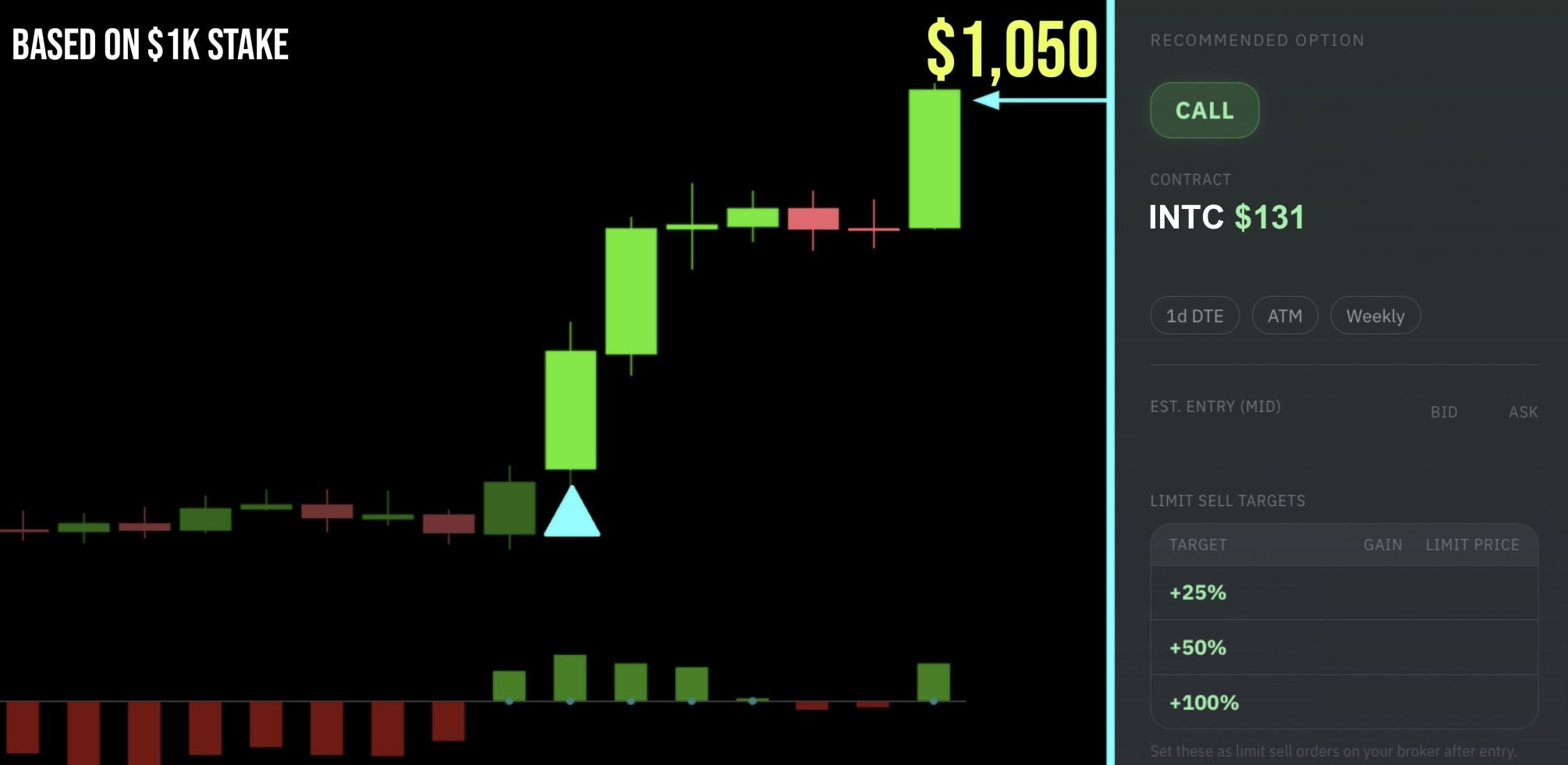
I'm talking moves like the $1,050* payout we caught on Intel days back.
That's why I've been so excited about the MI6 Software.
Now there were smaller wins and those that did not work out, I won’t lie and I can't make trading guarantees here...
But, imagine getting 1000+ of the exact same type of signals completely FREE!
Yes.
Not only will I show you how to use this breakthrough engine... I'll also hand its next 1000+ trade signals over to you, at no cost!
All you need is to get started here.
By clicking the link above you agree to periodic updates from The TradingPub and its partners (privacy policy)
'Til the next trade,
Lance Ippolito
*Based on a $1K stake
Old Dogs, New Tech: 3 Legacy Stocks Powering the AI Boom
Authored by Jeffrey Neal Johnson. Article Published: 9/23/2026.

Key Points
- Legacy technology suppliers like Corning, Cisco, and Texas Instruments provide critical physical infrastructure that AI computing depends on to function.
- All three companies show strong earnings growth, solid profit margins, and analyst Moderate Buy ratings with meaningful upside to price targets.
- Each firm pairs shareholder-friendly capital policies, including dividends and buybacks, with strategic repositioning toward AI-related infrastructure demand.
- Special Report: Grand Canyon Discovery Reshapes America's Energy Tax Credits.
Investors seeking steady capital appreciation often overlook older technology sector names, assuming their strongest growth years are behind them. A closer look shows how foundational hardware suppliers are adapting and how established balance sheets can capture substantial value during infrastructure transitions. Examining how long-standing industry leaders are repositioning their core businesses can help investors identify lower-volatility entry points supported by tangible revenue, reliable cash generation, and consistent dividend distributions.
Observing the physical demands of modern computing clarifies why software models eventually encounter real-world infrastructure constraints. Solving these operational bottlenecks requires manufacturing scale, specialized patent portfolios, and commercial relationships that newer entrants cannot quickly replicate.
Unplugging the Hype: Hard Truths in Pure Code
Trump's New Dollar (Ad)
Porter Stansberry says President Trump has signed an executive order initiating what he calls a full U.S. dollar reset - and most Americans don't know it's happening.
The last time America underwent a monetary shift like this, under Nixon in the 1970s, it minted an average of 1,300 new millionaires a day for over half a century. Stansberry has released a new documentary naming the assets he believes are positioned to surge as a result.
Watch the free briefing and see the three steps to prepare todayEarly enthusiasm for AI centered on foundational models and specialized processing units. Training and operating advanced models require moving vast datasets across server clusters, exposing tangible hardware constraints. Data centers face growing challenges involving heat dissipation, electrical grid capacity, and interconnect latency. Software cannot operate without reliable physical infrastructure, giving industrial suppliers significant commercial leverage.
Legacy technology leaders provide the physical pathways that keep high-performance computing running. By redirecting manufacturing capacity toward these infrastructure bottlenecks, established suppliers can generate steady operating margins. Three industry mainstays demonstrate how physical advantages, cyclical turnarounds, and shareholder-friendly capital policies can create attractive risk-adjusted opportunities for long-term investors.
Glass Act: Corning Built the Ultimate AI Data Pipeline
Dense computational clusters require specialized glass to transfer data. High-speed optical transceivers and fiber-optic cables connect processing clusters, reducing latency across server racks. Corning Incorporated (NYSE: GLW) has strategically shifted its commercial footprint from consumer display panels toward optical communications for hyperscale data centers.
Corning secured long-term visibility through an agreement with Verizon to supply more than 80 million miles of optical fiber between 2027 and 2032. In collaboration with Qualcomm (NASDAQ: QCOM) and Lumentum (NASDAQ: LITE), Corning is demonstrating high-density 1060-nanometer optical die-to-die connectivity at ECOC 2026 to accelerate data movement between parallel processors. Concerns surrounding an earlier $2 billion dilution event have also eased, reducing uncertainty around the company’s equity structure.
Corning trades near $159 with a market capitalization of approximately $136.70 billion. Second-quarter earnings came in at 78 cents per share, while revenue increased 17.1% year over year (YOY). Corning reports an 11.20% net profit margin, a 20.09% operating return on equity (ROE), and operating cash flow of approximately $4.35 per share. Although a forward price-to-earnings (P/E) ratio near 48.13 reflects the progress of its turnaround, Wall Street analysts maintain a Moderate Buy consensus with an average price target of $176.50, implying approximately 11% potential appreciation.
Guarding the Gateway: Cisco Plugs Enterprise AI Leaks
Deploying machine-learning tools in corporate environments creates significant data-protection challenges and complex traffic flows. Cisco Systems, Inc. (NASDAQ: CSCO) has evolved from a traditional network-switching company into an integrated software and cybersecurity provider, supported by its acquisition of Splunk.
By combining network telemetry with specialized security architectures and NVIDIA (NASDAQ: NVDA), Cisco provides the visibility organizations need to protect proprietary data across distributed networks. Its financial performance highlights the company’s shift toward recurring subscription revenue. Cisco reported quarterly earnings per share (EPS) of $1.22, exceeding consensus expectations by 5 cents, while revenue rose 17.6% YOY, pushing annual sales toward $63.33 billion.
Cisco has a market capitalization of approximately $433.51 billion, a 20.95% net profit margin, and a 30.16% ROE. Operating cash flow is approximately $4.34 per share. Following an 8% pullback over three months, Cisco stock trades near $111, equating to a reasonable forward P/E ratio of approximately 25.16. Capital allocation provides additional downside protection, highlighted by an active $15 billion share repurchase plan and a dependable 1.51% dividend yield. Analyst consensus is a Moderate Buy, with an average price target of $129.68, representing approximately 16% upside potential.
Steady Current: Texas Instruments Powers the Physical AI Edge
Digital microchips cannot function without analog semiconductors to convert real-world signals, manage electrical currents, and regulate system power. Texas Instruments Incorporated (NASDAQ: TXN) designs the essential components that connect digital systems with physical machinery, positioning the supplier at the center of automotive electrification and smart-factory automation.
The broader analog semiconductor industry endured an extended inventory correction over the past two years. Operating metrics now signal a clear inflection point. Texas Instruments reported quarterly EPS of $2.14, exceeding consensus projections of $1.91 by 23 cents as revenue expanded 22.8% YOY. This cyclical rebound supports the company’s decision to build low-cost, domestic 300-millimeter wafer manufacturing plants.
Texas Instruments generates strong financial returns, producing $5 billion in net income on annual revenue of approximately $17.68 billion. This output translates to a 31.11% net profit margin, a 35.77% ROE, and cash flow of approximately $7.72 per share, backed by a current ratio of 4.86. On Sept. 18, 2026, leadership increased the quarterly payout by 7% to $1.52 per share, marking 23 consecutive years of dividend increases. Trading near $269.27 with a forward P/E ratio of approximately 31.60 and a 2.11% dividend yield, Texas Instruments stock has an average analyst target of $312.12, pointing to roughly 16.9% upside.
Building Long-Term Exposure to AI Infrastructure
Assessing turnaround opportunities requires looking beyond speculative market trends to evaluate structural profitability and competitive advantages. High-performance computing relies heavily on physical manufacturing. Companies that provide optical data lines, enterprise network protection, and analog power regulation hold durable operational leverage.
Corning, Cisco Systems, and Texas Instruments demonstrate how mature corporate structures, disciplined shareholder-return programs, and critical product lines can withstand broader economic cycles. Valuations across the technology sector warrant careful risk management, yet these three established leaders combine fundamental stability with direct participation in long-term infrastructure expansion.
Investors seeking exposure to physical computing architecture can consider accumulating shares during market pullbacks or scaling into positions through dollar-cost averaging as quarterly filings confirm margin durability. Reviewing balance-sheet health and tracking institutional positioning can help investors identify appropriate entry points for a diversified portfolio.
Sandisk Joins the S&P 100—Is the Index Flow, or the AI Story, Driving the Stock?
Authored by Dan Schmidt. Article Published: 9/23/2026.
Key Points
- Sandisk's addition to the S&P 100 index has minimal market impact since the stock was already included in the much larger S&P 500 index.
- Sandisk's stock surge is primarily driven by strong NAND demand and record fiscal Q4 2026 earnings, though margin growth and consumer segment revenue are decelerating.
- Analyst price targets vary widely, from $1550 to over $3000, reflecting uncertainty over whether Sandisk's earnings have reached a cyclical peak.
- Special Report: Grand Canyon Discovery Reshapes America's Energy Tax Credits.
Flash memory producer Sandisk Corp. (NASDAQ: SNDK) officially entered the S&P 100 this week, another accolade for the soaring stock and a move that puts it alongside some of the market’s most prominent megacaps. Inclusion in major indexes like the S&P 100 brings prestige, but it also means index-tracking funds must buy the stock.
The change was announced on Sept. 4, and the stock gained nearly 12% during that session before quietly surrendering those gains over the following week. Now, the stock is ripping higher again as indexes rebalance at quarter-end. But how much of this bull case rests on S&P 100 inclusion? The answer is likely that the index rebalancing will have minimal impact. Instead, the stock’s 2026 surge is a story of NAND demand and a company operating near the peak of its earnings cycle.
The Index Flow Is Relatively Small Compared to Average Daily Volume
They're shrinking your dollars every single month (Ad)
Since 2020, the dollar has lost roughly a quarter of its buying power. A $500,000 nest egg today buys about what $375,000 did five years ago, even though no statement shows the change.
Central banks have bought over 1,000 tonnes of gold a year for three straight years, using the same published data now explained in a free guide.
The guide breaks down what's driving the shift in plain English, so readers can see the numbers for themselves.
Request the free guide and see the numbers for yourselfWhile Sandisk executives likely still broke out the champagne this week, S&P 100 inclusion is more a badge of honor than a demand driver. Sandisk joined Dell Technologies Inc. (NYSE: DELL), Palo Alto Networks Inc. (NASDAQ: PANW), and Arista Networks Inc. (NYSE: ANET) in the index, replacing Colgate-Palmolive Co. (NYSE: CL), Nike Inc. (NYSE: NKE), Simon Property Group Inc. (NYSE: SPG), and Honeywell Aerospace (NASDAQ: HONA). The theme of these additions is clear: tech is in, while consumer goods and REITs are out.
But the major caveat is that Sandisk is already a member of the S&P 500, which is a far more consequential event. The massive index funds that use the S&P 500 as a benchmark have already brought Sandisk into the fold, and adding it to the S&P 100 offers only an incremental layer of forced buying. Take the iShares S&P 100 ETF (NYSEARCA: OEF), for example. The cap-weighted fund has approximately $20 billion in assets, compared with the iShares S&P 500 Core ETF (NYSEARCA: IVV) and its $851 billion in assets. A stock like SNDK trades more than 15 million shares per day on average, so its average daily dollar volume surpasses OEF’s entire asset base. Inclusion in a fund like IVV certainly moves the needle, but based on market mechanics alone, S&P 100 inclusion is a non-event for SNDK shareholders.
NAND Demand Is Strong But Decelerating, and Company Valuation Implies Peak Earnings
Notably, the S&P 100 “pop” in SNDK shares also drew sympathy from other memory stocks, including Western Digital Corp. (NASDAQ: WDC) and Micron Technology Inc. (NASDAQ: MU). An industrywide move points to broader industry trends, and it appears the AI/NAND trade is once again driving the stock. But while NAND demand remains robust, pricing growth is slowing, and that trend is reflected in the valuation.
There is no need to rehash the top-line numbers; SNDK smashed expectations in its fiscal Q4 2026 earnings report on Aug. 5, reporting record revenue, record gross margins, and record quarterly earnings per share (EPS). Data center revenue more than doubled sequentially, and management lifted its fiscal Q1 2027 revenue estimate to 18% above its previous projection. However, the consumer-driven segment declined 32% from fiscal Q3, and fiscal Q1 2027 margin guidance is lower than the 84.6% reported in fiscal Q4 2026.
Gross margins above 80% are still spectacular, full stop. But the stock now trades at just nine times forward earnings, with a price-to-earnings growth (PEG) ratio of 0.18. That valuation suggests investors expect earnings to be near peak levels. NAND memory is typically a highly cyclical industry, and while data center revenue has disrupted the traditional business model, consumer demand for devices has fallen rapidly.
When will the music stop for SNDK shares? Even analysts aren’t sure. The consensus price target of $2,015 implies about 7% upside from current levels, but the average masks a wide discrepancy among analysts. Susquehanna and New Street Research both have targets above $3,000 for the stock, while Wells Fargo and Royal Bank of Canada have targets of $1,550 and $1,600, respectively.
Chart Shows Uptrend Regaining Strength Following Overbought Sell-Off
According to the daily chart, the music is still playing for now. After a downtrend reset stock prices across the AI trade, momentum has returned, and SNDK shares have recovered key technical milestones. A bullish crossover on the Moving Average Convergence Divergence (MACD) indicator signaled a bottom in early August, and the stock quickly resumed its ascent above the 50-day moving average.
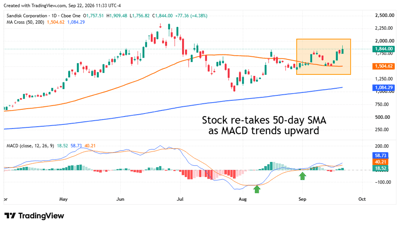
The MACD line has crossed above the signal line, while the histogram has turned positive, giving buyers an all-clear sign to re-enter the trade. The stock is trading near its highest level since its July all-time high, and the 50-day moving average is once again acting as support. The next catalyst for SNDK will be Micron’s fiscal Q4 2026 earnings report on Sept. 30, which will offer hints about NAND and DRAM pricing trends.
This email is a paid advertisement sent on behalf of The TradingPub, a third-party advertiser of MarketBeat. Why was I sent this email message?.
We develop tools and trading strategies to the best of our ability, but no one can guarantee a future outcome. The trading signals presented today were generated by the Mi6 Day Trading Software at the time shown. The Mi6 Day Trading Software is a tool for traders and is not a trading service. Users make their own trading decisions, and individual results will vary. No representation is made that any user will achieve results similar to those shown.
If you have questions or concerns about your subscription, please contact MarketBeat's U.S. based support team at [email protected].
If you would no longer like to receive promotional emails from MarketBeat advertisers, you can unsubscribe or manage your mailing preferences here.
© 2006-2026 MarketBeat Media, LLC. All rights reserved.
345 N Reid Place, Sixth Floor, Sioux Falls, SD 57103-7078. USA..