Major Buy Alert Issued for October 31st 
L3Harris’ $6 Billion THAAD Win Comes at a Crucial Moment for the Stock
Written by Jeffrey Neal Johnson on October 1, 2026
Key Points
- L3Harris Technologies secured an undefinitized $6 billion, seven-year THAAD propulsion contract from Lockheed Martin, boosting its long-term revenue backlog.
- A Pentagon-backed $1 billion investment in L3Harris's Missile Solutions unit precedes an initial public offering now delayed to mid-2027, with L3Harris retaining over 80% ownership.
- L3Harris shares have fallen about 22% over the past year amid a leadership shakeup, with new CEO Sam Mehta replacing Christopher Kubasik after a board conduct review.
- Special Report: The Rumors About Elon’s Next Move Are Spreading Fast

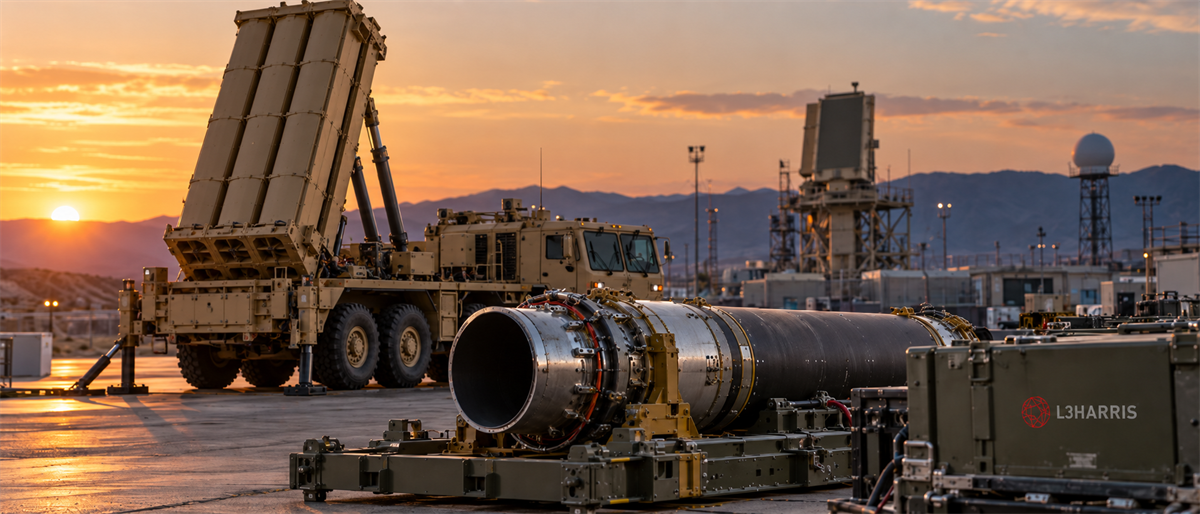
Global defense modernization is accelerating, creating unique entry points for investors watching the prime contractor space. L3Harris Technologies (NYSE: LHX) recently secured an undefinitized $6 billion, seven-year Terminal High Altitude Area Defense (THAAD) propulsion contract from Lockheed Martin (NYSE: LMT).
The agreement expands L3Harris Technologies' long-term backlog while signaling an urgent need to scale global threat-deterrence capabilities. Coupled with the impending initial public offering of its Missile Solutions unit backed by Pentagon capital, L3Harris Technologies presents an asymmetrical accumulation opportunity for those willing to absorb near-term leadership transition risks.
Gold is hitting record highs, but most investors are leaving income on the table. A $15 fund is quietly paying out up to $1,152 a month to regular investors - no mining stocks, no options, no physical metal required.
Chief Income Strategist Tim Plaehn calls it a breakthrough strategy that transforms gold's rally into reliable monthly payouts. The next distribution is just days away. Discover the gold income fund before the next payout date The Math Behind the THAAD Mandate
The core of the recent price action stems from Lockheed Martin's seven-year framework. This $6 billion mandate is designed to quadruple THAAD propulsion production, specifically scaling Solid Rocket Boost Motors and Liquid Divert and Attitude Control Systems. To meet the volume demands required by the Department of War, L3Harris Technologies will construct a new manufacturing facility.
From a top-line perspective, this provides immense revenue visibility. Defense mega-contracts typically insulate prime contractors from the macroeconomic cycles that weigh on consumer-facing equities. Investors should consider reviewing the nuances of an undefinitized contract. In defense procurement, this means the government has authorized the work to begin before the final pricing, production schedules, and margin profiles are completely negotiated.
The urgency of global geopolitical instability often forces the Department of War to fast-track production authorizations to ensure immediate deterrence capabilities. Finalizing these terms with Lockheed Martin is targeted for late 2026. Until then, L3Harris Technologies faces interim margin ambiguity while bearing the initial capital expenditures required for facility construction. The government mandate essentially guarantees long-term cash flow, but the exact profitability of those cash flows will remain a slight overhang until the contract is fully definitized.
The Pentagon's $1B Capital Injection
Looking past the THAAD contract, a significant structural catalyst is flying under the radar. Earlier in 2026, the Department of War injected $1 billion into L3Harris Technologies' Missile Solutions unit through convertible preferred securities. This unusual direct government capitalization underscores the Missile Solutions unit's strategic importance to national security infrastructure.
While leadership initially targeted late 2026 for the unit's initial public offering, volatile market conditions have pushed the timeline to mid-2027. When the IPO is executed, L3Harris will retain a majority stake of over 80%. Spinoffs and partial public offerings often unlock value. By taking Missile Solutions public, L3Harris Technologies can crystallize the unit's standalone value, which is often obscured within a large defense conglomerate.
The capital raised from this offering, combined with the prior injection from the government, accelerates production capacity without severely taxing L3Harris Technologies' balance sheet. Retaining an 80% stake ensures shareholders will still benefit from targeted growth in the missile defense sector. The influx of outside capital mitigates the financial risk of scaling operations so rapidly, providing a cleaner capital structure for the parent company as it funds new manufacturing footprints.
The largest energy source on Earth contains 50,000 times every oil and gas reserve on the planet combined - and much of it sits beneath the desert near the Grand Canyon.
A drilling crew just hit the DOE's 2035 targets twelve years early, with costs down 50% in 18 months. Google signed on, Gates invested, and the Pentagon made it a priority. One company has been quietly building this infrastructure for sixty years. See the company sitting on the biggest energy source on Earth Course Correction: Addressing Executive Overhaul
Despite the long-term backlog expansion, L3Harris Technologies' stock price has experienced notable downward pressure. Shares have pulled back about 22% over the last year, trading near 52-week lows. Short interest has risen to approximately 4.48 million shares, and several research firms have recently downgraded L3Harris Technologies to a Hold rating, although the overall analyst consensus remains Moderate Buy.
A primary driver of this skepticism is the sudden governance transition. In August 2026, Chief Executive Officer Christopher Kubasik departed following a board conduct review, leading to the rapid elevation of Sam Mehta to President and Chief Executive Officer. Leadership changes, especially unexpected ones, naturally invite elevated execution risk. Investors are assessing whether the new management team can navigate the capital-intensive facility expansions and the upcoming Missile Solutions public offering smoothly.
Some analysts flagged Mehta's insider selling earlier in the year as a bearish signal. Context matters here. Those liquidations occurred before his sudden appointment as Chief Executive Officer. Executive distributions made before a major promotion generally carry less predictive weight regarding future company performance than sales made by an entrenched executive. Ongoing investor-rights investigations by various law firms over alleged fraud are also creating headline noise. The burden of proof rests with L3Harris Technologies' new leadership to execute the $6 billion mandate without margin compression and quiet the regulatory noise.
Telemetry Data: Why the Math Supports Accumulation
When equities face technical breakdowns alongside strong fundamental catalysts, the priority becomes identifying the valuation floor. L3Harris Technologies is currently trading at a forward price-to-earnings ratio hovering around 19.9. This multiple represents a discount compared to historical averages for prime defense contractors with equivalent backlog visibility.
Recent quarterly earnings demonstrated operational stability, with L3Harris Technologies reporting $3.13 per share, comfortably beating consensus estimates of $2.80. This level of execution provides a buffer against the prevailing negative sentiment.
While the market digests the leadership transition and the undefinitized contract terms, investors can look to the dividend as a baseline for total return. L3Harris Technologies offers a forward dividend yield of about 2.1%, equating to an annualized payout of $5 per share. With a sustainable payout ratio of about 50%, the dividend appears secure. This leaves ample room for the heavy growth investments required by the new facility construction while paying investors to wait for the fundamental thesis to play out.
Positioning for the Defense Supercycle
Geopolitical instability continues to drive sustained capital injections into missile defense infrastructure globally. The $6 billion award cements L3Harris Technologies as an indispensable node in the Pentagon's procurement cycle, ensuring highly visible free cash flow for the next decade.
Investors weighing a position might consider the current share price weakness as an opportunity to acquire a premier defense asset at a compressed valuation. The upcoming Missile Solutions unit public offering and the final definitization of the THAAD contract serve as near-term milestones that could reverse the negative technical trend.
Those aiming to build exposure to the defense sector may find value in accumulating shares while the broader market focuses on short-term governance noise rather than the decade-long revenue visibility secured by the Department of War. Cautious investors might prefer to wait for the propulsion contract's final pricing terms before allocating capital.
Read this article online ›
Recommended Stories

Did you like this article?
 
| 