Hello,
Welcome to our flagship newsletter, MarketBeat Daily Ratings.
We'll deliver the latest "Buy" and "Sell" ratings from Wall Street's top-rated analysts directly to your inbox each morning.
But first, we need you to do two quick things:
1. Hit reply, and send a simple "Yes." Just one word. This tells Google (and other emails providers) that you actually want to get our newsletter.
2. After that, this link to confirm your subscription. That will tell us that you received our welcome email and that we should start sending your daily report.
Confirm your subscription here.
After you have completed these two steps, we would like to gift you a free copy of one of our most popular investing reports: 7 Stocks to Buy and Hold Forever. You can download the report with this link.
Thank you again for subscribing. We look forward to being an important part of your investing journey

Matthew Paulson
Founder and CEO, MarketBeat.
P.S. If you didn’t intend to subscribe, no problem—you can unsubscribe with this link.
(ARReply-161)
This Month's Featured Content Not Just Banks: 3 Trading Stocks to Watch After the Fed Rate HikeReported by Dan Schmidt. Publication Date: 9/19/2026. 
Key Points- The Federal Reserve raised its benchmark rate by 25 basis points on Sept. 16, reversing earlier expectations for 2026 rate cuts amid persistent inflation.
- Brokers and exchanges such as Interactive Brokers, Robinhood, and CME Group can benefit more than banks from rate hikes through faster-repricing net interest income and hedging demand.
- Interactive Brokers appears most directly tied to rate gains, while Robinhood's outlook depends on trading volume and CME Group benefits from ongoing rate path uncertainty.
- Special Report: Everyone wanted SpaceX. Smart money wants this.
What a difference a year makes. In fall 2025, markets expected 2026 to bring rate cuts. The Trump administration’s tariffs had been muted, the job market was shaky, and disinflation was the presumed economic outcome. But much like the calls for a recession in 2023, the real world has a funny way of making prognosticators look foolish. The Federal Reserve raised rates for the first time in three years on Sept. 16, moving the benchmark overnight rate up 25 basis points (bps). The vote was unanimous, and many Fed officials see room for additional hikes before year-end.
The immediate market reaction was a sell-off, but stocks surged the following day despite prospects for further hikes in 2026 (and 2027). A new hiking cycle is usually good news for the financial sector, and many investors will screen for banks that stand to benefit most in that environment. However, banks aren’t the only businesses in finance, and many brokers and exchanges could also reap rewards from rising short-term rates.
Why Brokers and Exchanges Deserve a LookIn 1974, Congress passed a law originally aimed at Richard Nixon that most investors have never read.
Addison Wiggin, Chief Investment Officer at The Grey Swan, says this obscure law could resurface after November 3rd, reshaping how Wall Street positions itself for the midterms.
He outlines five specific moves for investors to consider before that date. See Addison Wiggin's five-move blueprint before November 3rd arrives The rate path flipped on its head in less than 12 months because of persistent energy-driven inflation. Stoked by the war in Iran and the subsequent closure of the Strait of Hormuz, WTI crude futures soared from under $60 per barrel in January to more than $105 by September. With no exit ramp in sight, the interest-rate path remains murky and influenced by factors far beyond the Fed’s control.
The market typically views rate hikes as foul-tasting medicine: a needed remedy that goes down bitter. Higher rates mean lenders can charge more for loans, but they also need to compete to retain deposits. Brokers and exchanges often benefit more than banks during rate-hike cycles for three reasons:
Net interest income (NII) on cash sweeps and margin loans
Customers holding more cash for higher yields and engaging in less speculative trading
Increased demand for hedging products
Unlike banks, brokers and exchanges have no long-duration loan book and don’t need to worry about deposit beta. Customer cash spreads and margin loans reprice much more quickly during these cycles than typical banking activities, and the three companies listed below each offer a different way to profit in this environment.
Interactive Brokers: The Cleanest Beneficiary of a 25-Basis-Point Hike
Interactive Brokers Group Inc. (NASDAQ: IBKR) might be the most immediate beneficiary of a 25-bps hike, but you don’t have to take my word for it.
During the conference call for the company’s fiscal Q2 2026 earnings report on July 21, CFO Paul Brody estimated that a 25-bps hike would add $81 million in annual NII.
In Q2, NII rose 23% to $1.06 billion. Adding $81 million to an annualized NII figure of $4.2 billion would represent about a 2% lift for every 25 bps. NII also represented more than 56% of total Q2 revenue, so the rate story very much dominates this stock.
Interactive Brokers grew NII during the earlier part of the year thanks to expanding account balances, so this rate hike adds a tailwind to an already growing segment. Margin loan interest grew 39%, while margin loan balances increased 67% year-over-year (YOY) to $108.5 billion.
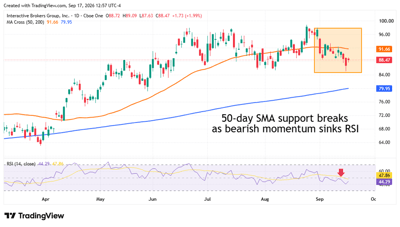
Investors should remain cautious, however. This rate hike was widely priced in, and IBKR shares likely need another catalyst to resume their rally. Support at the 50-day moving average has broken ahead of the fiscal Q3 2026 report on Oct. 20, and the Relative Strength Index (RSI) has dipped into bearish territory.
Robinhood: Interest Exposure at Odds With Growth Appetite
The story behind Robinhood Markets Inc. (NASDAQ: HOOD) is a little muddier.
On one hand, Robinhood earns payment for order flow, so the company generates more profit when trading volumes are high, especially for speculative assets such as options and cryptocurrencies.
On the other hand, net interest revenue (NIR) grew 9% YOY in fiscal Q2 2026, while the margin book more than doubled to a record $21.6 billion.
The conflict between growth and interest income is at the heart of the Robinhood thesis. If speculative risk appetite slows, the loss of trading revenue could more than offset the gains in interest revenue.
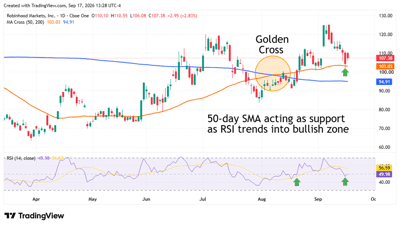
Traders bid up HOOD shares by more than 12% in the month leading up to the expected rate hike, and some technical signals have since turned higher. The RSI is once again trending above the bullish threshold of 50, while a Golden Cross in August affirmed support at the 50-day moving average.
CME Group: The Best Bet on an Uncertain Rate Path
Fed officials have made it clear that the rate path is littered with potential obstacles, and an uncertain future might be the best environment for CME Group Inc. (NASDAQ: CME).
CME operates global derivatives marketplaces where investors can bet on SOFR, Fed funds and Treasury futures. The more uncertainty reigns, the more demand for these hedging products is likely to increase.
Average daily volume (ADV) was up 8% YOY in fiscal Q2 2026, and August figures showed that nearly 30 million contracts were traded ahead of the Fed decision.
The September hike was widely telegraphed, yet trading volumes still grew strongly. An uncertain path in 2027 could unlock even more value in CME shares.
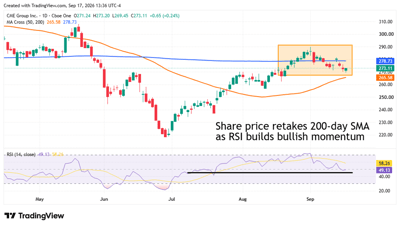
CME shares regained the 200-day moving average in the weeks leading up to the Fed meeting, and this level will need to hold as support for additional short-term gains. The RSI has retreated from overbought territory but continues to show bullish momentum. Investors will need to monitor these technical trends ahead of the fiscal Q3 2026 earnings catalyst on Oct. 21. |