If you ever watched Star Trek: The Next Generation, you probably remember those words… Spoken by Captain Jean-Luc Picard after he has been assimilated by the Borg – his face disfigured and his voice drained of all human emotion.
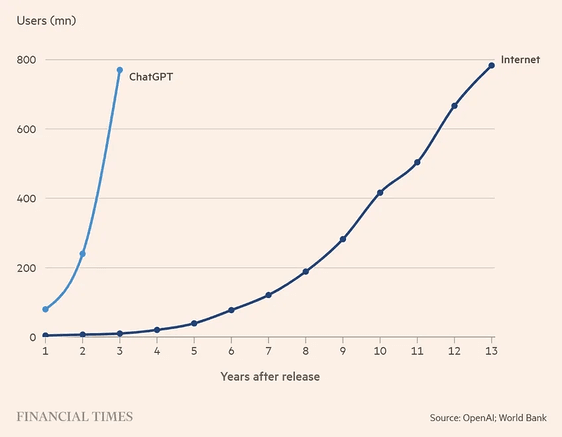
Editor’s Note: AI is spreading nearly twice as fast as the internet – and Porter believes it could create a brutal wealth divide between the people who profit from this revolution and those it leaves behind.
In his recent broadcast, he sits down with tech expert Luke Lango to reveal how to position your money before that divide becomes permanent.
“Your life, as it has been, is over. From this time forward, you will service us.”
If you ever watched Star Trek: The Next Generation, you probably remember those words…
Spoken by Captain Jean-Luc Picard after he has been assimilated by the Borg – his face disfigured and his voice drained of all human emotion.
The Borg – a collective machine intelligence – are frightening because they do not threaten or argue. Their assimilation of all life in the universe is simply an inevitability.
Not because machines are about to turn us into mindless servants (we already have TikTok for that)... but because AI is advancing without any need for public agreement or approval. It has reached a Borg-like inevitability.
It’s not waiting for Washington to make up its mind or for the average American to decide whether any of this is a good idea.
Once software or a machine can perform useful work at a fraction of the cost, its adoption becomes an inevitable economic compulsion.
And the speed with which it is tearing through our civilization is staggering.
A study from the Federal Reserve Bank of St. Louis found that 39% of Americans between the ages of 18 and 64 had used generative AI within roughly two years of its mass-market introduction.
At the comparable point, internet adoption was around 20%. The internet took approximately five years to reach the level AI reached us in less than two.
Until now, nothing in our lifetimes had spread as quickly as the internet. Based on the adoption data cited above, AI is moving nearly twice as fast.
Many investors will look at that curve and conclude that it’s time to dump a load of cash into AI stocks.
But that’s where the trouble begins – because recognizing an inevitable technology is not the same thing as understanding who will make money from it.
Stranded on the wrong side of history
In 1975, a Kodak engineer named Steve Sasson built the first self-contained digital camera. It weighed eight pounds, required 23 seconds to record a black-and-white image, and stored the result on a cassette tape.
Sure, the device was crude, but its potential impact was enormous. Kodak’s own engineer had invented a future in which people would no longer need film.
The management understood that potential perfectly well – and it terrified them. Because Kodak’s very existence depended on selling film. So, the company spent years defending the economics that its own invention was destroying.
By the time digital photography became impossible to resist, Kodak had lost both the habit and the ability to adapt. It entered bankruptcy in 2012.
Blockbuster had even less of an excuse to get steamrolled by technology. In 2000, Reed Hastings and Marc Randolph offered to sell Netflix to Blockbuster for $50 million. The Blockbuster executives reportedly struggled not to laugh.
Roughly a decade later, Blockbuster was bankrupt and Netflix was fast becoming the new distribution system for filmed entertainment. That was one of the more expensive chuckles in business history.
The internet boom taught me that history acts without mercy to people who can see a technological change in front of them but continue on in futility, unwilling to accept or embrace it.
In hindsight, the rise of the online world was obviously unstoppable.
Yet even some of the most respected publications of the day were deeply skeptical of the companies at the frontier.
In May 1999, Barron’s famously ran a cover story titled “Amazon.bomb,” declaring: “Investors are beginning to realize that this storybook stock has problems.”
I recommended Amazon two months before Barron’s ran that story. I saw something different I guess. I saw that Amazon had an undeniable business model. The shares have since risen more than 7,000%.
Years later, after using Shopify to operate one of my own businesses, our research recommended the stock in March 2016. We closed the position 18 months later with a 256% gain.
My interest in Bitcoin came from the same basic observation. The internet had created a genuinely scarce digital asset that could move around the world without relying on the traditional financial system.
These were very different investments, and the best examples of what can happen when everything goes right for us. I’m not claiming that happens every time. And, of course, past performance doesn’t tell us what will happen in the future.
But the question was always the same simple one: What becomes more valuable because this technology exists?
That is the question investors must answer about AI right now.
Betting on the inevitable
AI technology (in many different forms) will touch practically every company in America. But it will not reward all of them equally.
Enormous sums – trillions of dollars – are already pouring into semiconductors and the power-hungry data centers required to run the models.
Some businesses will turn that colossal buildout into decades of cash flow and investment returns for shareholders.
A great many more will discover that spending money on an indispensable technology does not make the spender indispensable.
The Great AI Divide will not be between people who believe in AI and people who do not. It will be between those who own the scarce, profitable parts of this new economy and those whose livelihoods are being repriced by it.
That’s why I recorded this sit-down with Luke Lango, one of the best technology investors I know. Luke recommended AMD in 2015, and he has spent years studying how these technological shifts create – and destroy – fortunes.
In our critical broadcast, Luke and I explain where we believe the durable economics of AI will appear and why several of today’s most popular stocks may disappoint their investors.
We also reveal the name and ticker of a little-known spin-off from a century-old American business that we believe could become crucial to the data-center buildout.
The Borg were right: resistance is futile. So, for investors, the only useful question that remains is this:
Will your capital be positioned before or after AI completely takes over the world?
Good investing,
Porter Stansberry
Power Field Notes
The Week Ahead: OPEC+ on October 4 and the Entrenched Stalemate
The coming week brings a supply-side catalyst amid the diplomatic stalemate: the OPEC+ meeting on October 4, when seven core members convene after holding October output at 31.01 million barrels a day. The meeting comes as the US-Iran talks have stalled following Trump’s rejection, though he told Axios he expects negotiations to resume this week. The week thus combines the OPEC+ production decision — which will shape the supply outlook independent of the conflict — with the continuing diplomatic uncertainty, as the market settles into pricing the protracted stalemate that the rejection has entrenched.
The week ahead is defined by the interaction of the OPEC+ decision and the entrenched stalemate. The OPEC+ meeting on October 4 will determine whether the group adjusts production in response to the elevated prices and the conflict-driven disruption; a decision to increase output could help offset the Iranian supply constraint and moderate prices, while holding output steady would leave the conflict as the dominant price driver. The diplomatic track, meanwhile, continues in its stalled state: Trump’s rejection has removed the near-term resolution scenario, but his stated expectation of resumed talks this week and his openness to a deal keep the channel alive, even as the reporting of expected post-midterm strikes signals the escalation risk. The market is settling into pricing the protracted stalemate that Kyle Rodda described — Brent around $100-107, reflecting a less acute supply shock than at the war’s start but a persistent premium from the unresolved conflict. The key variables are the OPEC+ output decision, any resumption of the talks, and the continuing Houthi threat to Saudi infrastructure.
■ OVERVIEW · October 4
OPEC+ meets — seven core members, after holding October output at 31.01 million b/d · a supply-side catalyst amid the stalemate
■ ANALYSIS · The stalemate
The talks stalled after Trump’s rejection, though he expects them to resume this week · post-midterm strike risk looms over the near term
■ OUTLOOK · The picture
The market is settling into pricing a protracted standoff: Brent around $100-107 · watch the OPEC+ output decision, any resumed talks, the Houthi threat