| Unsubscribe |
Jensen Huang said a little-known corner of the AI world is a “once-in-a-generation opportunity.”
As you probably know, he's the CEO of NVIDIA, the top AI chip company in the world.
Strangely, this “once-in-a-generation opportunity” has nothing to do with cutting edge AI chips, programs like ChatGPT, or data center buildouts.
Instead, it involves AI breaking free of computers and the internet to work right beside us in the real world.
And that’s why Jensen Huang also called it "the dawn of a new industrial revolution."
What is he talking about?
See the story, including details on my #1 pick in this exciting space.

NVDA CEO’S “ONCE IN A GENERATION OPPORTUNITY” REVEALED
To your wealth,
Matt McCall
P.S. I called NVDA, back when it was $6. It has shot up 3,100% in 6 years. So, I think NVDA’s CEO knows what he’s talking about. Click here for more details.
A Sub-20 P/E on GOOGL? The Market May Be Missing Something
Reported by Ryan Hasson. Publication Date: 9/15/2026.
Key Points
- Alphabet shares rose more than 3% Monday to $349.39, yet the stock's price-to-earnings ratio has fallen to roughly 17.5, below the S&P 500 average.
- Alphabet signed a 22-year power purchase agreement with Fortum for Finland's Loviisa nuclear plant, anchoring a commitment of at least €13 billion in AI infrastructure through 2028.
- Analysts maintain a consensus Buy rating with a $420.19 price target implying 20% upside, while institutions bought nearly $125 billion in shares over the past year.
- Special Report: Everyone wanted SpaceX. Smart money wants this.
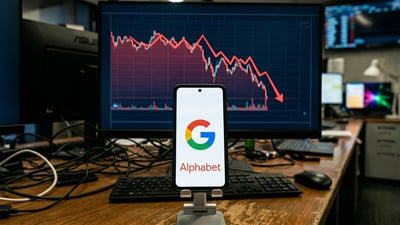
Alphabet (NASDAQ: GOOGL) made a notable move on Monday, climbing more than 3% to close at $349.39, even as the broader conversation around artificial intelligence turned increasingly cautious over the weekend.
That rally pushed the stock higher, but one number stands out: Alphabet's price-to-earnings ratio (P/E) has slipped below 20 and now sits at roughly 17.5. For one of the most dominant and profitable technology companies in the world, such a low valuation looks increasingly difficult to justify.
A Rare Discount for a Dominant Business
I'm giving you a space stock today. Free. (Ad)
On December 8th, $600 billion in frozen SpaceX stock comes loose. Dylan Jovine says one simple purchase in any regular brokerage account gives investors exposure to SpaceX and 66 of its neighbors, without an IPO allocation.
He is also naming two space stocks he would consider dumping before December, plus a $14 stock that Elon has personally put his name on.
Get the free space ticker before the December 8th unlockTo put that multiple in context, the average stock in the S&P 500 trades at a meaningfully higher earnings multiple than Alphabet does right now.
This is a company generating $132 billion in net income, with net margins approaching 55% and a return on equity above 51%.
Businesses of this quality rarely trade at a market discount, yet Alphabet does, with a trailing P/E of 17.5 and a forward multiple near 17. The stock is up a relatively modest 12% this year, lagging several of its mega-cap peers.
Why the AI Slowdown Chatter May Not Be All Bad
Over the weekend, calls for a slowdown in the AI race grew louder, including fresh warnings from prominent researchers about the risks of advancing the technology too quickly. Counterintuitively, that backdrop may not be as negative for Alphabet as it first appears. Google spent the early part of the AI race widely viewed as playing catch-up to OpenAI and, more recently, to fast-moving rivals such as Meta Platforms (NASDAQ: META) and xAI's Grok.
A more measured pace across the industry could actually work in Alphabet's favor, giving it room to close the gap and roll out increasingly competitive models without the pressure of an all-out sprint. For a company with Alphabet's resources, distribution and data advantages, time is often an ally rather than an enemy.
Locking In Power for the Long Haul
Another structural story this month involved electricity rather than algorithms. On Sept. 9, Alphabet announced a 22-year power purchase agreement with Finnish energy company Fortum, securing access to up to half of the output from the Loviisa nuclear plant. The deal anchors a broader commitment to invest at least €13 billion, or roughly $15 billion U.S., in AI infrastructure across Finland through 2028. It is the company's largest single investment in Europe.
The significance runs deeper than the headline number, though. Power has arguably become the biggest bottleneck in the AI buildout, and Alphabet has just locked in clean, reliable baseload electricity for two decades while helping keep a nuclear plant online that might otherwise have closed in 2030. It is Google's first major nuclear deal in Europe and reflects a company thinking years ahead about the constraint that matters most.
GOOGL's Technical Formation Is Taking Shape
On the chart, GOOGL is looking increasingly attractive. After pulling back from its record high set in May, the stock has now spent close to four months consolidating and digesting its prior surge to new highs. Although the stock is now down almost 15% from its 52-week high, it remains above its 200-day simple moving average (SMA) and trades near several short-term SMAs. As time passes and the range tightens further, GOOGL may be setting up a higher-time-frame bull flag.
Institutional activity and analyst sentiment are also sending positive signals. GOOGL has an outright consensus Buy rating based on 54 analyst ratings. The implied upside from the consensus price target is particularly notable, with the $420.19 target implying 20% upside potential. In line with analyst sentiment, institutional players have purchased close to $125 billion in stock over the past 12 months, compared with almost $74 billion in outflows.
Where Things Stand
Alphabet presents an unusual combination right now: a dominant, profitable business trading at a market discount, paired with a management team making shrewd long-term bets on the infrastructure that will define the next decade of computing. The analyst community remains firmly constructive, and institutions continue to be heavy net buyers. The AI slowdown chatter is worth respecting in the near term, but for investors weighing quality against price, a sub-20 earnings multiple on a company like Alphabet is a setup that rarely lasts long.
Despite Record Sales, Texas Roadhouse Has Beef With Beef Costs
Author: Peter Frank. Originally Published: 9/22/2026.

Key Points
- Texas Roadhouse shares have fallen roughly 19% since its Aug. 6 earnings release despite reporting record average weekly sales and 6.2% comparable sales growth.
- Rising beef costs squeezed margins and pressured earnings per share, even as management lowered its full-year commodity inflation forecast and traffic stayed strong.
- Analysts maintain a consensus Moderate Buy rating with a $209 price target, implying roughly 25% upside despite risks from cattle supply and high valuation.
- Special Report: Everyone wanted SpaceX. Smart money wants this.
On Aug. 6, Texas Roadhouse (NASDAQ: TXRH) posted the best sales quarter in its history—and investors didn’t like it.
Texas Roadhouse generated record average weekly sales in the second quarter, while comparable sales rose 6.2% and customer traffic remained positive. But since the report was released, shares have retreated sharply from their summer high as restaurant stocks contend with concerns about consumer spending, inflation and rising operating costs.
JP Morgan: SpaceX could unlock "the next phase of the space economy" (Ad)
In 2024, Dylan Jovine flagged an obscure space stock trading under $4 a share. It later climbed as high as $151, a 3,874% move.
Now Jovine is tracking a tiny company partnered with SpaceX on a historic NASA project. JP Morgan says the SpaceX deal could unlock the next phase of the space economy.
Jovine believes this under-the-radar player could be positioned for outsized gains as the space economy expands.
Read Dylan Jovine's full report on this space stock now.That disconnect is the investment question here. When a restaurant chain sets records while its shares fall, either the market is missing something, or there’s something behind the sales figures.
In this case, it’s the latter, and the culprit is beef.
For investors willing to look past a single, potentially cyclical cost problem, the underlying business tells a much better story than the stock chart.
Record Sales Show Demand Is Not the Problem
Recent figures show a company firing on nearly all cylinders. Texas Roadhouse continues to attract more customers even as many restaurant operators struggle with consumers becoming more selective about discretionary spending.
Average weekly sales at a company restaurant reached an all-time high of $177,252. Revenue grew 11.1% to $1.68 billion, above analyst expectations of $1.67 billion. Comparable restaurant sales rose 6.2%, with a healthy portion of that growth coming from more guests walking through the door rather than higher menu prices, which is the most valuable kind of growth in casual dining.
Earnings came in at $122 million, or $1.85 per share, two cents above analyst estimates but 0.7%, or one cent per share, below year-earlier results. Much of the decline came as restaurant margins slipped because food and beverage costs climbed sharply amid commodity inflation. The stock has fallen roughly 19% since its earnings report.
Lower Commodity Forecast Signals Potential Relief
There are real signs the story is turning, however. Management lowered its full-year commodity inflation forecast from 7% to approximately 4%, well below the 9.5% it experienced last year.
Momentum has not faded, either. Comparable sales early in the third quarter are running at about the same pace as in the second quarter, the company said.
Management has also made a deliberate choice to protect its value positioning rather than fully pass costs on to guests, taking only a modest 1% menu price increase heading into the fourth quarter.
That decision keeps traffic strong and loyalty intact, but it also means margins will remain squeezed until commodity costs cooperate.
The company continues to expand from a position of strength, with a healthy pipeline of new company-owned restaurants planned for this year, alongside an annual dividend of $3 per share for a 1.8% yield.
Analysts See Upside Potential
Analyst coverage of Texas Roadhouse is extensive but split, producing a consensus Moderate Buy rating.
Of the 23 analysts covering the stock, 11 have rated it a Buy, including one who has tagged it a Strong Buy, while 12 have placed the company at a Hold.
The highest price target is $235 per share, and the lowest is $175, with both above where shares are currently trading.
Overall, the consensus price target of $209 implies upside of roughly 25%.
That level would represent a significant recovery for a stock that has climbed dramatically three times this year, only to fall back each time.
To date, Texas Roadhouse shares are nearly flat since the start of the year and are up about 5% over the past 12 months.
Cattle Supply Keeps Beef Costs a Key Risk
The most important risk facing Texas Roadhouse these days is one the company cannot control.
The U.S. cattle herd sits near multidecade lows after years of drought, and beef is by far the company's largest input cost. A New World screwworm scare in cattle herds this past June was a reminder of how quickly that supply picture can worsen. If beef inflation increases, earnings estimates could fall no matter how many diners show up.
Valuation is the second concern. Paying a rich multiple of nearly 27 times trailing earnings for a company whose earnings per share declined over the past year is not the profile most investors associate with a bargain.
The growth engine is also less diversified than it looks. The company's smaller Bubba's 33 concept posted only modest comparable sales growth in the quarter, a reminder that Texas Roadhouse itself is still doing almost all the heavy lifting.
The stock is also prone to swings tied to the broader casual-dining group rather than its own fundamentals. The company already fights for market share against aggressive competitors such as Darden Restaurants (NYSE: DRI), which owns LongHorn Steakhouse and Ruth’s Chris Steak House, Bloomin' Brands (NASDAQ: BLMN) and its Outback Steakhouse, and Chili's Grill & Bar, owned by Brinker International (NYSE: EAT).
Strong Operations Support the Outlook
Despite recent sentiment, Texas Roadhouse is a notably well-run operator with a genuine consumer franchise and no apparent demand problem. The issue is the cost of the product it sells, and that problem may prove cyclical rather than permanent.
Interested investors are likely to approach this stock with the understanding that beef costs typically normalize over time. If cattle supply recovers over the next couple of years, this record-setting operator might be well-positioned to recapture its margins.
This email is a paid sponsorship sent on behalf of Monument Traders Alliance, a third-party advertiser of MarketBeat. Why did I receive this email message?.
This ad is sent on behalf of The Oxford Club. 105 W Monument St, Baltimore, Maryland 21201. If you would like to optout from receiving offers from The Oxford Club please click here
If you have questions or concerns about your newsletter, please email our U.S. based support team at [email protected].
If you would no longer like to receive promotional emails from MarketBeat advertisers, you can unsubscribe or manage your mailing preferences here.
© 2006-2026 MarketBeat Media, LLC. All rights reserved.
345 North Reid Place, Sixth Floor, Sioux Falls, South Dakota 57103-7078. United States of America..