| Unsubscribe |
Editor’s Note: Jeff Brown is the former tech executive who picked Nvidia in 2016 before it jumped 37,000% higher. He’s now recommending another AI stock that’s the same size Nvidia was 10 years ago. He calls it “Elon Musk’s One Stock Retirement Plan” because he believes Elon Musk is about to create massive demand for this company’s patented technology. Click here to see the details or read more below.
Dear Reader,
I just found what I believe is the perfect tech stock…
It checks all the boxes I look for in potential home runs…
#1- It’s a leader in a tech breakthrough that could change the world…
Its patented tech can produce intelligence up to 1,000 times FASTER than regular AI.
#2- This AI breakthrough is protected by 150 patents…
Meaning no other company can do what they do.
#3- This stock is entering a phase of exponential growth…
With Wall Street projecting sales to more than triple in the coming year.
#4- It’s a relatively small company, unknown to most people…
Which means there’s a ton of upside potential.
In fact, this company is about the same size Nvidia was back in 2016…
Before it exploded 37,800% higher...
And while I can’t guarantee you’ll become a millionaire...
That was enough to turn $5,000 into an entire retirement nest egg of $1,895,000.
And last but not least…
#5 It has a catalyst on November 11 that could send shares skyrocketing.
Click here to see the details before it’s too late.
We have so much to look forward to,
Jeff Brown,
Founder & CEO, Brownstone Research
P.S. I call this opportunity “Elon Musk’s One Stock Retirement Plan.”
Why?
Because Elon Musk just made two moves that I believe will create massive demand for this company’s patented technology.
And I believe if you buy shares of this company BEFORE the upcoming announcement from its executive team…
This single investment could potentially be your ticket to retirement.
Sandisk Joins the S&P 100—Is the Index Flow, or the AI Story, Driving the Stock?
Authored by Dan Schmidt. Publication Date: 9/23/2026.
Key Points
- Sandisk's addition to the S&P 100 index has minimal market impact since the stock was already included in the much larger S&P 500 index.
- Sandisk's stock surge is primarily driven by strong NAND demand and record fiscal Q4 2026 earnings, though margin growth and consumer segment revenue are decelerating.
- Analyst price targets vary widely, from $1550 to over $3000, reflecting uncertainty over whether Sandisk's earnings have reached a cyclical peak.
- Special Report: Everyone wanted SpaceX. Smart money wants this.
Flash memory producer Sandisk Corp. (NASDAQ: SNDK) officially entered the S&P 100 this week, another accolade for the soaring stock and a move that puts it alongside some of the market’s most prominent megacaps. Inclusion in major indices like the S&P 100 brings prestige, but it also means index-tracking funds must buy the stock.
The change was announced on Sept. 4, and the stock gained nearly 12% during that session before quietly surrendering those gains over the following week. Now, the stock is ripping higher again as indices rebalance at quarter-end. But how much of this bullish case rests on S&P 100 inclusion? The answer is likely that index rebalancing will have a minimal impact. Instead, the stock’s 2026 surge is a story of strong NAND demand and a company operating near the peak of its earnings cycle.
The Index Flow Is Relatively Small Compared to Average Daily Volume
The energy story near the Grand Canyon (Ad)
The largest energy source on Earth contains 50,000 times every oil and gas reserve on the planet combined - and much of it sits beneath the desert near the Grand Canyon.
A drilling crew just hit the DOE's 2035 targets twelve years early, with costs down 50% in 18 months. Google signed on, Gates invested, and the Pentagon made it a priority. One company has been quietly building this infrastructure for sixty years.
See the company sitting on the biggest energy source on EarthWhile Sandisk executives likely still broke out the champagne this week, S&P 100 inclusion is more a badge of honor than a demand driver. Sandisk joined Dell Technologies Inc. (NYSE: DELL), Palo Alto Networks Inc. (NASDAQ: PANW), and Arista Networks Inc. (NYSE: ANET) in the index, replacing Colgate-Palmolive Co. (NYSE: CL), Nike Inc. (NYSE: NKE), Simon Property Group Inc. (NYSE: SPG), and Honeywell Aerospace (NASDAQ: HONA). The theme of these additions is clear: tech is in, while consumer goods and REITs are out.
But the major caveat is that Sandisk is already a member of the S&P 500, which is a far more significant event. The massive index funds that use the S&P 500 as a benchmark have already brought Sandisk into the fold, and adding it to the S&P 100 offers only an incremental layer of forced buying. Take the iShares S&P 100 ETF (NYSEARCA: OEF), for example. The cap-weighted fund has a market capitalization of just $20 billion, compared with the iShares S&P 500 Core ETF (NYSEARCA: IVV) and its $851 billion market cap. A stock like SNDK trades more than 15 million shares per day on average, so its average daily dollar volume surpasses OEF’s entire market cap. Inclusion in a fund like IVV certainly moves the needle, but based on market mechanics alone, addition to the S&P 100 is a non-event for SNDK shareholders.
NAND Demand Is Strong but Decelerating, and Company Valuation Implies Peak Earnings
Notably, the S&P 100 “pop” in SNDK shares also drew sympathy from other memory stocks like Western Digital Corp. (NASDAQ: WDC) and Micron Technology Inc. (NASDAQ: MU). An industry-wide move points to broader industry trends, and it appears the AI/NAND trade is once again driving the stock. But while NAND demand remains robust, pricing growth is slowing, and that is being reflected in the valuation.
There is no need to rehash the top-line numbers: SNDK smashed its fiscal Q4 2026 earnings report on Aug. 5 with record revenue, record gross margins, and record quarterly earnings per share (EPS). Data center revenue more than doubled from the previous quarter, and management lifted its fiscal Q1 2027 revenue estimate 18% above its previous projection. However, the consumer-driven segment declined 32% from fiscal Q3, and margin guidance for fiscal Q1 2027 is lower than the 84.6% figure reported in fiscal Q4 2026.
Gross margins above 80% are still spectacular, full stop. But the stock now trades at just nine times forward earnings, with a price-to-earnings growth (PEG) ratio of 0.18. That valuation implies the company is near the middle of an absolute earnings peak. NAND memory is typically a highly cyclical industry, and while data center revenue has disrupted the traditional business model, consumer demand for devices has fallen rapidly.
When will the music stop for SNDK shares? Even analysts are not sure. The consensus price target of $2,015 implies about 7% upside from current levels, but the average masks a wide discrepancy among analysts. Susquehanna and New Street Research both have targets above $3,000 on the stock, while Wells Fargo and Royal Bank of Canada have targets of $1,550 and $1,600, respectively.
Chart Shows Uptrend Regaining Strength Following Overbought Sell-Off
According to the daily chart, the music is still playing for now. After a downtrend reset prices across the AI trade, momentum has returned, and SNDK shares have recovered key technical milestones. A bullish crossover on the Moving Average Convergence Divergence (MACD) indicator signaled a bottom in early August, and the stock quickly resumed its ascent above the 50-day moving average.
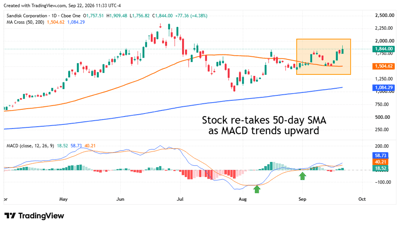
Both the MACD and signal lines have moved into positive territory, giving buyers an all-clear sign to re-enter the trade. The stock is trading near its highest level since its July all-time high, and the 50-day moving average is once again acting as support. The next catalyst for SNDK will be Micron’s fiscal Q4 2026 print on Sept. 30, which will offer clues about NAND and DRAM pricing trends.
Analysts Are Punting Their Calls Into the Next Quarter After Adobe’s Mixed Earnings
Submitted by Dan Schmidt. Originally Published: 9/14/2026.

Key Points
- Adobe reported an earnings beat and raised guidance, but shares still fell as underlying growth appeared weaker once the Semrush acquisition's contribution was excluded.
- Management declined to offer fiscal 2027 guidance, prompting a mixed analyst response with some price targets rising and others, including JPMorgan Chase and Jefferies, being cut.
- ADBE shares have broken below key technical levels, including the 50-day and 200-day moving averages, with the RSI signaling sellers remain in control.
- Special Report: Everyone wanted SpaceX. Smart money wants this.
The software business is a tough industry these days. A $100 billion company trading at 14 times earnings can report a double beat and raise guidance, yet its stock might still sell off afterward. That’s exactly what happened to Adobe Inc. (NASDAQ: ADBE) when it reported its fiscal Q3 2026 results after hours on Sept. 10.
The stock had been slowly recovering some of its losses over the last few months but was still down nearly 30% for the year. Despite the strong headline numbers, this earnings report did little to dispel market fears.
M&A Made Headline Numbers Appear Stronger Than Reality
I'm giving you a space stock today. Free. (Ad)
On December 8th, $600 billion in frozen SpaceX stock comes loose. Dylan Jovine says one simple purchase in any regular brokerage account gives investors exposure to SpaceX and 66 of its neighbors, without an IPO allocation.
He is also naming two space stocks he would consider dumping before December, plus a $14 stock that Elon has personally put his name on.
Get the free space ticker before the December 8th unlockWhen Adobe’s fiscal Q3 2026 results first hit the screen, they appeared to show a clean-cut beat. The company reported record quarterly revenue of $6.76 billion, up 12.9% year over year (YOY).
Earnings per share (EPS) also surpassed expectations, total ending annualized recurring revenue (ARR) rose 11.2% YOY to $27.50 billion, and management raised its full-year 2026 EPS and revenue projections ahead of the final fiscal quarter. However, the total ending ARR figure was inflated by the Semrush acquisition and deserves closer scrutiny.
Earlier this year, Adobe acquired Semrush for $1.9 billion, with the transaction closing in Q2. Management projected that Semrush would add $480 million in ending ARR, and fiscal Q3 was the first full quarter in which Adobe realized that contribution. Subscription revenue from Semrush was projected at $280 million for the period. If you subtract the M&A-related portion of ending ARR from the total, the resulting growth rate is in the single digits, not 11.2%. Management admitted that its push to add new members through “freemium” products contributed to a 36%-37% YOY decline in new net ARR, which likely caused the sell-off. Current remaining performance obligation (cRPO) growth of 9% also lags revenue growth, suggesting that forward demand is slowing relative to recognized revenue.
Guidance Projections Have Analysts Punting to Q4
The market hoped for color on fiscal 2027 projections, but management offered only fiscal Q4 updates and deferred all 2027 commentary. Management expects fiscal Q4 revenue of $6.80 billion to $6.85 billion, bringing its full-year 2026 projection range to $26.58 billion to $26.63 billion. Year-end operating margin is projected at approximately 45%, with full-year EPS between $18.12 and $18.17.
Analysts weren’t impressed with the guidance, especially since the company failed to provide any 2027 projections amid its freemium software push. When information is scarce, the market tends to confirm its priors, and analysts kick the can down the road. That’s the pattern playing out in the analyst community following Adobe’s earnings results.
Of the 33 analysts covering ADBE shares, seven adjusted their price targets on the Friday after the conference call. Among the five who raised their targets, the average increased from $235 to $259. Meanwhile, JPMorgan Chase cut its target from $340 to $315, and Jefferies cut its target from $285 to $275.
The gap between price targets remains extreme, but it is closing as bullish analysts lower their targets and bearish analysts raise theirs. ADBE shares recovered some losses on Friday after the report, closing just above $250 per share. The average price target among the analysts who made post-earnings adjustments is $269, implying just 7% upside from Friday’s close. Analysts covering ADBE must be practicing for the NFL season, since these adjustments are the equivalent of punting their calls into the fourth quarter.
ADBE Daily Stock Chart Shows Decline Accelerating
ADBE shares briefly joined the software renaissance this summer, rising from $193 to $293 in just over eight weeks. However, the stock is still down more than 25% over the last 12 months. When the calendar flipped to September, buyers fled the stock like beachgoers leaving their rentals after Labor Day.
The stock closed lower in six of the seven trading sessions preceding earnings as traders began parsing the odds of a potentially poor report. Now, a few key technical levels are in jeopardy, threatening to intensify the decline further.

ADBE briefly poked its head above the 200-day moving average at the end of August, but the move turned out to be a bull trap, and the stock quickly retreated below this crucial level. Making matters worse, the 50-day moving average was breached for the first time since mid-July during the after-hours session following the earnings release.
The relative strength index (RSI) confirmed the downward momentum by falling below the bearish threshold of 50, indicating that sellers are once again firmly in control of the stock. Investors should watch the RSI for any oversold signals that could trigger a rebound. However, the stock will likely need to retake the 200-day moving average to regain sustained upward momentum.
This email is a paid advertisement for Brownstone Research, a third-party advertiser of Earnings360 and MarketBeat.
If you need help with your account, please feel free to contact MarketBeat's U.S. based support team at [email protected].
If you no longer wish to receive email from Earnings360, you can unsubscribe.
Copyright 2006-2026 MarketBeat Media, LLC. All rights reserved.
345 North Reid Place, Suite 620, Sioux Falls, S.D. 57103-7078. United States..