 A Message From Base Camp Trading Hi Trader, Most “gurus” who teach beginners how to trade options start in the wrong place… Because they immediately launch into complicated concepts like Greeks, spreads, and implied volatility. And before long, most new traders are completely lost… and move on. The free guide I want to share with you today takes a different approach. Instead of overwhelming you with technical details… It starts with the basics and shows you exactly how options work, why traders use them, and how they can fit into a simple trading plan. If you’ve ever wanted to understand options but didn’t know where to start... This is your chance. Click here and get your free copy now. To your trading success, Dave Aquino
Lead Options Trader, Base Camp Trading
This Week's Featured Story 3 Dividend Kings to Buy While They’re Still Beaten DownWritten by Thomas Hughes. Article Posted: 9/14/2026. 
Key Points- Three Dividend Kings, Target, Hormel, and Procter and Gamble, appear undervalued after setbacks, offering potential for market-beating total returns.
- Target's stock trades near a four-year high following improved traffic and comps, with analyst price targets trending upward toward the mid-$180s.
- Hormel and Procter and Gamble both show depressed valuations alongside signs of stabilization, including heavy institutional buying and improving retail market share.
- Special Report: The $100 Stock Behind Elon's Next Move
Dividend Kings are not always good buys. While they are always good to hold, cyclicality can boost valuations and depress yields, setting the stage for poor long-term returns. The trick is finding these stocks when they’re down or, even better, in the midst of a rebound. Dividend Kings in this position offer attractive valuations and yields that can produce market-beating total returns over time. Total returns matter most for retirement accounts because they measure wealth building, including both capital appreciation and dividend income. In this scenario, savvy investors can use those dividends to compound their positions and accelerate annual returns. Target Is in the Midst of a Structural RecoveryTarget’s (NYSE: TGT)dividend-increase history spans more than 50 years, and the company is positioned to continue its annual increases, given its financial health, cash flow and business-growth outlook. The 2026 narrative is that Target is recovering from structural missteps that drove shoppers away. Now, they’re coming back, and that improvement is reflected in the results. The Q2 results revealed a second consecutive quarter of growth, with outperformance underpinned by improved traffic. Comparable sales grew 3.8% on a 3.6% increase in traffic, prompting management to raise guidance. The guidance isn’t robust, but it aligns with a recovery and is likely to be cautious, given the return of shoppers. Analyst trends are central to the stock’s recovery because they reflect the turnaround. The Q2 report triggered numerous revisions, including upgrades and price-target increases, strengthening sentiment and pushing the stock’s rating toward the high end of the price-target range. MarketBeat tracks 32 analysts with current ratings on TGT, with 56% of ratings at Hold and 35% at Buy. The consensus target offers little upside as of mid-September, but the trend is what counts: Consensus is up compared with last year, last quarter and last month, while high-end targets reach the mid-$180s. 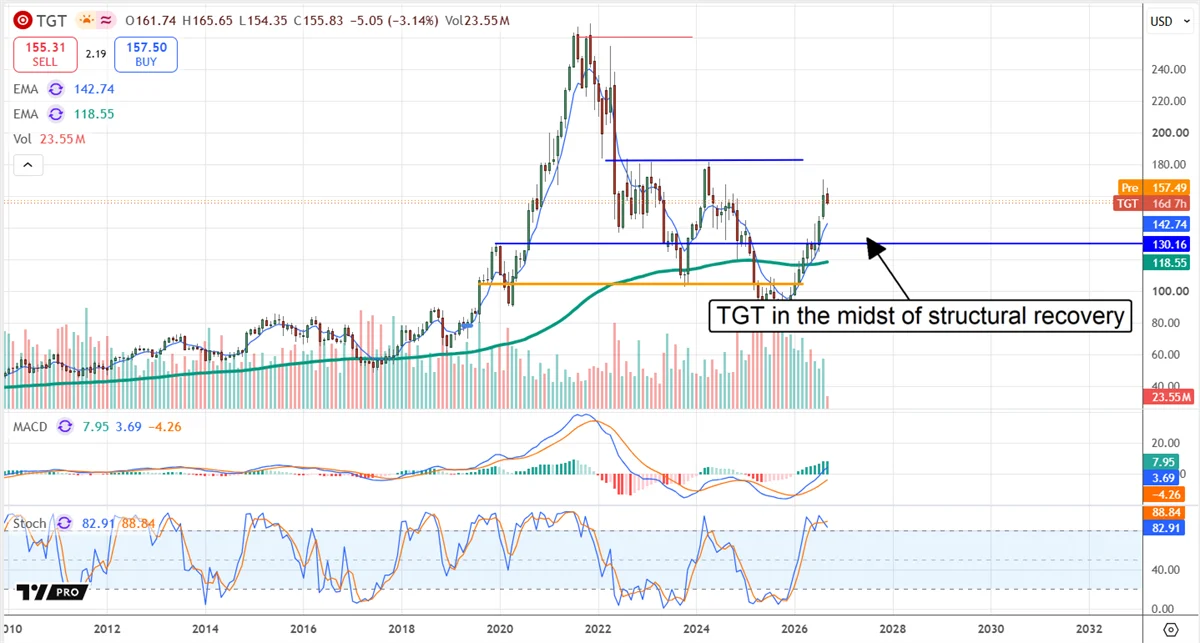
The mid-$180s would put TGT stock at a four-year high, above a critical pivot point. In this scenario, Target’s stock is on track for a full price recovery and may reclaim its all-time high of $260 within the next few years. The dividend yields approximately 3% at recent prices. Hormel Stock Trades Below Its Decade LowHormel (NYSE: HRL) faces headwinds from changing consumer habits, rising costs and margin pressure. Weak results and guidance cuts depressed the stock to a decade low, pushing its valuation toward the low end of its historical range and its dividend yield toward the high end. The dividend, which yields more than 5.5%, is reliable, as the company is a Dividend King with a management team committed to returning capital. Reported earnings and trailing-12-month payout ratios make the dividend look barely covered. However, cash flow is sufficient to fund operations while returning capital to shareholders. The pace of increases is likely to be slow in the coming years, but the high yield and potential share-price gains could offset that slower growth. Hormel is more than 50% below its highs, 10% below analysts’ low-end target and sitting on solid support. That support dates back to a 2013 continuation signal and is highlighted by increased volume. 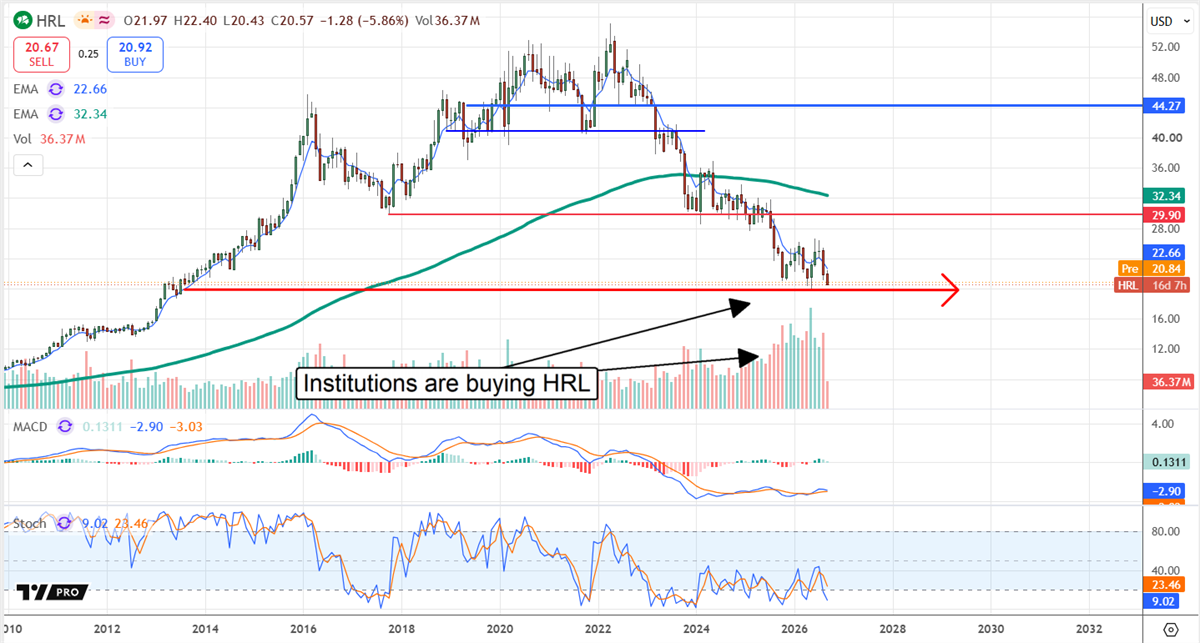
Institutions, including the Hormel Foundation, own more than 90% of the stock and have been accumulating shares over the past few quarters. These investors—particularly the Hormel Foundation, which uses its dividends to support philanthropic work—help ensure that the company remains focused on its long-term, capital-returning goals. Procter & Gamble on Track for Structural Market Share RecoveryProcter & Gamble shares are down because of weak results, margin pressure, consumer headwinds and valuation concerns, but those factors are not what investors should focus on today. Procter & Gamble shares now trade at a depressed valuation, offer a reliable dividend yield of 3% and are poised for a quiet reacceleration in market share and growth. Management highlighted an interesting detail during a recent earnings conference call and a subsequent investor event: Among P&G’s largest U.S. retail customers, the share of customers that were holding or gaining market share climbed from under 10% in the first half of the fiscal year to around 50% in the second half. That improvement points to renewed momentum in P&G’s biggest and most profitable market. In this environment, the company has two levers for growth: its own efforts and those of its retail customers. 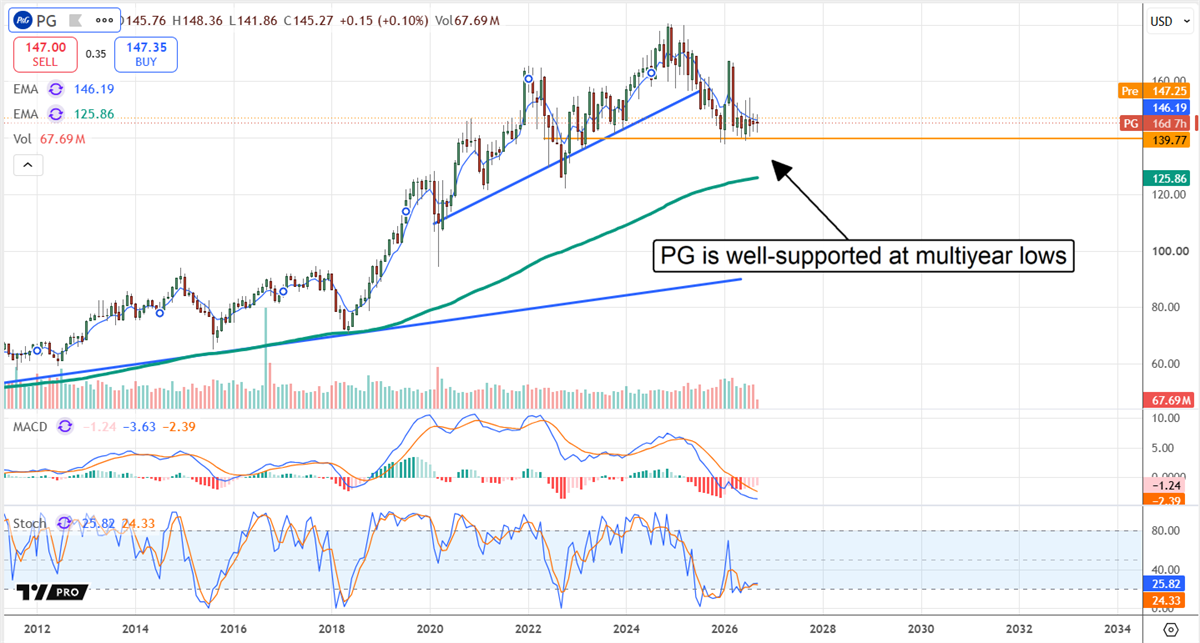
Analysts show conviction in this play, with 24 analysts contributing to a consensus rating of Moderate Buy and a 54% Buy-side bias in the data. The group has been trimming price targets in 2026, but those targets still provide a floor for price action, with the low-end target at $145. The $145 target aligns with the stock’s bottoming action and is unlikely to be broken. Institutions are gobbling up shares. . | 


