

John,
We can't recycle our way out of all this plastic.
For decades, we've been told a simple story: Just place your plastic bottles and containers into the blue bin and they will be recycled.. But when you look past the chasing arrows symbol, the reality is a lot different.
Recycling can play a valuable role in keeping waste out of our communities, but it's no silver bullet, especially when it comes to plastic. Let's take a look at three sobering truths about plastics recycling:
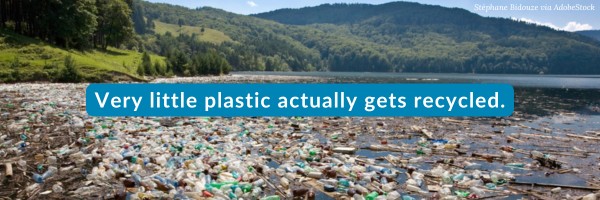
Plastic bags. Plastic bottles. Plastic packaging.
Single-use plastics have taken over our world. We use them for just a few moments, then they end up as trash clogging our oceans, polluting our roadsides and littering our green spaces for centuries.
That's in part because recycling systems can't keep up with all this plastic, and most of it isn't designed to be recycled in the first place. In fact, less than 10% of plastic ever created has been recycled.1
We can't recycle our way out of a problem this big. The most practical and effective way to halt plastic pollution is to reduce the amount of throwaway plastic produced in the first place.
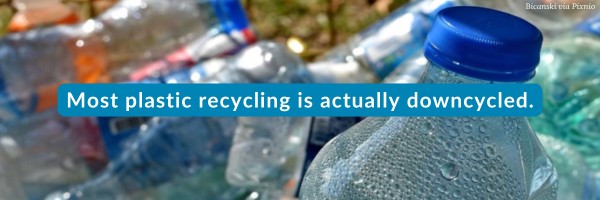
Plastic just isn't built for endless recycling.
Unlike glass or aluminum -- which can be melted down and reused without losing quality -- plastic breaks down every time it's recycled. In fact, most types of plastic can only handle a handful of trips through the recycling plant before the material gets too weak to recycle again. Some can't ever be recycled at all.2
Because of this constant degradation, most plastic is downcycled. Instead of making another bottle from an old bottle, the material is demoted into park benches, polyester clothes, plastic lumber or other low-quality, dead end items.3
Sure, downcycling keeps waste out of landfills a little longer. But it's not fixing the root problem of too much plastic.
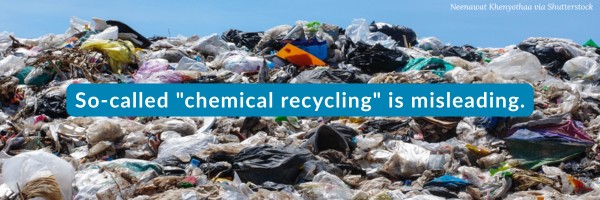
The plastics industry frequently promotes so-called "chemical recycling" as the next big thing in plastics recycling. But "chemical recycling" is just a new term for an old and dirty practice: incineration.4
These energy-intensive facilities rarely turn old plastic into new plastic. Instead, they primarily heat plastic waste to convert it into low-grade fuels to be burned. Burning this fuel means more air pollution, more asthma attacks and more lung disease.5
When it comes to reducing plastic waste, recycling alone just isn't going to cut it. . When 400 million tons of new plastic are entering our world every year, the only true and lasting solution is to produce less plastic to begin with.6
That's why U.S. PIRG and our national network are advocating for real solutions to plastic pollution, from convincing corporations to make and use less plastic in the first place, to phasing out the worst uses of single-use plastics at the state level, and holding polluters accountable.
Thank you for standing with us,
Faye Park
President
P.S. We're working to attain real solutions to plastic pollution. Will you help power this work with a donation?
1. Kelly Leviker and Celeste Meiffren-Swango, "Are plastics recyclable?" PIRG, March 1, 2025.
2. Kelly Leviker and Celeste Meiffren-Swango, "Are plastics recyclable?" PIRG, March 1, 2025.
3. Kelly Leviker and Celeste Meiffren-Swango, "Are plastics recyclable?" PIRG, March 1, 2025.
4. Celeste Meiffren-Swango, Grace Vickers, James Horrox and Carol Li, "Chemical recycling": What you need to know." U.S. PIRG Education Fund, July 14, 2025.
5. Janet Domenitz, "A new EPA move on chemical recycling would hike pollution," PIRG, April 27, 2025.
6. "Fast Facts -- What is Plastic Pollution?" United Nations, last accessed September 1, 2026.
Your donation will power our dedicated staff of organizers, policy experts and attorneys who drive all of our campaigns in the public interest, from banning toxic pesticides and moving us beyond plastic, to saving our antibiotics and being your consumer watchdog, to protecting our environment and our democracy. None of our work would be possible without the support of people just like you.
Join us on Facebook | Follow us on Twitter
U.S. PIRG, Main Office: 1543 Wazee St., Suite 460, Denver, CO 80202, (303) 801-0582
Federal Advocacy Office: 600 Pennsylvania Ave. SE, 4th Fl., Washington, DC 20003, (202) 546-9707
Member Questions or Requests: 1-800-838-6554.

If you want us to stop sending you email then follow this link -- unsubscribe.