| Unsubscribe |
This has been disseminated on behalf of Starfighters Space.

FJET: The Small-cap Space Name Flying Under the Radar!
While SpaceX and other mega-cap aerospace companies dominate the space race, Starfighters Space (NYSE: FJET) is targeting a far more specialized and potentially critical piece of the industry.
FJET operates what it describes as the world's only commercial fleet of flight-ready Mach 2+ F-104 Starfighter aircraft, giving the company a rare platform for high-speed flight testing, captive-carry missions and aerospace research.
Its “Wind Tunnel in the Sky” concept is designed to put experimental hardware into real high-speed atmospheric conditions, while its relationships across the aerospace and defense ecosystem give the company exposure to growing demand for hypersonic testing, advanced propulsion and next-generation defense technologies.
But FJET isn't stopping at testing. The company is developing STARLAUNCH, an air-launched system targeting suborbital missions, while new collaborations with Vaya Defense & Space and The Bionetics Corporation could expand its capabilities across propulsion, hypersonic test articles and payload processing.
With commercial space, hypersonics and defense spending all attracting major attention, FJET offers investors a different way to play the broader aerospace boom, not by trying to become the next SpaceX, but by building specialized infrastructure that could help the next generation of aerospace technology get tested, validated and ultimately launched.
Roper Technologies In Rebound and a Hot Buy Despite Insider Selling
Reported by Thomas Hughes. Posted: 9/9/2026.

Key Points
- Roper insiders sold shares near depressed summer levels, but the company’s Q2 results and guidance increase point to stronger fundamentals.
- Roper’s niche software businesses, AI product development and recurring revenue profile help counter broader SaaS disruption fears.
- Buybacks, dividend growth and expected Indicor proceeds support the capital-return case, though acquisitions and integration remain key risks.
- Special Report: Forget SpaceX. Buy the company Musk can't replace.
Roper Technologies (NASDAQ: ROP) insiders raised eyebrows over the summer by selling shares near long-term lows. The move ran counter to the fundamental signals in the Q2 earnings report, which suggested deep value and the potential for a rebound that has since begun.
The takeaway for investors is that insider activity isn’t always the signal that headlines make it out to be, and investors should consider other factors before making investment decisions. In this case, insider sales are a red herring that distracts the market from an otherwise bullish opportunity.
Roper Technologies Is Immune to SaaS-Pocalypse Disruption
Silver's record run faded but this project never slowed (Ad)
Silver is up more than 50 percent over the past year, yet interest has faded since its January record.
The metal gave back roughly half that move and most traders moved on to other trades.
One explorer kept its drill rig running through the pullback, working the site while attention was elsewhere.
See what this silver explorer has been drilling forRoper Technologies is the holding company for a diversified portfolio of application and network software businesses, as well as technology-related manufacturers. The 2026 narrative is that its stock price imploded because of SaaS-Pocalypse fears that have since proved unfounded. Roper Technologies has a sizeable moat, providing critical niche software for heavily regulated industries, including healthcare and insurance.
While AI model developers or customers’ internal efforts could disrupt its business, Roper is well established in industries where switching vendors after implementation is difficult, at best. Roper’s advantage lies in its ability to deliver AI functionality through its existing framework, enabling faster time to market and lower costs for customers.
Highlights from H2 2026 include persistent outperformance, continued growth and improving guidance. The company raised guidance at the end of both quarters, signaling improving momentum and a likely continuation into the second half of the year. Key highlights include accelerating earnings growth and ample cash flow to support robust buybacks. Executives took advantage of improved cash flow and low share prices to repurchase shares aggressively, reducing the share count by 8% over the trailing three quarters.
Roper Technologies Is Well-Positioned for Capital Returns
The only bad news is that aggressive share repurchases increased debt and reduced equity at the end of Q2. However, there is an offset: One of its portfolio companies sold an asset expected to generate more than $1.25 billion in cash for Roper Technologies. The company plans to use that cash to strengthen its balance sheet and prepare for future acquisitions. Even so, the balance sheet remains healthy, with total liabilities below 1x equity, net long-term debt just above 0.5x equity, and liabilities below 0.5x assets. The likely outcome is that Roper will continue generating cash, enabling it to execute its strategy, including acquisitions and capital returns.
Capital return includes dividends. The dividend isn’t substantial, yielding about 0.8% with shares well off their highs, but it is reliable, and distributions are expected to grow annually. The company pays less than 20% of its adjusted earnings outlook and has increased its payment annually for more than three decades. In this scenario, the stock is a Dividend Champion on track to become a Dividend King, as reflected in analyst and institutional activity.
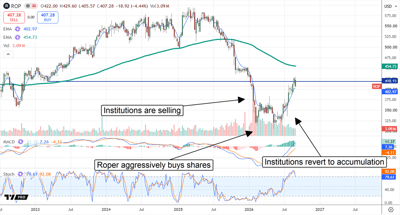
Analysts and Institutions Underpin Support and Drive Price Rebound
Analyst data shows relatively firm conviction in the stock, with 19 analysts tracked. They rate ROP as a Hold, with only three sells logged and an approximately 37% buy-side bias. Activity was mixed following the Q2 release in July, including some downgrades and price-target reductions, but it also included numerous upgrades and price-target increases. The activity ultimately affirmed the Hold rating and consensus price target of $466. That implies roughly 15% upside as of early September, while many individual targets are substantially higher.
Institutional activity is more bullish, with institutions owning more than 90% of the stock and accumulating shares aggressively in early Q3. InsiderTrades data shows selling in Q1 and Q2 but a return to accumulation in Q3, with activity surging to a multiyear high in line with the stock price rebound.
Stock price action suggests the stock topped in September. ROP moved above $418 for the first time since early January, triggering a selling event. The price action confirmed resistance at a critical target, setting the stage for an inflection later this year. The stock may pull back as deeply as $375 before making another attempt at fresh highs, but new highs are likely given the company’s growth, outperformance and capital returns. Assuming a move to fresh highs, the technical targets match the magnitude of the reversal pattern—about $100—indicating a move toward the $518 region within two to three quarters.
The company’s biggest risk is acquisition integration. Because it focuses on earlier-stage companies, it faces a higher risk of missteps and delays. However, its solid track record somewhat mitigates that risk. Roper focuses on high-margin, asset-light businesses within its target verticals. Rather than rushing into integration, the company tends to leave existing management in place, allowing acquired businesses to grow independently while Roper explores synergies and other opportunities.
Can ServisFirst Keep Delivering?
Reported by Peter Frank. Posted: 9/17/2026.

Key Points
- ServisFirst Bancshares posted strong second-quarter results, with net income up 39.7% year-over-year and an expanding net interest margin.
- Analysts hold a consensus Buy rating on the stock, with an average price target of $47.67 suggesting roughly 16% upside.
- Rising nonperforming loans and heavy geographic concentration in Alabama and Florida pose risks despite the bank's efficient, high-return operating model.
- Special Report: Forget SpaceX. Buy the company Musk can't replace.
ServisFirst Bancshares (NYSE: SFBS) has spent two decades building a reputation as one of the leanest, fastest-growing business banks in the Southeast.
That reputation appears to be paying off, as analysts rate the regional bank a Buy.
98 of the top 100 cryptos rose last week (Ad)
The week that the Clarity Act vote failed, 98 of the 100 coins in CoinDesk's benchmark crypto index closed higher. That is not a Bitcoin rally… that's the entire market moving at once.
Solana ran 10%. XRP gained 7%. Hyperliquid jumped over 12%. Layer-2 names like Starknet and Arbitrum climbed more than 17% in a single day. Zoom out and it gets clearer. Over the past month, Ethereum is up 35%. Solana is up 41%.
That kind of breadth… money spreading across hundreds of coins instead of crowding into one… is what the beginning of an altcoin cycle looks like.
Reveal my #1 crypto under $1 now.A stock split, a set of high-profile index additions and some of the strongest quarterly numbers the bank has posted in years arrived even as the broader regional banking group wobbled under the weight of rising Treasury yields.
With analysts projecting meaningful 12-month upside for the stock and higher rates potentially on the horizon, ServisFirst’s operating momentum is worth the attention of bank-sector investors.
Stock Split and Index Additions Boost Visibility
The shareholder event of the year came on July 20, when the board declared a two-for-one stock split in the form of a stock dividend, with post-split trading beginning Aug. 21. Management framed the move as an effort to broaden the shareholder base and improve trading liquidity.
Around the same time, index provider FTSE Russell added the stock to the Russell 2000 Value, Russell 2500 Value, Russell 3000 Value and related value benchmarks in its June 2026 reconstitution. The move typically brings in new institutional buyers that track those funds.
Earnings Show Strong Momentum
Underneath the corporate action, the underlying banking business had a strong second quarter.
Net income for the quarter rose 39.7% year over year to $85.8 million, while diluted earnings per share came to 79 cents, or $1.57 on a pre-split basis, up 40.2% from $1.12 a year earlier.
Net interest income climbed 18% to $155.6 million, while the net interest margin expanded to 3.63%, up 53 basis points from a year ago.
Loan growth remained brisk, with total loans increasing by $533 million, or 15% on an annualized basis, in the second quarter to $14.48 billion. Deposits grew 5% to $14.55 billion, providing funding for that expansion.
Profitability metrics also stand out for a bank this size. The company’s efficiency ratio was just 29.65%, down from 33.46% a year ago. Its annualized return on average assets was 1.91%, while its return on common equity was 17.71%.
Those results build on a strong full year in 2025, when both net income and earnings per share climbed sharply from the prior year.
Growth and Efficiency Strengthen the Bull Case
That combination of double-digit loan growth, expanding margins and a sub-30% efficiency ratio is the core of the bull case.
ServisFirst runs a low-overhead, relationship-banking model that avoids the branch bloat of larger regional peers. It has been methodically extending that formula beyond Alabama into Florida, Georgia, Tennessee and the Carolinas, opening a new office in Panama City, Florida, in May and now operating 35 full-service banking locations across eight states.
The bank was also recently ranked sixth nationally among banks with $10 billion to $50 billion in assets for overall performance. That kind of organic expansion, funded without heavy reliance on brokered deposits or Federal Home Loan Bank advances, is an interesting differentiator for investors seeking growth in the banking sector.
Share Gains Raise Valuation Questions
Much of that growth has already occurred. Although the company’s stock is up just 3% over the past three months, it has increased 15% since the start of the year. It hit a 52-week high of $46.04 in mid-August.
For income investors, the board also raised the quarterly dividend 13.4% in December 2025. On a post-split basis, the stock now pays 19 cents per share quarterly. The resulting yield of about 1.8% is modest, but a 10-year streak of consecutive increases and a conservative payout ratio of about 26% suggest room for further hikes.
Analysts See More Upside Ahead
Wall Street analysts are generally impressed. With a consensus rating of Buy, one analyst covering the stock rates ServisFirst a Strong Buy, three suggest a Buy and one recommends a Hold.
The stock carries a 12-month average price target of $47.67, representing roughly 16% upside. With the highest price target at $48.50 and the lowest at $47, there appears to be little disagreement about the company’s future prospects.
Credit Quality and Concentration Pose Risks
Still, some skepticism is warranted before chasing this stock.
Credit quality deserves a watchful eye. Nonperforming loans more than doubled from a year ago to $171 million, while the allowance for credit losses rose nearly $8 million to $181.9 million over the past three months. Those figures are a reminder that rapid loan growth in commercial real estate and business lending carries risk. The company said one large real estate-secured relationship led to the second-quarter increase in nonperforming assets.
Geographic concentration is another factor. Nearly all of ServisFirst’s loan book is concentrated in Alabama, Florida and a handful of neighboring states, leaving it more exposed than diversified peers such as Pinnacle Financial Partners (NYSE: PNFP), SouthState (NYSE: SSB) and Ameris Bancorp (NYSE: ABCB) to a regional downturn.
ServisFirst Needs to Sustain Its Momentum
Even with those risks in mind, ServisFirst looks like a well-run, high-return regional bank.
The split and index inclusions are more about liquidity and visibility than fundamentals, but the underlying growth in loans, deposits and net interest margin is real and difficult for larger, slower-moving peers to replicate.
For patient investors comfortable with regional-bank volatility and rate sensitivity, the current pullback from the 52-week high could offer an attractive entry point.
Yet with the future path of Fed policy and Treasury yields uncertain, and given the bank’s regional concentration, investors may want to keep watch. This growth-oriented regional bank still needs to prove it can sustain its momentum through a full interest-rate cycle.
This email message is a paid advertisement provided by Trading Wire, a third-party advertiser of Earnings360 and MarketBeat.
We are not securities dealers or brokers, investment advisers or financial advisers, and you should not rely on the information herein as investment advice. Any investment should be made only after consulting a professional investment advisor and only after reviewing the financial statements and other pertinent corporate information. Further, readers are advised to read and carefully consider the Risk Factors identified and discussed in the profiled company's SEC and/or other government filings. Investing in securities, particularly microcap securities, is speculative and carries a high degree of risk.
If you need help with your subscription, please don't hesitate to email our U.S. based support team at [email protected].
If you no longer wish to receive email from Earnings360, you can unsubscribe.
© 2006-2026 MarketBeat Media, LLC. All rights reserved.
345 North Reid Place, Suite 620, Sioux Falls, S.D. 57103-7078. U.S.A..