Hello,
Welcome to our flagship newsletter, MarketBeat Daily Ratings.
We'll deliver the latest "Buy" and "Sell" ratings from Wall Street's top-rated analysts directly to your inbox each morning.
But first, we need you to do two quick things:
1. Hit reply, and send a simple "Yes." Just one word. This tells Google (and other emails providers) that you actually want to get our newsletter.
2. After that, this link to confirm your subscription. That will tell us that you received our welcome email and that we should start sending your daily report.
Confirm your subscription here.
After you have completed these two steps, we would like to gift you a free copy of one of our most popular investing reports: 7 Stocks to Buy and Hold Forever. You can download the report with this link.
Thank you again for subscribing. We look forward to being an important part of your investing journey

Matthew Paulson
Founder and CEO, MarketBeat.
P.S. If you didn’t intend to subscribe, no problem—you can unsubscribe with this link.
(ARReply-161)
Special Report Thor Industries Is Boring—And That May Be Its Biggest AdvantageWritten by Thomas Hughes. First Published: 9/23/2026. 
Key Points- Thor Industries shares are trading near the low end of their range, yielding about 3% while facing an industry-wide slump in RV demand.
- Despite an 8.4% revenue decline and margin contraction in fiscal Q4 2026, Thor remained profitable and gained market share in a weak environment.
- Institutional investors have bought shares every quarter in 2026, and analysts maintain a Hold consensus with price targets implying nearly 20% upside.
- Special Report: Everyone wanted SpaceX. Smart money wants this.
Thor Industries (NYSE: THO) is not an exciting stock, but that lack of excitement is what makes it such an attractive buy-and-hold investment. Beyond its core business of manufacturing RVs, Thor Industries generates consistent cash flow that supports balance sheet health while funding dividends and share repurchases. The stock tends to trade within a wide range driven by consumer habits, which is where today’s opportunity lies.
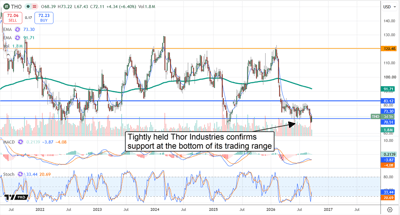
Thor Industries is in the midst of a major industrywide slump, and its stock price presents an attractive entry point near the bottom of its range. Weak discretionary spending is weighing on sales, particularly in domestic markets. This has pressured the stock price but has not impaired the company’s capital-return outlook. The takeaway is that THO shares yield approximately 3% while trading at rock-bottom prices and confirming support at a critical level.
Silver is up more than 50 percent over the past year, yet interest has faded since its January record.
The metal gave back roughly half that move and most traders moved on to other trades.
One explorer kept its drill rig running through the pullback, working the site while attention was elsewhere. See what this silver explorer has been drilling for Investors buying at the low end of this range could see a little more than 70% upside, in addition to the dividend, over the next few years. The dividend is reliable, represents less than 50% of next year’s projected earnings and is on track to increase annually. The company is a Dividend Achiever on track to become a Dividend Champion within the next 10 years.
Thor Industries Sacrifices Margins for Market Share GainsNear-term headwinds include contracting revenue and margins. Revenue in the fourth quarter of fiscal 2026 (FY2026) contracted by 8.4%, less than expected but still bad news for investors. Weakness was concentrated in the domestic market, where unit sales fell by double digits. Pricing, mix and the European segment offset some of the decline. European sales were a bright spot, rising 5%, and are expected to remain healthy, underpinning an outlook for roughly flat results next year.
Margins were another sore spot. Management says it is leaning into affordability measures, while rising material costs compounded the resulting margin pressure. Gross margin contracted by 230 basis points (bps), accelerating the decline in earnings and net income. The key point is that $40.8 million in net income was sufficient to support the company’s financial health, leaving it well positioned to execute its strategy and sustain capital returns in 2027. Additionally, the company gained market share, setting the stage for an accelerated recovery when RV markets stabilize.
Thor’s strategy includes realigning production and its business operations with industry demand. Executives do not expect a robust rebound soon but are confident in the company’s ability to recover margins once conditions stabilize. For now, Thor is not providing explicit guidance until after the fall industry events, when it expects to have greater visibility into what lies ahead.
Institutional Holders Exude Confidence in THO’s Cash-Returning CapacityInstitutional activity reflects strong confidence in THO’s outlook. Institutions own nearly 100% of the shares and have bought stock each quarter in 2026, ramping up activity sequentially to record levels as of late Q3. The increase is significant because it aligns with the confirmation of technical support, suggesting that downside may be limited.
With these factors in play, THO’s share price is unlikely to fall below $67.50 and is more likely to rebound as the year progresses. The question is how high it might rise by year-end and next year; the answer is modestly higher.
Analyst trends also reflect confidence in THO’s outlook. MarketBeat tracks 14 analysts with current ratings, enough to support moderate conviction in the outlook. The consensus rating is Hold, with no Sell ratings and a 21.4% Buy-side bias. More importantly, price targets suggest almost 20% upside at the consensus, and even the low end of the range offers some upside.
The biggest risk now is how long the slump lasts and how it affects investor sentiment. Management is not expecting much, but the stock needs an eventual recovery to return to the high end of its trading range. The trigger is likely to be external, linked to oil prices and the Fed, which are weighing on consumer discretionary spending.
The best-case scenario is that oil prices return to the low end of their range within the next quarter or two, and there is a case for that happening. Industry workarounds and increased non-OPEC production raise the risk of a supply glut next year, which could undermine oil markets and inflationary trends. Thor’s catalysts include its North American model restructuring, which is intended to simplify its cost structure, and substantial dealer inventory reductions that could help sustain order volume. |