Hello,
Welcome to our flagship newsletter, MarketBeat Daily Ratings.
We'll deliver the latest "Buy" and "Sell" ratings from Wall Street's top-rated analysts directly to your inbox each morning.
But first, we need you to do two quick things:
1. Hit reply, and send a simple "Yes." Just one word. This tells Google (and other emails providers) that you actually want to get our newsletter.
2. After that, this link to confirm your subscription. That will tell us that you received our welcome email and that we should start sending your daily report.
Confirm your subscription here.
After you have completed these two steps, we would like to gift you a free copy of one of our most popular investing reports: 7 Stocks to Buy and Hold Forever. You can download the report with this link.
Thank you again for subscribing. We look forward to being an important part of your investing journey

Matthew Paulson
Founder and CEO, MarketBeat.
P.S. If you didn’t intend to subscribe, no problem—you can unsubscribe with this link.
(ARReply-161)
Additional Reading from MarketBeat Media Oracle’s AI Spending Is Still Huge, But the Payoff Is Starting to Show in EarningsAuthored by Thomas Hughes. Date Posted: 9/11/2026. 
Key Points- Oracle’s fiscal first-quarter revenue rose 30% as cloud infrastructure revenue surged 121% and remaining performance obligations reached $664 billion.
- Oracle generated a record $23 billion in operating cash flow, but free cash flow remained negative as data center spending stayed elevated.
- Oracle’s improving earnings leverage and swelling backlog support the AI monetization thesis, although debt, dilution, and capital spending remain important risks.
- Special Report: Forget SpaceX. Buy the company Musk can't replace.
Oracle’s (NASDAQ: ORCL) stock price is on track for a substantial recovery and a sustained upswing as the monetization of its AI ambitions begins.
Highlights from the Q1 fiscal year 2027 (FY2027) release reveal the effects of spending, capital raises and dilution, which were overshadowed by improving earnings leverage and cash flow. The likely outcome is that monetization of its AI network will accelerate in the coming quarters, while capital expenditures (CapEx) could begin to taper over time.
Moderna's stock doubled in a single day after its cancer vaccine hit key Phase 3 goals, and Merck jumped too. But according to a former Steve Cohen fund manager, the next big opportunity is not Moderna or Merck.
It is a different kind of company tied to a technology already backed by Elon Musk, Sam Altman, Jeff Bezos, and Peter Thiel. Nvidia's Jensen Huang says it will have a dramatic impact on daily life, while Anthropic's CEO believes it could unlock a century of medical progress in just ten years.
Nature Magazine estimates its potential value at $367 trillion globally, and it is already rolling out across the United States. Click here to learn about this new era of medical technology The result could be rapid profitability improvement, strong growth, accelerated earnings and, eventually, debt reduction—a quartet of bullish stock price catalysts.
Migration to Oracle’s Cloud Accelerates in FQ1Oracle’s results were robust across metrics, driving sequential and year-over-year revenue growth acceleration to 30%. Revenue of $19.35 billion outperformed MarketBeat’s consensus estimate by more than 100 basis points (bps), underpinned by strength in the cloud business and 850 megawatts of new GPU capacity. Total cloud revenue grew 62%, with infrastructure revenue up 121% and software-as-a-service (SaaS) revenue up 10%. By segment, Services grew 5% and Hardware grew 15%, while Legacy Software, now less than 30% of the business, contracted 3%.
The real news is in the margins and cash flow. After two years of accelerating spending, negative free cash flow, rising debt and shareholder dilution, the company is showing traction with its strategy. Backlog conversion contributed to significant improvement in operating and net income, both on a GAAP and adjusted basis, with both outpacing top-line growth. Key takeaways include a record $23 billion in operating cash flow, 55% growth in GAAP earnings per share, 30% growth in adjusted earnings and a sizable earnings beat versus consensus.
The only downside is that free cash flow remains negative because of intense data center demand. Oracle reported negative free cash flow of $5 billion in Q1 FY2027. The offset is that the backlog continues to swell, growing about 46% year over year (YOY) in the first quarter to $664 billion. More importantly, the company says the new orders do not translate into increased capital needs, meaning the revenue and earnings outlook has improved without requiring an increase to its existing capital-raising plan. Oracle said more than $30 billion in new AI cloud contracts booked during Q1 had no incremental impact on its capital-raising plans. Guidance reflects this improvement, with management citing a strong Q2 and raising its full-year targets while forecasting continued acceleration.
Analysts Highlight Oracle’s AI-Driven Inflection Point: Accelerating Growth AheadThe analysts’ response is mixed and includes at least one price-target reduction. However, that view is an outlier, given that most revisions are bullish. Commentary focused on the massive beats and guidance, which indicate that AI monetization is not only on track but progressing ahead of schedule. Barclays reiterated a Buy rating while anticipating accelerating earnings growth in the coming quarters.
At present, the 40 analysts MarketBeat tracks show high conviction in the Moderate Buy rating. The data reflects a 75% Buy-side bias, while the consensus price target, which was validated by post-release responses, implies nearly 65% upside from early September trading levels. In this scenario, analyst sentiment is firming and will likely continue to strengthen as the year progresses.
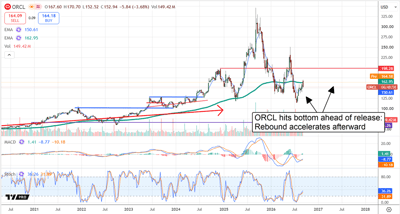
Oracle’s Stock Price Inflection Is HereStock price action is favorable. The late 2025 and early 2026 pullback was overdone and disconnected from the opportunity, and a reversal is now underway. The bottom appears to be near $130, which is now the critical support level. Indicators such as the stochastic oscillator and MACD align with Buy signals across multiple time frames. The hurdle is the long-term 150-week EMA near $135, which marks an inflection point for traders and reflects the stance of institutional and long-term investors. A move above that level would signal a shift in sentiment and clear the way for a fuller price recovery.
Institutions will make the difference because Oracle is a tightly held stock. The group owns more than 40%, a seemingly small figure until considering that insiders also own more than 40%. The risk is that selling, which dominated their activity in calendar Q2, will pick up again as the share price rises. However, that is less likely if profitability continues to improve. Early Q3 activity reflects a surge in buying, which is the more likely outcome. With this in play, institutional buying could help limit downside if price weakness returns.
Oracle’s biggest risks are debt and dilution, but they are becoming easier to absorb as growth accelerates. The surging backlog and monetization reduce those risks, leaving investors to wonder when share buybacks will resume. While buybacks are unlikely in 2027, 2028 is a possible target, as most of the planned capacity will be online or nearly operational by then. The dividend helps make up the difference, yielding about 1.3% at current prices near $150, and the distribution is expected to increase over time. Oracle does not raise its dividend annually but has a record of increasing it every few years. |