Hello,
Welcome to our flagship newsletter, MarketBeat Daily Ratings.
We'll deliver the latest "Buy" and "Sell" ratings from Wall Street's top-rated analysts directly to your inbox each morning.
But first, we need you to do two quick things:
1. Hit reply, and send a simple "Yes." Just one word. This tells Google (and other emails providers) that you actually want to get our newsletter.
2. After that, this link to confirm your subscription. That will tell us that you received our welcome email and that we should start sending your daily report.
Confirm your subscription here.
After you have completed these two steps, we would like to gift you a free copy of one of our most popular investing reports: 7 Stocks to Buy and Hold Forever. You can download the report with this link.
Thank you again for subscribing. We look forward to being an important part of your investing journey

Matthew Paulson
Founder and CEO, MarketBeat.
P.S. If you didn’t intend to subscribe, no problem—you can unsubscribe with this link.
(ARReply-161)
Today's Bonus Story Lennar's Q3 Miss Hides a Stronger Operating Story Beneath the Housing SlumpAuthored by Thomas Hughes. First Published: 9/18/2026. 
Key Points- Lennar's Q3 revenue fell 9.2% year over year to $8 billion and missed expectations, while adjusted cash flow dropped sharply to $294 million.
- Despite near-term weakness, Lennar continues aggressive capital returns through dividends and buybacks, supported by a resilient balance sheet with reduced debt.
- Analysts, institutions, and technical signals send mixed but generally supportive signals, suggesting Lennar may be near a bottom ahead of an eventual housing recovery.
- Special Report: Forget SpaceX. Buy the company Musk can't replace.
Lennar (NYSE: LEN) faces hurdles, but these are near-term issues that obscure what investors should focus on. The company is a cash-flow machine, sustaining aggressive capital returns while building a better business. Key takeaways from the Q3 report and conference call include lower construction costs and faster turnover. These improvements should enhance profitability and accelerate growth as the market recovers. Until then, the Even-Flow strategy is working. The company is sustaining volume despite market deterioration by offering incentives and gaining share as smaller operators are priced out of business.
Lennar’s capital return is substantial, even with the risk of a slowdown. As it stands, the dividend yields approximately 2.63% with shares trading near long-term lows, while buybacks are aggressively reducing the share count. The share count was down about 7% on average at quarter-end, giving investors significant leverage and offsetting the impact of buybacks on the balance sheet. Balance sheet highlights include reduced cash, although the company retains a sufficient amount to sustain operations and capital returns in upcoming quarters. Total assets were steady, while debt and liabilities declined. Equity contracted, but only mildly, given the reduction in shares outstanding and the subsequent addition to treasury shares.
Analysts and Institutions Give Mixed Signals, but Support Is SolidBill Poulos is giving away his Simple Options Trading For Beginners book through a temporary link. Once that link expires, it returns to its usual price of $29.97.
The content stays the same - plain-English lessons and a handful of proven techniques - only the price changes. Waiting means paying for something you could have gotten for free. Download your free copy before the link expires today. Analysts and institutions provide conflicting signals, with a consensus rating of Reduce and declining activity. However, analysts remain fairly confident. With 19 analysts covering the stock, Lennar appears to be an ownable stock, although September’s Q3 results may not make this the ideal time to enter. Meanwhile, institutional data reflects a reduction in overall activity more than a reduction in total holdings. Trailing 12-month activity shows an approximately $600 million bearish balance, worth about 3.3% of the September market cap, while total quarterly activity had declined to less than $100 million as of mid-Q3 2026. Institutions own more than 80% of the stock, reflecting strong confidence in its long-term, cash-generating opportunity.
Short interest is a concern in the near term. It isn’t astronomically high, but it reflects caution and hedging at more than 8%, a long-term high. The risk is that short-sellers will lean further into this trade and drive the stock to lower lows, but that scenario could also create an opportunity. Trading at 14 times current-year expectations puts LEN stock at the high end of its range, suggesting that lower share prices may be ahead. The longer-term outlook, however, prices in an eventual housing recovery and puts the stock’s valuation in the low single digits within five years, suggesting ample upside.
Bears are wrong to assume housing markets will remain frozen forever. While inflation, affordability concerns and interest rates are undercutting demand today, interest rates will eventually fall, unleashing historically high demand. Until then, Lennar’s strategy is focused on building houses to fill the void, using affordability to drive sales and cash flow while refining its processes. Looking forward, the company is well-positioned as a top-tier builder, commanding a massive share of the mid-tier market, the largest segment of housing in America.
Lennar Whiffs in Q3 Despite Structural ImprovementLennar’s Q3 results highlight the near-term risks. The company’s $8 billion in revenue fell 9.2% year over year and missed expectations because of lower pricing and traffic. New orders also fell 9%, but there was some good news: New orders slightly outpaced deliveries, setting the stage for stability in the upcoming quarter, if not growth.
Other details include reduced earnings power and cash flow. Adjusted cash flow fell by a solid double-digit percentage to $294 million, which was insufficient to cover capital returns. That is where the risks lie. In this scenario, the company’s balance sheet can help sustain returns, but it cannot do so forever. The upshot is that Lennar remains in a fortress-like position and can execute its strategy, including taking advantage of ultra-low stock prices. The question is when repurchases may slow and by how much. The answer is likely sometime in the coming year, with buybacks potentially falling by half or more.
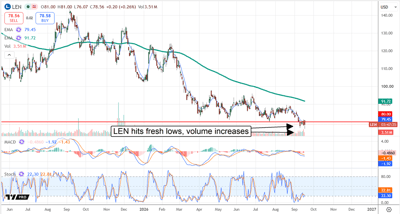
The post-release price action is as mixed as the quarterly details. Results triggered an initial pop, followed by selling and then a rebound, reflecting indecision. The technical signal is a falling wedge, which often signals a reversal. The best-case scenario is that Lennar is at its bottom and will begin to recover soon. However, it is unlikely to advance significantly and is more likely to reenter its trading range, which tops out near $90. The worst-case scenario is that Lennar’s support base shifts, the stock begins distributing shares and the market moves to fresh lows. That outcome is not expected. Factors suggesting the lows are in include increased volume as LEN reached fresh lows.
|