Hello,
Welcome to our flagship newsletter, MarketBeat Daily Ratings.
We'll deliver the latest "Buy" and "Sell" ratings from Wall Street's top-rated analysts directly to your inbox each morning.
But first, we need you to do two quick things:
1. Hit reply, and send a simple "Yes." Just one word. This tells Google (and other emails providers) that you actually want to get our newsletter.
2. After that, this link to confirm your subscription. That will tell us that you received our welcome email and that we should start sending your daily report.
Confirm your subscription here.
After you have completed these two steps, we would like to gift you a free copy of one of our most popular investing reports: 7 Stocks to Buy and Hold Forever. You can download the report with this link.
Thank you again for subscribing. We look forward to being an important part of your investing journey

Matthew Paulson
Founder and CEO, MarketBeat.
P.S. If you didn’t intend to subscribe, no problem—you can unsubscribe with this link.
(ARReply-161)
Additional Reading from MarketBeat Media Sandisk Joins the S&P 100—Is the Index Flow, or the AI Story, Driving the Stock?Author: Dan Schmidt. First Published: 9/23/2026. 
Key Points- Sandisk's addition to the S&P 100 index has minimal market impact since the stock was already included in the much larger S&P 500 index.
- Sandisk's stock surge is primarily driven by strong NAND demand and record fiscal Q4 2026 earnings, though margin growth and consumer segment revenue are decelerating.
- Analyst price targets vary widely, from $1550 to over $3000, reflecting uncertainty over whether Sandisk's earnings have reached a cyclical peak.
- Special Report: Forget SpaceX. Buy the company Musk can't replace.
Flash memory producer Sandisk Corp. (NASDAQ: SNDK) officially entered the S&P 100 this week, another accolade for the soaring stock and a move that places it alongside some of the market’s most prominent megacaps. Inclusion in major indices like the S&P 100 brings prestige, but it also means index-tracking funds must buy the stock.
The change was announced on Sept. 4, and the stock gained nearly 12% during that session before quietly surrendering those gains over the following week. Now, the stock is ripping higher again as indices rebalance at quarter-end. But how much of this bull case rests on S&P 100 inclusion? The answer is likely that the index rebalancing will have a minimal impact. Instead, the stock’s 2026 surge is a story of NAND demand and a company operating near the peak of its earnings cycle.
The Index Flow Is Relatively Small Compared to Average Daily Volume
Bill Poulos is giving away his Simple Options Trading For Beginners book through a temporary link. Once that link expires, it returns to its usual price of $29.97.
The content stays the same - plain-English lessons and a handful of proven techniques - only the price changes. Waiting means paying for something you could have gotten for free. Download your free copy before the link expires today. While Sandisk executives likely still broke out the champagne this week, S&P 100 inclusion is more of a badge of honor than a demand driver. Sandisk joined Dell Technologies Inc. (NYSE: DELL), Palo Alto Networks Inc. (NASDAQ: PANW), and Arista Networks Inc. (NYSE: ANET) in the index, replacing Colgate-Palmolive Co. (NYSE: CL), Nike Inc. (NYSE: NKE), Simon Property Group Inc. (NYSE: SPG), and Honeywell Aerospace (NASDAQ: HONA). The theme of these additions is clear: tech is in, while consumer goods and REITs are out.
But the major caveat is that Sandisk is already a member of the S&P 500, which is a far more significant event. The massive index funds that use the S&P 500 as a benchmark have already brought Sandisk into the fold, and adding it to the S&P 100 offers only an incremental layer of forced buying. Take the iShares S&P 100 ETF (NYSEARCA: OEF), for example. The cap-weighted fund has a market capitalization of just $20 billion, compared with the iShares S&P 500 Core ETF (NYSEARCA: IVV) and its $851 billion market cap. A stock like SNDK trades more than 15 million shares per day on average, so its average daily dollar volume exceeds OEF’s entire market capitalization. Inclusion in a fund like IVV can certainly move the needle, but based on market mechanics alone, addition to the S&P 100 is a non-event for SNDK shareholders.
NAND Demand Is Strong but Decelerating, and Company Valuation Implies Peak Earnings
Notably, the S&P 100 “pop” in SNDK shares also drew sympathy from other memory stocks like Western Digital Corp. (NASDAQ: WDC) and Micron Technology Inc. (NASDAQ: MU). An industry-wide move points to broader industry trends, and it appears the AI/NAND trade is once again driving the stock. But while NAND demand remains robust, pricing growth is slowing, and that trend is being reflected in the valuation.
There is no need to rehash the top-line numbers; SNDK smashed its fiscal Q4 2026 earnings report on Aug. 5, posting record revenue, record gross margins and record quarterly earnings per share (EPS). Data center revenue more than doubled quarter over quarter, and management raised its fiscal Q1 2027 revenue estimate to 18% above its previous projection. However, the consumer-driven segment declined 32% from fiscal Q3, and margin guidance for fiscal Q1 2027 is lower than the 84.6% reported in fiscal Q4 2026.
Gross margins above 80% are still spectacular, full stop. But the stock now trades at just nine times forward earnings, with a price-to-earnings growth (PEG) ratio of 0.18, implying that the market expects earnings to be near an absolute peak. NAND memory is typically a highly cyclical industry, and while data center revenue has disrupted the traditional business model, consumer demand for devices has fallen rapidly.
When will the music stop for SNDK shares? Even analysts aren’t sure. The consensus price target of $2,015 implies about 7% upside from current levels, but the average masks a wide discrepancy among analysts. Susquehanna and New Street Research both have targets above $3,000 for the stock, while Wells Fargo and Royal Bank of Canada have targets of $1,550 and $1,600, respectively.
Chart Shows Uptrend Regaining Strength Following Overbought Sell-Off
According to the daily chart, the music is still playing for now. After a downtrend reset prices across the AI trade, momentum has returned, and SNDK shares have recovered key technical milestones. A bullish crossover on the Moving Average Convergence Divergence (MACD) indicator signaled a bottom in early August, and the stock quickly resumed its ascent above the 50-day moving average.
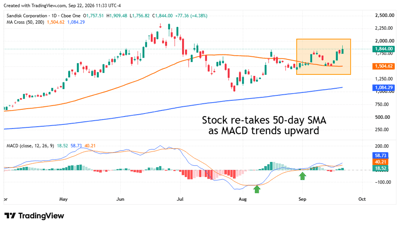
Both the MACD and signal lines have moved above zero, giving buyers an all-clear signal to re-enter the trade. The stock is trading near its highest level since its July all-time high, and the 50-day moving average is once again acting as support. The next catalyst for SNDK will be Micron’s fiscal Q4 2026 print on Sept. 30, which will offer clues about NAND and DRAM pricing trends. |