Hello,
Welcome to our flagship newsletter, MarketBeat Daily Ratings.
We'll deliver the latest "Buy" and "Sell" ratings from Wall Street's top-rated analysts directly to your inbox each morning.
But first, we need you to do two quick things:
1. Hit reply, and send a simple "Yes." Just one word. This tells Google (and other emails providers) that you actually want to get our newsletter.
2. After that, this link to confirm your subscription. That will tell us that you received our welcome email and that we should start sending your daily report.
Confirm your subscription here.
After you have completed these two steps, we would like to gift you a free copy of one of our most popular investing reports: 7 Stocks to Buy and Hold Forever. You can download the report with this link.
Thank you again for subscribing. We look forward to being an important part of your investing journey

Matthew Paulson
Founder and CEO, MarketBeat.
P.S. If you didn’t intend to subscribe, no problem—you can unsubscribe with this link.
(ARReply-161)
Exclusive Story from MarketBeat.com The September Scramble: Find Sanctuary in These 3 Defensive Dividend StocksBy Thomas Hughes. Published: 9/17/2026. 
Key Points- Amid rising inflation and interest-rate concerns, investors are gravitating toward defensive dividend stocks that combine strong balance sheets with pricing power.
- Casey's General Stores is diversifying into prepared foods, becoming the fifth-largest domestic pizza chain while maintaining 27 consecutive dividend increases and low debt.
- Johnson & Johnson's pipeline and MedTech repositioning support its Dividend King status, while PepsiCo's GLP-1-driven selloff has created a high-yield opportunity near 4.3%.
- Special Report: The company SpaceX cannot operate without
Fed uncertainty, oil prices, and macroeconomic pressures are bringing inflation and interest-rate fears to a head. Investors are fleeing to dividends, and for good reason: Dividends provide steady, reliable income and returns regardless of market volatility.
Defensive dividend stocks are even more attractive. These names tend to withstand higher interest rates and inflation and are especially prized by investors. Regardless of sector or end market, they share several characteristics, including healthy balance sheets, limited debt exposure, and pricing power tied to nondiscretionary products and services.
Bill Poulos is giving away his Simple Options Trading For Beginners book through a temporary link. Once that link expires, it returns to its usual price of $29.97.
The content stays the same - plain-English lessons and a handful of proven techniques - only the price changes. Waiting means paying for something you could have gotten for free. Download your free copy before the link expires today. Their stock prices aren’t immune to market malaise and can fall alongside the broader market. However, they tend to decline less during downturns and produce market-beating total returns over time, particularly for compounders. Compounding is critical because dividend reinvestment accelerates annual returns. The best defensive dividend stocks also buy back shares, supporting earnings-per-share growth while giving investors even more leverage.
Casey’s General Stores Is in the Midst of an Inflection
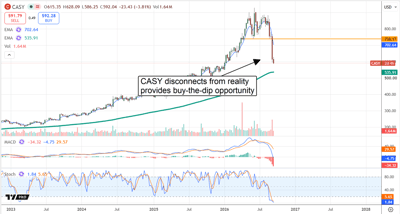
Casey’s General Stores (NASDAQ: CASY) is a poster child for buy-and-hold investing. The company is consolidating highly fragmented markets, expanding its convenience-store chain organically and through acquisitions, and doing so with very little debt.
Key details include the ability to self-fund growth, pay dividends, and buy back shares. These factors underpin the 2026 thesis, but they aren't the whole story, because the company is in the midst of a major transition.
Casey’s strategy includes inside sales, specifically food and, more specifically, hot prepared items such as sandwiches and pizza. Store-count expansion and the popularity of its pizza have pushed the company into the position of the fifth-largest domestic pizza chain, changing its fundamental nature. Casey’s is a convenience store and a gas station, but it is also a restaurant with solid margins, profitability, cash flow, and growth at a time when others are struggling.
Casey’s dividend isn’t substantial in terms of yield—about 0.4% as of mid-September—but it is exceptionally safe and expected to grow at a moderately aggressive pace in the coming years. Casey’s is a Dividend Champion with 27 consecutive increases, a low, sub-15% payout ratio, and a double-digit distribution growth rate. Share buybacks are also sustainable, reducing the share count incrementally each quarter. The biggest risks are expectations for additional acquisitions and the possibility that management will suspend buybacks to help cover the costs.
Johnson & Johnson, a King Among Dividend Payers
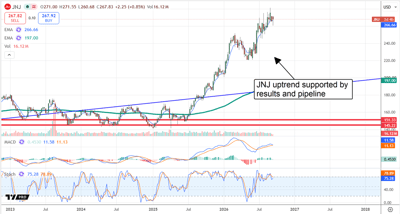
Johnson & Johnson (NYSE: JNJ) stock has risen in 2026 due to a combination of factors, from Kenvue’s spinoff to its strong pipeline.
The firm is repositioning around Innovative Medicine and MedTech, improving margins and accelerating sales of key therapies.
For investors, this means sustained cash flow, capacity for dividends, and the likelihood that moderately aggressive distribution increases will continue. Johnson & Johnson is a Dividend King with more than 60 consecutive increases. It pays out about 60% of earnings, with earnings expected to grow at a modest double-digit pace over the next five years.
The growth outlook has analysts bullish, underpinning the stock-price action and the market advance.
While consensus assumes fair value near the late-summer highs, positive trends support the high end of the range and the potential for fresh all-time highs. Catalysts include FDA approval of Icotyde and Imaavy, as well as positive trial results for several compounds treating blood cancers.
Dividend King PepsiCo Down on GLP-1 Medications
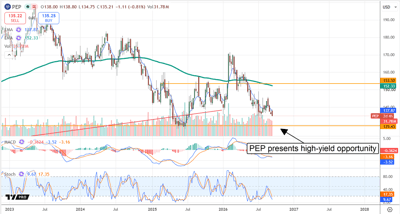
PepsiCo (NASDAQ: PEP) shares are suffering from GLP-1-related pressure as consumers snack less than before.
The caveat is that PepsiCo is a well-established consumer giant, the largest staples company in the market, and well-positioned to pivot. Efforts are already underway to realign with changing snacking trends, including protein-enhanced products designed to meet the needs of GLP-1 users and support modern health trends.
The market gets this company wrong because underlying metrics reveal slow, steady improvements, with strengths in key areas such as international markets.
Key details: 2026 results are sufficient to sustain financial health, pay dividends, buy back shares, and invest in growth.
PepsiCo uses debt as part of its strategy but mitigates this exposure with its strong balance sheet. Most of its debt is at fixed rates and is therefore unaffected by rate increases.
PepsiCo’s dividend is very attractive. The 2026 price weakness created a deep-value, high-yield opportunity, with PEP at the low end of its historical valuation range and the high end of its yield range. Trading at a mid-teens price multiple, PepsiCo’s stock price could rise about 65% on valuation alone while paying a 4.3% dividend yield.
Buybacks aren’t robust, but they reduce the share count quarterly, aiding earnings-per-share growth. PepsiCo’s risks include rising commodity costs, including PET resin, a critical bottling component. To address these challenges, PepsiCo, in line with Elliott Management’s recommendations, is cutting costs, rationalizing stock-keeping units (SKUs), and investing in AI-driven efficiencies. |