Budget 2026: ‘exciting opportunities’ for devolution and growth, but £5.2 billion funding gap ‘looms large’
The prospect of the government devolving more powers and resources could bring “exciting opportunities” to the capital, London Councils has declared.
In its submission to the Autumn Budget, the cross-party group highlights the many priorities boroughs share with the government – including building council housing, helping more Londoners into work, and generating good growth in every postcode.
Through more fiscal autonomy for London and local government, boroughs emphasise that faster progress can be made achieving these ambitions.
However, London Councils also warns of a growing funding gap in town hall budgets that threatens to destabilise local services and undermine delivery. London Councils’ latest analysis of local government finances in the capital forecasts up to a £1.2 billion funding gap this year (2026-27), with London boroughs facing a cumulative budget shortfall of £5.2 billion between now and 2030.
Boroughs in the capital remain disproportionately reliant on emergency borrowing to avoid bankruptcy through the government’s Exceptional Financial Support (EFS) scheme. Nine of London’s 33 local authorities receive EFS.
Cllr Stephen Cowan, Chair of London Councils, said:
“Strengthening London boroughs by devolving new fiscal resources would put us in a much stronger position to tackle London’s challenges, grow the economy, and maximise London’s contribution to the public coffers. The benefits would be felt not only by Londoners but by communities around the country.
“Boroughs have a vital role to play but are too often held back by enormous budget pressures. As we plan how best to invest in local services, to build housing, and to grow our economies, a worsening funding gap looms large over everything we do. For too long, the funding available to us has failed to keep pace with skyrocketing costs and demand for services.
“Everyone knows the local government finance system is broken. The upcoming Budget is an opportunity to help stabilise town hall finances, give boroughs more fiscal tools, and support the local delivery we all want to see.”
Read our full press release online.
Housing takes centre stage at London Councils' fringe event at Liberal Democrat conference
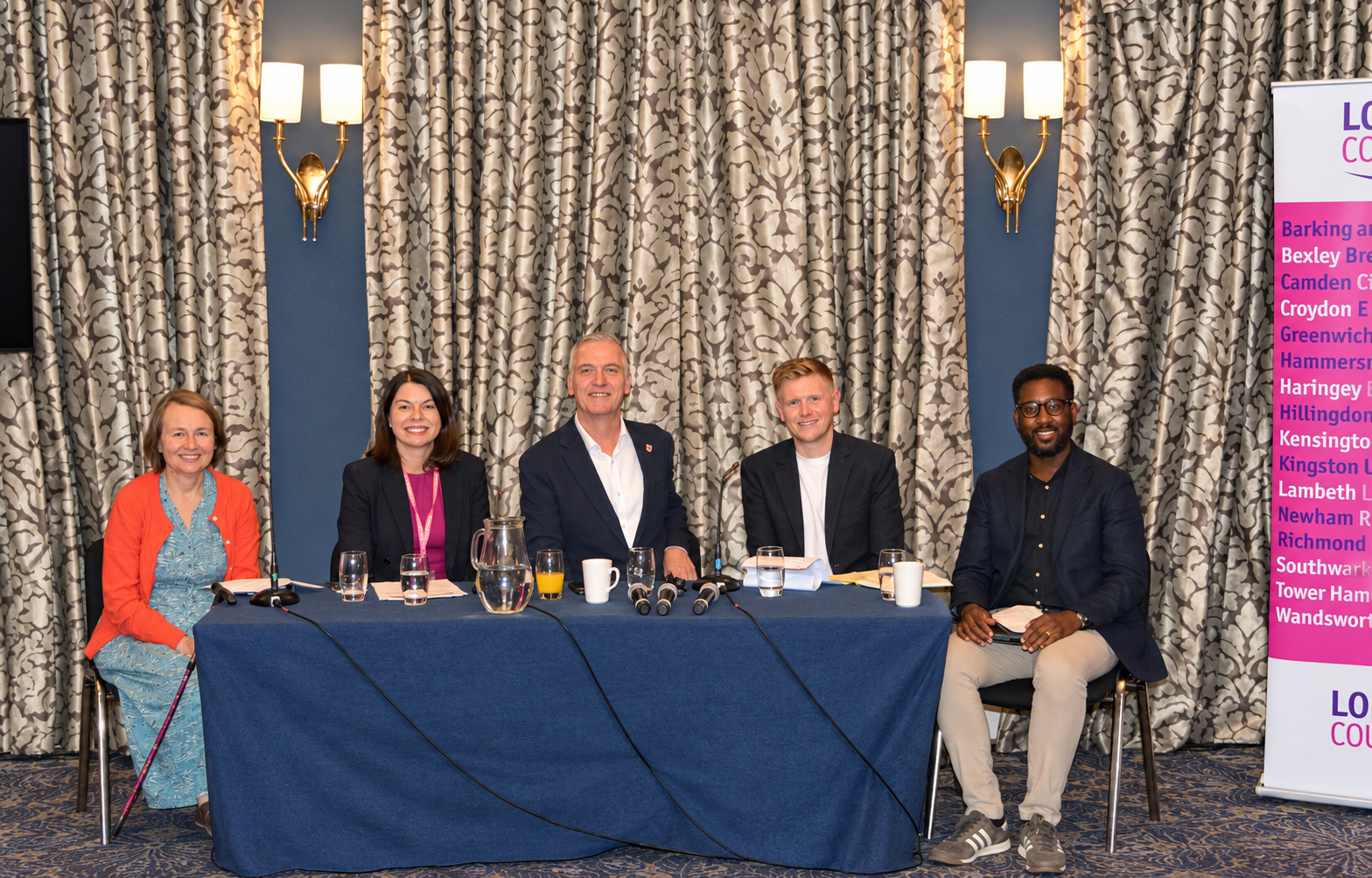
London Councils held an energising and lively panel event at the Liberal Democrat party conference in Brighton this week, titled “London needs more social homes – can Liberal Democrat councils deliver?”
All speakers shared strong support for boroughs building more social housing to support vulnerable residents – 1 in 50 Londoners is homeless and living in temporary accommodation and there are 341,000 families on social housing waiting lists across the capital.
The panel and audience discussed the barriers to boosting supply of new social homes and how these can be overcome, why quality is key, how councillors can be pivotal in getting projects moving, and the impact social housing has on the lives of Londoners and in stimulating economic growth.
Thank you to everyone who attended and a special thanks to our excellent panellists: Cllr Gareth Roberts AM, Vice Chair of London Councils and Leader of the London Borough of Richmond, who chaired the session; Sarah Olney MP; Cllr Victor Chamberlain, Deputy Leader of Southwark Council; Cllr Emily Davey, councillor in Kingston upon Thames; and Peter Baffoe, Vice Chair of Peabody.
The Casey Commission's Big Conversation on Social Care enters next phase
The Casey Commission is the independent review of social care in England, chaired by Baroness Louise Casey. Established in 2025, it is tasked with building a shared understanding of the challenges facing social care and developing practical, deliverable proposals for reform that will support the Government's ambition to establish a National Care Service.
A central part of the Commission's work is the Big Conversation on Care, a nationwide engagement programme designed to give people across England the opportunity to shape the future of adult social care. Launched in July 2026, the programme invites the public to consider what adult social care is for, who it should support, what people should expect from the state, and what responsibilities should sit with individuals, families, and communities.
The first phase of the Big Conversation on Care focused on the values, principles, and eligibility criteria that should underpin a future care system. Engagement has been significant, with more than 350,000 votes cast and over 6,000 proposals submitted during the first phase.
The next phase will explore some of the more difficult questions facing social care reform, including how care should be funded and how change should be delivered. Insights from both phases will inform the Commission's final recommendations to Government, which are expected in summer 2027.
Have your say: The Big Conversation on Care is continuing as it moves into its next phase. Find out more about the Commission's work and opportunities to get involved on the Casey Commission website.
|
|
In the media...
London councils face £5bn gap by 2030, group warns
BBC News
London’s schools are running out of children
Financial Times
London will fall behind European rivals if tourists are charged to visit museums, ministers warned
The Standard
Graham Chapman: The devolution paradox
LGC
Government faces possible legal challenge over funding cuts
The MJ
Council spending on housing homeless families in England at almost £3bn a year: ‘It’s crippling’
Big Issue
Over £20m confirmed in affordable home funding
LocalGov
Awaab’s law is not working, say social housing tenants stuck in mouldy homes
The Guardian
How councils are tackling climate adaptation
LGC
|