| Unsubscribe |
Dear Reader,
I've discovered a fatal flaw built into Elon's AI model.
In fact, I found it built into every frontier AI model on earth right now...
And the race to fix it could soon send one obscure stock soaring.
This flaw has nothing to do with chat models. It's a physical hardware ceiling... and you likely won't find tech founders like Elon Musk and Sam Altman talking about it.
But right now, hidden behind a high-security fence in rural Tennessee...
The U.S. government is quickly working to solve this very problem by developing a new form of AI – what I call sovereign AI.
One that could create a $248 trillion boom for the markets.
That's 56x bigger than the current AI market today.
I've spent more than a half century on Wall Street. I've traded through the rise of the personal computer, the internet, the smartphone...
And what's coming next could mint the next generation of millionaires.
I expose every detail of this fast-moving situation in my new presentation.
Including the name and ticker of the company leading the AI reset, for free.
Be well,
Marc Chaikin
Founder, Chaikin Analytics
Insiders Signal Deep Value In DICK’s Sporting Goods
Reported by Thomas Hughes. Article Posted: 9/21/2026.

Key Points
- Insider buying has picked up sharply after DICK’s Sporting Goods’ post-earnings sell-off, offering a notable counterpoint to weaker guidance and Foot Locker concerns.
- The longer-term opportunity increasingly depends on whether DICK’s can use its technology, customer data and retail ecosystem to extract more value from Foot Locker.
- Analyst caution and near-term margin pressure remain significant hurdles, but the lower valuation and roughly 4% dividend yield have changed the risk-reward setup.
- Special Report: SpaceX is offering you shares. Don't take them.
Insiders are signaling deep value in DICK’s Sporting Goods (NYSE: DKS), with several directors buying shares in early Q3. The purchases are not only contrary to the broader trend but also a response to a deeply discounted share price. DKS shares imploded following the Q2 miss; however, the market is mispricing the opportunity. While headwinds exist, this isn’t a retail turnaround. Instead, it’s an aggressive ecosystem expansion underpinned by technology and, more importantly, a vast pool of data on athletic shopping habits and the revenue and earnings power it can generate.
The hurdle today is the shoe segment and, specifically, integrating Foot Locker and realizing its potential. The pain is store-count rationalization, compounded by consumer headwinds. The opportunity is to expand DICK’s Sporting Goods, traditionally a big-box retailer, into niche urban markets in a targeted way, providing athletes with what they’re looking for and the accessories to go with it. Foot Locker also provides real estate, making this a land grab as much as anything else, along with entry into a coveted demographic: fashionable urbanites. Additional benefits include cross-selling and omnichannel integration.
Insiders and Institutions Reflect Confidence in DICK’s Long-Term Opportunity
SpaceX's march to $10 trillion (Ad)
SpaceX just signed a deal JPMorgan says could unlock the next phase of the space economy, putting the company on a path toward a 10 trillion valuation.
But analyst Dylan Jovine says the biggest winner won't be SpaceX itself. He's identified a small firm, less than half a percent SpaceX's size, that partnered with it directly.
An upcoming NASA announcement could be the catalyst. Jovine previously flagged Rocket Lab before it climbed from under 4 dollars to over 151.
See the full story on this SpaceX-linked stock nowInsider buying is noteworthy because of the timing and the individuals involved, which include industry insiders and tech titans. It is also notable because they didn’t need to buy. Insiders, including family holdings, account for about 30% of ownership and are reinforced by a strong institutional presence. In this scenario, insider buying can trigger market inflows and drive a reversal. Institutions likewise own a significant amount, with total holdings approaching 90%, and the group is accumulating shares. InsiderTrades data reveals activity spiking to record levels in Q3 as DKS price action fell to long-term lows.
Valuation is a hurdle today, but execution can overcome it. Trading at approximately 11.5 to 12 times its current-year outlook, the stock aligns with long-term trends but fails to price in the forecasts. Analysts expect the DICK’s-Foot Locker integration to unlock only modest but sustainable revenue growth, compounded by steadily improving margins. In this scenario, DKS shares trade at around five times the six-year outlook, suggesting 100% upside from current levels—and that’s assuming the forecasts are correct.
Assuming DICK’s progresses with its strategy and consumer headwinds ease, revenue and earnings growth will outperform estimates, setting the stage for earnings growth to amplify the valuation-based upside. If headwinds clear and the market reprices DKS to align with peers, which trade in the high-teens to high-20s range, upside potential could more than double.
Analysts Send DICK’s to Long-Term Lows, Keeping Price Depressed
Analysts present another hurdle for share prices, as the trends reflect caution, with numerous downgrades and price-target reductions catalyzed by the Q2 release. That caution is reflected in the consensus rating: Hold across 23 analysts, with 11 Buy, nine Hold and three Sell ratings. While low-end targets put DKS in the $100 to $110 range, consensus is closer to $167, aligning with the midpoint of a trading range and representing more than 35% upside from the critical support level. The likely outcome is that DKS reverts to the middle of its range; the only questions are when and what comes next.
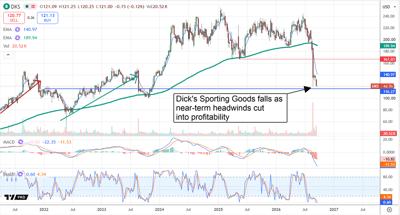
Critical support is just above $115. The technical risk is that DKS’s initial bounce was very weak despite the high volume, suggesting that a dead-cat bounce may be in play. The term assumes even a dead cat will bounce if it hits the ground hard enough, and such a move can lead to lower prices or prolonged stagnation. Lower lows aren’t expected, given that results missed expectations but weren’t bad and still offer opportunities for growth, margin improvement and sustained capital returns. Stagnation is a real risk, however; DKS shares can wallow at these lows indefinitely if upcoming results don’t reinvigorate market appetite.
DICK’s dividend is substantial, yielding approximately 4% with shares at mid-September lows. The payout is reliable but carries some risk, as margin pressure remains and free cash flow hasn’t been sufficient. The likely outcome is that dividend growth slows in the coming year but doesn’t disappear, before accelerating the following year. The more pressing concern is the impact on share buybacks, which have slowed, and the share count, which is up. The caveat is that the increase in the share count is tied to the Foot Locker acquisition, while buybacks, albeit at a slower pace, continue to reduce the share count each quarter.
DICK’s Q4 results are likely to be a catalyst. The company expects meaningful comparable-sales improvements as early as Q4, with structural margin recovery beginning in early 2027 and progressing throughout the year as restructuring concludes. Analysts forecast another quarter of solid growth offset by margin pressure.
3 Nimble Free Cash Flow Names With Light Assets
Reported by Nathan Reiff. Article Posted: 9/18/2026.

Key Points
- Ryan Specialty, Kinsale Capital, and Casey's General Stores may benefit from a market shift favoring asset-light, services-oriented businesses with strong free cash flow.
- Ryan Specialty posted Q2 2026 revenue of $917 million, up 7.2% year over year, and has sustained organic growth above 10% for several years.
- Kinsale Capital maintains a combined ratio below 80% and expanded its buyback program by $250 million, while Casey's revenue grew 24% year over year with analysts largely rating it a Buy.
- Special Report: SpaceX is offering you shares. Don't take them.
In the current market cycle, growing momentum may favor companies that are more service-oriented than product-focused and are therefore light on assets while generating solid free cash flow. Think of companies in the software, financial services, insurance or health care services industries: These businesses tend to earn fees or margins from transactions that don't require physical production. They can also convert a large share of their revenue into free cash flow because they generally require less capital equipment.
Three companies in particular may fit this profile and could therefore be poised for success as the market shifts. Ryan Specialty Holdings Inc. (NYSE: RYAN), Kinsale Capital Group Inc. (NYSE: KNSL) and Casey’s General Stores Inc. (NASDAQ: CASY) may be nimble enough to grow revenue while keeping costs and asset requirements under control. Each company achieves this through different mechanisms and in a different industry.
Ryan Specialty Is an Insurance Industry Standout
SpaceX's march to $10 trillion (Ad)
SpaceX just signed a deal JPMorgan says could unlock the next phase of the space economy, putting the company on a path toward a 10 trillion valuation.
But analyst Dylan Jovine says the biggest winner won't be SpaceX itself. He's identified a small firm, less than half a percent SpaceX's size, that partnered with it directly.
An upcoming NASA announcement could be the catalyst. Jovine previously flagged Rocket Lab before it climbed from under 4 dollars to over 151.
See the full story on this SpaceX-linked stock nowRyan Specialty is an insurance broker and managing general underwriter that earns commissions by placing complex risks with insurance carriers on behalf of brokers. Crucially, Ryan does not take on insurance risk itself. The company specializes in cyber policies, professional liability programs and similar coverage.
Recent financial performance helps confirm that this strategy has paid off. Ryan's second-quarter 2026 results exceeded expectations on multiple metrics, including revenue of $917 million, an increase of 7.2% year over year (YOY), and adjusted earnings per share (EPS), which climbed more than 12% over the same period.
The company's consistency is also key. It has delivered organic revenue growth of more than 10% for several consecutive years, while adjusted EBITDA margins have expanded as the business has scaled.
Importantly, the specialty insurance industry has provided an essential tailwind.
Ryan Specialty's segment of the market has grown as a share of total U.S. property and casualty insurance premiums for several years. When standard carriers decline certain risks, Ryan can make money by helping place them elsewhere. Ongoing challenges such as climate risk, cyber threats, artificial intelligence and the Iran conflict have all increased Ryan's usefulness.
Kinsale Capital Makes a Mark on the Underwriting Portion of Insurance
While Ryan Specialty operates on the distribution side of the specialty insurance landscape, Kinsale focuses on underwriting. The company uses proprietary data and analytics to operate faster and more accurately than its competitors, allowing it to compound book value at more than 25% annually for five consecutive years.
For underwriters, the combined ratio is a critical measure of profitability, and Kinsale's has consistently been below 80%. This means the company retains more than 20 cents from every premium dollar as pure underwriting profit.
The company has also performed well recently in investment income, which climbed nearly 20% YOY in the latest quarter. This allowed Kinsale to expand its buyback program by $250 million, bringing its total return to shareholders in the latest round to $337 million.
Kinsale is not without risks. The geopolitical complexities and other concerns affecting Ryan also expand the range of risks it faces. However, the companies are not competitors; they are co-participants in the same insurance ecosystem. This means investors can hold both without worrying that one will take business from the other.
Casey's Is a Free Cash Flow Compounder in Retail
It may seem counterintuitive to include a company operating 2,700 convenience stores in a list of asset-light, free cash flow-focused winners. However, Casey's General Stores may be a name to consider, albeit a surprising one. The company has unique ways of generating profits. Its prepared-food business, for example, has excellent margins comparable to those of leading fast-food companies. It also benefits from a strong loyalty program with enviable customer retention.
Casey's financial performance demonstrates its strength in the retail space. Revenue surged 24% YOY last quarter, while same-store inside sales climbed 6.5%.
Rewards member transactions increased 14% as the company's digital loyalty program continued to thrive. Even after a recent sell-off, shares are still up about 10% year to date (YTD), and the stock climbed more than 30% during the first half of the year.
The company also stands out among many retail competitors because of analysts' optimism about its future stock trajectory.
Notably, 15 out of 21 analysts consider it a Buy, and Wall Street sees more than 38% potential upside. Both are signs that Casey's may be able to successfully navigate a landscape that has been punishing for many retailers.
This email content is a paid advertisement sent on behalf of Chaikin Analytics, a third-party advertiser of InsiderTrades.com and MarketBeat.
This ad is sent on behalf of Chaikin Analytics, 201 King Of Prussia Rd., Suite 650, Radnor, PA 19087. If you would like to optout from receiving offers from Chaikin Analytics please click here.
If you have questions or concerns about your subscription, please don't hesitate to contact our U.S. based support team at [email protected].
If you no longer wish to receive email from InsiderTrades.com, you can unsubscribe.
Copyright 2006-2026 MarketBeat Media, LLC. All rights protected.
345 N Reid Pl. #620, Sioux Falls, SD 57103-7078. United States..