| Unsubscribe |
Dear Reader,
The average stock yields under 2%... The average gold stock - even worse — less than 1%.
But I’ve found a unique gold security (backed by one of the world’s best gold mines) that’s yielding upwards of 10%.
The Rothschilds, Vanguard, and BlackRock have already claimed their stake…
And you can buy this security in most brokerage accounts right now.
The mine itself has at least another 8 years of production — so it’s possible that early investors will be able to collect 80% total yields (not to mention capital gains)...
The catch?
The price is starting to move.
But you can lock in this high yield now - the sooner the better.
Best,
Garrett Goggin, CFA, CMT
Lead Analyst and Founder, Golden Portfolio
P.S. With the Fed raising rates, the only winner in this scenario is gold, and specific gold securities. And this particular security operates one of the world’s best mines… Complete with a 10% yield on top.
That’s real income that can help any investor protect their wealth from whatever comes next.
Nasdaq’s $100 Million Kraken Bet Prepares It for a Market That Never Closes
By Jeffrey Neal Johnson. Posted: 9/13/2026.

Key Points
- Nasdaq invested $100 million in Payward, Kraken's parent, to launch tokenized Nasdaq Equity Tokens through the xStocks ecosystem by mid-2027.
- The deal also requires Kraken to license Nasdaq's trade surveillance software, creating a potential new recurring revenue stream beyond transaction fees.
- Nasdaq's second-quarter results showed adjusted EPS of $1.07 and 15% revenue growth, with analysts projecting a 12-month price target near $110.
- Special Report: Forget SpaceX. Buy the company Musk can't replace.
Are traditional financial exchanges at risk of falling behind as trading shifts toward continuous digital venues? For generations, U.S. equity markets have operated on rigid schedules, opening at 9:30 a.m. Eastern time and closing overnight, on weekends and on holidays. Capital, however, does not sleep. Digital asset markets have demonstrated that institutional and retail participants value continuous access to liquidity. Rather than watching independent venues capture this activity, Nasdaq, Inc. (NASDAQ: NDAQ) is moving directly onto digital rails.
Through a strategic $100 million commitment to Payward, the parent company of Kraken, which is reportedly valued at approximately $21 billion, Nasdaq is connecting established clearing rails with round-the-clock networks. This partnership represents a fundamental defense of market infrastructure. By preparing to roll out Nasdaq Equity Tokens, known as NETs, the company is building an operational framework for securities that can move across traditional and tokenized markets while preserving legal shareholder protections. To appreciate the potential financial impact of this transaction, investors should look closely at how post-trade clearing functions.
Killing the T+1 Lag: How Atomic Settlement Frees Billions
The REAL Reason Trump is Invading Iran (Ad)
For a moment…
Forget about Trump’s ties to Israel.
Forget about reports of Iran’s nuclear program.
Because my research has led me to believe we’re risking World War 3 with Iran for a completely different reason.
Click here to find out what it is.Every trading day, more than $2 trillion in stock volume moves through the U.S. clearing system. Central counterparties net these trades down by about 98%, matching buy orders against sell orders so that only the residual transactions require settlement. Even with that level of netting, clearing organizations still require broker-dealers to post between $10 billion and $20 billion in margin collateral while trades await settlement.
That cash sits idle, serving as an insurance buffer against counterparty default. When the market moved from a two-day settlement window to one day in 2024, the transition released roughly $3 billion in liquidity. Taking that process onto on-chain rails could remove the settlement delay entirely.
Nasdaq and Payward's joint roadmap calls for the launch of Nasdaq Equity Tokens in the second quarter of 2027 through the xStocks ecosystem. On distributed rails, settlement can occur through atomic transactions, meaning the security and payment transfer occur simultaneously. When settlement is immediate, counterparty risk can fall sharply, potentially reducing the need for clearinghouses to tie up billions of dollars in broker capital.
Clearing and settlement have long formed the primary competitive moat for legacy exchanges. High-frequency matching engines are relatively simple to build, but trusted, regulated clearing infrastructure is exceptionally difficult to duplicate. By linking its Digital Liquidity Networks division with Kraken, Nasdaq is protecting this clearing franchise and helping ensure that future trading volume remains anchored to its settlement ecosystem.
Surveillance Software Adds Another Revenue Opportunity
Trading volume fluctuates with market sentiment. During quiet summer periods or prolonged consolidation, exchange transaction fees can decline quickly. To build a more stable financial foundation, Nasdaq has spent the past decade remaking itself into a specialized enterprise technology provider.
The arrangement with Payward includes an enterprise software license that requires Kraken to integrate Nasdaq's trade-surveillance architecture across its product lineup. That umbrella includes crypto spot trading, traditional equities, tokenized shares, futures and options. Market surveillance software serves as an exchange's operational radar, scanning continuous transaction books for wash sales, spoofing, front-running and artificial price distortions.
By licensing this platform to Payward, Nasdaq adds another potential source of recurring software revenue. Nasdaq has not disclosed the financial terms of the surveillance agreement. This recurring-revenue strategy mirrors Nasdaq's approach after acquiring Adenza, as well as its purchase of Dasseti in early September 2026 to enhance its private-market AI tools.
Instead of relying solely on volatile per-trade fees, Nasdaq is positioning its technology as part of the compliance infrastructure for modern digital venues. The resulting software subscriptions could provide more predictable revenue alongside the company's transaction-driven businesses.
Software Growth Supports Nasdaq’s Broader Valuation Case
The shift toward software and modern clearing rails is reflected in the company's fundamental performance. In its second-quarter financial results, Nasdaq posted adjusted earnings per share (EPS) of $1.07, surpassing consensus estimates of 98 cents. Total net revenue grew about 15% year over year (YOY) to $1.5 billion, supported by steady corporate adoption of its data analytics and anti-financial-crime software suites.
Key fundamental metrics demonstrate effective operating discipline:
Return on equity (ROE) sits near 18%, pointing to efficient use of shareholder capital.
Net profit margins hover around 23%, reflecting the operating leverage created by software expansion.
The debt-to-equity ratio stands near 0.71, indicating manageable leverage that allows leadership to fund strategic investments without straining liquidity.
Nasdaq stock trades at a forward price-to-earnings (P/E) ratio of around 22, while consensus analyst forecasts place the 12-month price target near $110, representing about 18% upside from current market levels.
Income-focused investors also receive tangible yield support, as the equity provides an approximate 1.3% dividend yield, with an ex-dividend date of Sept. 11, 2026, and payment scheduled for Sept. 25, 2026.
Investors should also evaluate the prospective risks. A target rollout date in mid-2027 leaves a multiyear development period during which regulatory guidelines could shift. Connecting centralized clearing entities with public or private blockchains requires precise technical execution, and Payward's $21 billion private valuation means Nasdaq's investment must be matched by meaningful NETs volume to create significant equity accretion.
Ringing the Midnight Bell
The possible move toward 24/7 financial markets is not a fleeting trend but a natural evolution of global capital flows. By combining a direct equity position in Payward with proprietary software licensing, Nasdaq is addressing two strategic priorities at once. The firm is hedging against volume loss to continuous-trading alternatives while simultaneously securing enterprise technology revenue from an expanding, multi-asset platform.
Investors who evaluate the firm strictly as a legacy stock market operator are looking backward. Nasdaq is systematically building the operational infrastructure to clear, settle and supervise assets across both traditional and distributed rails.
Investors seeking durable exposure to modern financial plumbing might look past day-to-day share price fluctuations. Those with a patient time horizon could consider using seasonal price pullbacks to build an allocation, allowing the fundamental benefits of the 2027 tokenized-equity rollout to unfold over the coming years.
Micron’s AI Memory Boom Could Send Shares 100% Higher
By Thomas Hughes. Posted: 9/16/2026.
Key Points
- Analyst consensus rates Micron stock a Buy with 92% bullish bias, forecasting upside toward $1,295 and potentially $2,000 per share.
- Micron's chart technicals point to a $1,600 to $2,400 price target range, supported by a strong rally and MACD convergence signals.
- Persistent high-bandwidth memory demand, sold-out capacity through 2027, and over $100 billion in orders suggest tightness will continue for years.
- Special Report: Forget SpaceX. Buy the company Musk can't replace.
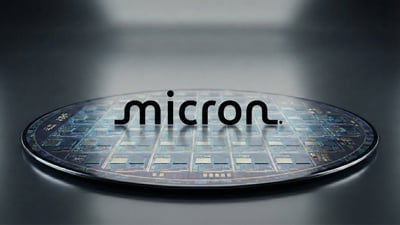
Signals ranging from chart price action to analyst sentiment point to another massive run for Micron (NASDAQ: MU) stock. While headwinds and hurdles—including market anxiety, profit-taking, and repositioning—are weighing on price action today, long-term trends suggest at least another 100% upside. The hurdle in September is the broad call to slow AI’s advancement.
Micron Is Well-Positioned for AI’s Virtuous Cycle
The news reads as a red flag, but it’s also a red herring: Alarm over runaway models obscures who actually stands to gain when AI’s advance stalls.
The REAL Reason Trump is Invading Iran (Ad)
For a moment…
Forget about Trump’s ties to Israel.
Forget about reports of Iran’s nuclear program.
Because my research has led me to believe we’re risking World War 3 with Iran for a completely different reason.
Click here to find out what it is.As concerning as the advancement of uncontrollable models may be, it’s not the models that AI companies are worried about. In this scenario, slowing AI’s advancement—cough, cough, pausing training of the most expensive models—is what the market needs. It would reduce AI’s high upfront costs, enable hyperscalers to monetize the infrastructure already in place, improve cash flow, and reassure investors while affirming their ability to continue spending. Regarding regulation, as MarketBeat writer Chris Markoch likes to put it, what more could AI companies ask for than the government installing roadblocks for startups and widening their moat?
For Micron, this means continued, persistent demand for its high-bandwidth memory (HBM) products. The biggest risk is an anticipated earnings cliff tied to capacity expansion and price normalization. Memory chip stocks command premium pricing in 2026, which is a central factor in Micron’s results and earnings outlook.
The market is getting this wrong: This isn’t a legacy-style memory cycle in which demand spikes, peaks, and retreats, undermining pricing power. Instead, it’s the early stage of a long-running trend in which data-center demand and inference keep prices elevated. The concern is that efficiency gains will reduce the amount of memory each query requires. But efficiency isn’t a memory killer. Rather, it makes inference more affordable, and affordability drives demand, increasing the number of queries and the need for memory.
Micron Winds Up for a Big Move, With Technicals Pointing to a $1,600-$2,400 Range
Micron’s chart price action is very bullish. The stock has rallied strongly over the trailing 12 months, rising almost $800, or 500%. It also crossed an inflection point, creating a price gap that was later confirmed as support.
The weekly chart shows a robust rally and consolidation range, likely signaling continuation. The critical details are the magnitudes of the range and rally, which approach $400 and $800, respectively. These are the projections for future price action, assuming a fresh high is set, putting the technical price targets at $1,600 and $2,400.
Among the more bullish technical factors is MACD convergence. This signal points to a strengthening market that is likely to retest existing highs and move on to new ones. The technical risk is that the price will top out near its existing highs, but earnings and analyst trends suggest otherwise.

Micron’s analyst trends are as bullish as they have been in the last two years. MarketBeat’s data reveals steady, firm coverage, with 38 analysts showing strong conviction. They rate MU a consensus Buy, with a 92% Buy-side bias, and the price-target trend is upward. The consensus forecast calls for a move to $1,295, representing 40% upside as of mid-September—sufficient to set a fresh high. More importantly, the trend points to a consensus-or-better price, with the high end at $2,000, representing more than 100% upside and falling within the technical targets.
Capacity Constraints to Continue: HBM Prices Aren’t Going to Fall Soon
The catalyst for MU stock is capacity constraints. The market focuses on expansion plans but fails to recognize that capacity increases aren’t expected to significantly impact supply until at least late next year. Market tightness is likely to linger through 2028 or longer. More aggressive forecasts suggest that tightness will persist into 2031, and there are numerous reasons to believe them.
Not only is the DRAM market neglecting its legacy business and creating shortfalls in non-AI markets, but systemwide HBM demand will continue to increase. Advanced Micro Devices (NASDAQ: AMD) isn’t using MU for its MI-450s but does use HBM—more than NVIDIA (NASDAQ: NVDA), in fact. Its sales are expected to explode over the next few quarters, keeping HBM supplies tight.
If investors need further proof, they need only look at Micron’s backlog and commitments. As it stands, the company has more than $100 billion in logged orders, its capacity is sold out through 2027, and it will likely sell out through the end of 2028 soon. Commitments include 16 major long-term supply contracts with set pricing, providing visibility. In the words of CEO Sanjay Mehrotra, demand exceeds capacity by approximately 50%. In this environment, there is no reason to think the HBM market will crash anytime soon. Acceleration is more likely.
This message is a sponsored message from Golden Portfolio, a third-party advertiser of Earnings360 and MarketBeat.
If you need assistance with your account, please don't hesitate to contact MarketBeat's South Dakota based support team at [email protected].
If you no longer wish to receive email from Earnings360, you can unsubscribe.
© 2006-2026 MarketBeat Media, LLC. All rights protected.
345 North Reid Place, Sixth Floor, Sioux Falls, S.D. 57103. USA..