Hello,
Welcome to our flagship newsletter, MarketBeat Daily Ratings.
We'll deliver the latest "Buy" and "Sell" ratings from Wall Street's top-rated analysts directly to your inbox each morning.
But first, we need you to do two quick things:
1. Hit reply, and send a simple "Yes." Just one word. This tells Google (and other emails providers) that you actually want to get our newsletter.
2. After that, this link to confirm your subscription. That will tell us that you received our welcome email and that we should start sending your daily report.
Confirm your subscription here.
After you have completed these two steps, we would like to gift you a free copy of one of our most popular investing reports: 7 Stocks to Buy and Hold Forever. You can download the report with this link.
Thank you again for subscribing. We look forward to being an important part of your investing journey

Matthew Paulson
Founder and CEO, MarketBeat.
P.S. If you didn’t intend to subscribe, no problem—you can unsubscribe with this link.
(ARReply-161)
Featured Content from MarketBeat Campbell’s Dividend Cut May Reset the Stock, But the Turnaround Still Has to DeliverAuthored by Thomas Hughes. Article Published: 9/8/2026. 
Key Points- Campbell Soup cut its quarterly dividend to 25 cents, creating a more sustainable payout with a forward yield of about 4.7% while it works to reduce debt.
- Technical signs suggest CPB shares may be forming a bottom near the low $20 range, supported by high short interest and steady institutional accumulation.
- Weak consumer demand pushed Campbell to lower its outlook, forecasting a 3% organic revenue decline, though analysts largely maintain Hold ratings with an $18 price floor.
- Special Report: The company SpaceX cannot operate without
The Campbell's Company (NYSE: CPB) has reset its dividend, giving investors a cleaner way to assess the stock: the payout is now more sustainable, but the turnaround still needs to deliver. While investors hoped for the best, believing the company’s brand strength and balance sheet could sustain the payout until turnaround efforts took hold, cash flow failed to cover the payment and debt ballooned. The result is reflected in the share price: CPB stock shed 60% over the preceding quarters as the market priced in the risk, if not the full reality.
Campbell’s new dividend is lower, but it is also easier to defend. The 25-cent quarterly payout gives the stock a forward yield of about 4.7% at recent prices, which remains attractive for a consumer staples company. Shares also trade at a modest forward earnings multiple, suggesting much of the bad news may already be reflected in the price. More importantly, the reset brings the payout back to a more manageable level, giving Campbell’s more room to absorb weakness, reduce debt and fund its turnaround.
For a moment…
Forget about Trump’s ties to Israel.
Forget about reports of Iran’s nuclear program.
Because my research has led me to believe we’re risking World War 3 with Iran for a completely different reason. Click here to find out what it is. The benefits of cutting distributions are immediate, including approximately $170 million in annual cash flow that can go directly toward debt reduction. Additional catalysts include plans for up to $500 million in cost savings, which should free up future cash flow for accelerated debt reduction, improved equity value and potential capital returns.
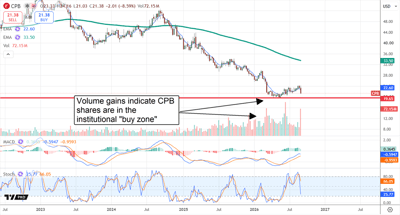
Campbell’s Downtrend May Be EndingCampbell’s downtrend may not be over, but the signs of a bottom continue to strengthen. Although the stock declined by more than 8% during the week of the dividend cut, it failed to set a new low or even approach the existing low, suggesting buyers remain active within the range. Additionally, a volume spike aligns with signs of aggressive accumulation at solid support in the low-$20 range.
The likely outcome is that CPB retests its existing lows, if it falls that far, before rebounding within its range. In this scenario, CPB shares are near a bottom but may trend sideways until the company produces tangible turnaround results. When that happens, the upside could be significant because short interest is exceptionally high. As of early September, CPB was among the most shorted blue-chip stocks, with short interest in the high teens.
Campbell's Suffers From Changing Consumer HabitsCampbell's didn’t have a terrible quarter, but it wasn’t particularly good. Results showed organic sales down 1%, with declines in both volume and mix, after accounting for an extra week in the prior year. The main hurdle is changing consumer behavior: lower-income shoppers are turning to cheaper private-label brands, while higher-income consumers are shifting toward fresh foods and protein. The worst news concerns the outlook, which was cut alongside the dividend. Management forecasts a weak year, with organic revenue expected to decline by 3% and margins to compress.
Analysts were not pleased and lowered their price targets after the release. However, even with sentiment reflected in a consensus rating of Reduce, the breakdown is more neutral than that label might suggest: 13 of the 19 analysts tracked rate the stock Hold, while six rate it Sell. The average price target sits below the current share price, although the $18 low target remains near the stock’s recent support zone. CPB may push to a new low, but doing so could trigger a buying signal. Institutions have been taking advantage of CPB’s low share price, accumulating shares throughout the downturn and accelerating their activity in early Q3.
The biggest risk for CPB investors is the timing of the turnaround signals. The base-case scenario is that the stock trades sideways indefinitely, although a catalyst is expected in the coming quarters. The best-case scenario is that turnaround efforts gain traction quickly. Campbell’s has a healthy portfolio of popular brands outside its soups, including Rao’s, V8, Goldfish and Cape Cod chips, giving the company several growth levers to pull. The worst-case scenario is that consumer headwinds worsen or executive missteps emerge, leading to lower stock prices before the rebound and recovery begin.
Other reasons to buy CPB include a cyclical recovery in consumer staples stocks. The sector is trading near long-term lows and at the low end of its historical price-to-earnings (P/E) ranges, setting it up for a substantial recovery. It will take time, but buy-and-hold investors can expect a return to quarterly growth in the coming year for most companies in the sector, including Campbell’s, along with growth-driven gains that lead to higher P/E multiples over time. Trading near 12.5 times earnings, CPB could advance by 60% based on valuation metrics alone, and that would only bring it back to the historical average. An earnings recovery could push the stock to the high end of its P/E range, adding another 4,000 basis points of upside, in addition to the dividend. |