Hello,
Welcome to our flagship newsletter, MarketBeat Daily Ratings.
We'll deliver the latest "Buy" and "Sell" ratings from Wall Street's top-rated analysts directly to your inbox each morning.
But first, we need you to do two quick things:
1. Hit reply, and send a simple "Yes." Just one word. This tells Google (and other emails providers) that you actually want to get our newsletter.
2. After that, this link to confirm your subscription. That will tell us that you received our welcome email and that we should start sending your daily report.
Confirm your subscription here.
After you have completed these two steps, we would like to gift you a free copy of one of our most popular investing reports: 7 Stocks to Buy and Hold Forever. You can download the report with this link.
Thank you again for subscribing. We look forward to being an important part of your investing journey

Matthew Paulson
Founder and CEO, MarketBeat.
P.S. If you didn’t intend to subscribe, no problem—you can unsubscribe with this link.
(ARReply-161)
Exclusive Article 3 Stocks to Buy and Hold for Higher Interest RatesWritten by Thomas Hughes. Originally Published: 9/9/2026. 
Key Points- With higher-for-longer interest rates now the norm, investors might focus on rate-resistant stocks featuring healthy balance sheets, pricing power, and reliable cash flow.
- JPMorgan Chase benefits from rising net interest income and a low dividend payout ratio, with 28 analysts rating it a consensus Moderate Buy.
- Exxon Mobil and Alphabet round out the list, offering consistent dividend growth and buybacks, respectively, backed by bullish analyst price-target trends.
- Special Report: The company SpaceX cannot operate without
While the debate over how high interest rates will go continues, the FOMC almost certainly won’t cut rates anytime soon. The takeaway for investors is that the “new normal” of higher-for-longer rates, which took effect two or three years ago, is now simply normal—and unlikely to change. For investors, this means refocusing on high-quality, rate-resistant stocks that deliver value.
Rate-resistant stocks share several qualities that can drive positive stock price performance over time, whether the FOMC is hiking or cutting rates. These include healthy balance sheets, pricing power, and reliable cash flow. Low- or fixed-rate debt insulates companies from rising borrowing costs, while strong cash positions can generate yield on deposits. Pricing power comes from brand strength and market position, which typically involve essential goods and services—products and necessities that people and businesses can’t live without. This allows companies to pass through higher costs while maintaining margins, which is critical.
Trump has called an Iran deal close 38 times since the war began, yet the fighting keeps flaring back up.
One day it's a ceasefire, the next it's bombs again. The back and forth may be masking a bigger story most investors are missing.
See the real reason this conflict may never fully end. Uncover the real reason Trump may never end this war Reliable cash flow is what matters. Rate-resistant stocks can generate cash flow throughout economic cycles and, more importantly, free cash flow for reinvestment and capital returns. Capital returns often include dividends and share buybacks, both of which can support investment returns. In this light, many Dividend Champions and Dividend Kings would qualify as rate-resistant, having proven their ability to sustain cash flow and capital returns through multiple business cycles.
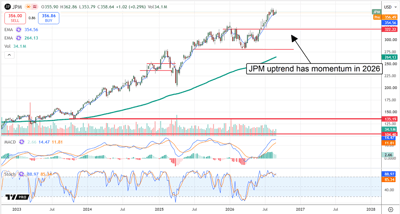
JPMorgan Chase & Co: Benefiting From Structural TailwindsWhile higher rates may impair JPMorgan’s (NYSE: JPM) business activity, they are good news for its cash flow and balance sheet. Higher rates can support wider margins, improve cash flow from investments, and drive net interest income (NII) growth. NII growth underpins the bank’s ability to maintain strong financial health and deliver substantial capital returns.
JPM yields approximately 1.7% annually as of early September, paying out less than 30% of its annualized earnings and remaining on track to sustain annual distribution increases.
As it stands, JPM’s dividend has increased for 15 consecutive years, making it a Dividend Achiever on track for Champion status.
JPMorgan’s growth outlook isn’t robust but remains positive. Growth is expected to continue at a low- to mid-single-digit pace over the next five to 10 years while the company maintains its margins.
The 10-year forecast suggests the stock is trading at a deep discount, with its valuation approximately half the current-year level. This could set the stage for a triple-digit stock price increase over time.
Analysts and institutions express confidence in the outlook, with 28 analysts rating it a consensus Moderate Buy, a buy-side bias in the data, an uptrend in price targets, and institutions accumulating shares in 2026.
Exxon Mobil: Well Positioned for Higher Oil PricesExxon Mobil (NYSE: XOM) is a rate-resistant stock because its forward-thinking management takes a prudent, cash-conserving approach to the business.
While Exxon could deliver larger capital returns when higher oil prices drive margin expansion, it instead chooses to preserve financial health and prepare for periods when oil prices are less favorable.
As a result, Exxon Mobil maintains a healthy balance sheet and the capacity to return capital to shareholders through reliable dividends and share buybacks.
The dividend, yielding about 2.6% in early September, isn’t the highest in the energy sector, but it is remarkably consistent, and the distribution grows annually.
Exxon Mobil has increased its dividend for more than 40 consecutive years, putting it on track to become a Dividend King before 2035. That milestone could attract institutional and retail buy-and-hold investors.
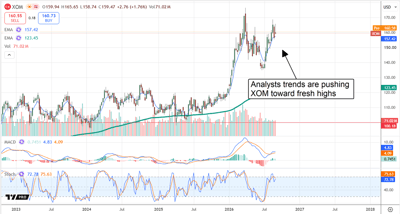
Analysts rate XOM a consensus Hold, with a 45% buy-side bias among 22 tracked analysts. The price-target trend is bullish, and the institutional group is accumulating shares.
Alphabet: Defying Logic in an AI-Driven WorldAlphabet (NASDAQ: GOOGL) is not unique, but unlike most other mega-cap technology companies, it has a fortress balance sheet, a massive cash pile, and a nearly unmatched capacity to self-fund growth.
Its dominance in search—an estimated 90% market share—anchors a highly profitable advertising business that generates enormous cash flow.
Self-funded growth is particularly important in 2026, as Alphabet is a top-three hyperscaler central to the data center buildout and is accelerating its capital expenditure (CapEx) plans each quarter. While risks remain, its surging backlog helps mitigate them, pointing to sustained growth and strong margins over time.
Alphabet’s dividend is not robust, serving primarily as a token payment intended to enable broader investment among institutional groups. Buybacks are more substantial.
The caveat for 2026 is that buybacks are effectively paused while the AI buildout is underway. However, they are expected to resume as front-loaded CapEx converts into revenue and cash flow.
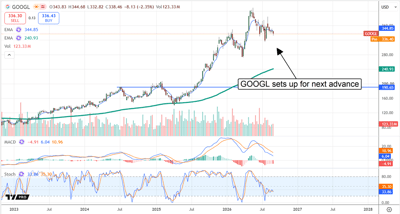
Until then, analyst trends are bullish, with 54 analysts rating GOOGL a consensus Buy, sentiment firming, and price targets trending higher. Consensus forecasts call for more than 20% upside from early Q3 support levels, with revisions pushing toward the high end and implying another high-teens advance. |