| Unsubscribe |
Dear Reader,
Don't buy Nvidia.
Not when the AI companies that will define the next decade are selling for pennies.
You won't find them on any stock exchange.
That's not where they're being funded anymore, and Washington figured that out before most investors did.
The White House appointed David Sacks as the first ever AI and crypto czar.
One person. Both roles.
Then they published a document titled "Winning the Race: America's AI Action Plan."
I worked on Wall Street for years, and I've never seen a bigger opportunity than this.
At the highest level of government, AI and crypto are not two revolutions… they're one.
And that's where most people hit a wall.
OpenAI isn't for sale to you.
Neither is Anthropic.
Sequoia and a16z write the $100 million checks that buy access, and there's no version of this where they let retail in beside them.
But the next generation of AI companies isn't waiting on VCs.
The big funds already know it.
Their focus has shifted to a subsegment they call decentralized AI.
They're launching tokens in the native markets.
This is where coins list months before Coinbase, Kraken, or Robinhood… because raising from millions of investors beats begging a handful of funds.
Take TAO.
It listed in the native markets in May 2023 around $35. Less than a year later it traded above $700.
But TAO is the foundation. The opportunity is what runs on top of it.
What TAO built is called subnets… independent AI companies operating on its network, each with its own token.
One runs among the best weather forecasting models in the world.
Another is a coding assistant.
Another is cloud storage that undercuts the majors.
Many are generating real revenue today.
You can buy into any of them directly, for as little as $50.
My research team lives in these markets.
For two years our research has been independently audited by Conquest Investment Advisory AG, a German firm regulated by BaFin.
The audit covers 571 research calls, 86.34% of which rose more than 20%, with an average return to all-time high of 416.88%*.
Most people still think digital assets are about currency. That narrative died in 2020.
This is the world's first open venture capital market… a teacher in Ohio investing at the same stage as a billionaire in Singapore.
To your wealth,
Tan Gera, CFA©
Decentralized Masters
P.S. Nvidia is worth trillions. TAO was $35 three years ago. The next potential unicorns are sitting in the native markets right now. See how to access them →
*Audited results as of July 20, 2026. Audit conducted by CONQUEST Investment Advisory AG.
Apple Unveils Foldable iPhone, But Stock's Muted Reaction Raises Questions
By Sam Quirke. Article Posted: 9/10/2026.

Key Points
- Apple unveiled its first foldable iPhone, the Duo, alongside updated Pro models, but shares finished the launch day roughly flat.
- Bulls argue the premium-focused lineup could raise average selling prices and deepen customer engagement across Apple's services ecosystem.
- Bears cite foldables' niche history, rising memory chip costs, and Apple's lagging AI strategy as reasons for caution.
- Special Report: SpaceX is offering you shares. Don't take them.
After weeks of buildup, Apple Inc. (NASDAQ: AAPL) finally pulled back the curtain on its most significant new product lineup in years on Wednesday, Sept. 9. Alongside the usual refresh of its premium iPhones, the company unveiled its first-ever foldable iPhone—its boldest reinvention of the iPhone in more than a decade.
The market's reaction, however, was notably muted. Apple shares dipped during the event before recovering to finish the day roughly flat, a curiously neutral response to what was billed as a landmark launch. Sure, the stock remains up more than 16% for the year, but it’s still sitting around 8% below July’s all-time high, and the launch-day price action suggests the market wants to see more before sending it back up there.
Small Colorado Company (Backed by Sam Altman) Could Save U.S. Power Grid (Ad)
A small Colorado company has secured rights to technology that could prevent the U.S. public power grid from collapsing — and billionaire Sam Altman is now an investor.
This under-the-radar firm is drawing serious attention from those watching the energy infrastructure space closely.
Click here to learn this company's name for free todayStill, there's no doubt this week's launch has set Apple up for a pivotal few months. The foldable and the higher-priced Pro models are its biggest efforts in years to breathe fresh life into iPhone sales, and how they sell will go a long way toward shaping the stock from here. Investors must now weigh whether the launch proves to be a blockbuster that sustains growth or a promising but incremental step.
Apple’s Premium Push Takes a New Shape
The undoubted star of the event was the folding iPhone, dubbed the iPhone Duo, which opens into a large, tablet-sized screen while still slipping into a pocket. Positioned by new CEO John Ternus as Apple's most innovative iPhone yet, it creates a new ultra-premium tier above the traditional Pro models, starting at $1,999. It supports features such as the Apple Pencil and split-screen multitasking.
It wasn't the only headline act, however. The iPhone 18 Pro and Pro Max arrived with new chips, substantially upgraded camera systems, better battery life and deeper AI integration. Apple also refreshed its Watch and AirPods lines, with the former gaining more advanced health monitoring and the latter receiving a new acoustic design and improved noise cancellation.
Taken together, it was a launch built squarely around the premium end of the range, a clear signal that Apple is leaning ever harder on high-value products.
Why Apple’s Premium Push Could Lift iPhone Revenue
For the optimists, that premium focus is precisely the point. By introducing the Duo as a pricey new tier and pushing its Pro models harder, Apple can lift the average price of the iPhones it sells, supporting revenue even if total unit sales stay broadly flat. In a maturing smartphone market, generating more revenue from each sale matters enormously.
The foldable also offers a fresh reason to upgrade. Even if it sells in modest numbers at first, the radically new design could tempt loyal Pro users to trade up, lure some switchers from rival foldables and deepen engagement across Apple's lucrative services ecosystem.
Then there is the AI angle. For the bulls, the new chips, smarter camera features and AI-enabled wearables are less about generating direct revenue and more about making Apple's devices stickier. That could give customers another reason to stay within its ecosystem, upgrade their hardware and spend more on services over time.
The Bear Case: New Hardware, Familiar Growth Challenges
The doubters, though, have their reservations. Chief among them is that foldable phones have been around for years and remain a niche corner of the market. A folding iPhone may generate plenty of buzz, but the bears question whether a larger screen alone is transformative enough to spark the broad, volume-driven upgrade wave the bulls are hoping for.
The stubborn problem of rising costs also looms. Memory chip prices are climbing sharply amid booming AI demand, squeezing Apple's margins and forcing an awkward choice: raise prices and risk deterring buyers, or absorb the hit to profitability. With upgrade cycles already lengthening as customers hold onto their phones longer, that is a delicate balance to strike.
Finally, questions linger over Apple's broader AI strategy, which many skeptics still regard as a step behind those of its rivals. For the new features to move the needle, they must offer real, everyday usefulness rather than mere marketing gloss. On that score, the jury is still out.
For Apple Stock, the Next Test Is Customer Demand
All told, the picture is mixed, and the flat reaction in the shares tells its own story. This was a solid, even impressive launch, but not an immediate catalyst for the shares. Sure, the foldable is a bold statement of intent, yet its real impact will only become clear once sales figures start to roll in.
For now, investors can watch how the shares trade in the coming sessions. Apple was ticking higher in early premarket trading on Thursday, Sept. 10, a tentatively encouraging sign, but the reaction into the weekend and beyond will offer a far better read.
Step back, and the bigger picture is unchanged from before this week’s event. Apple is still betting on premium hardware and a sticky ecosystem to drive it forward, and whether its bold new foldable proves a turning point or a pricey sideshow will come down to one thing—how many people actually buy it.
3 European Banks That Could Win Big From ECB Rate Hikes
Reported by Dan Schmidt. Published: 9/14/2026.

Key Points
- The ECB has raised rates twice in 2026 to combat inflation from an energy shock, while other major central banks have held steady.
- Santander and BBVA benefit from large floating-rate mortgage books that reprice quickly with ECB hikes, boosting projected net interest income.
- Deutsche Bank stands to gain from a sticky deposit base as UniCredit's pending Commerzbank merger limits competitive rate promotions in Germany.
- Special Report: SpaceX is offering you shares. Don't take them.
While Federal Reserve officials debate (and debate) whether to raise interest rates in September, their counterparts at the European Central Bank have already gone full Leroy Jenkins. The ECB’s Governing Council raised each of its three benchmark rates by 25 basis points during its June meeting for the first time since 2023, then hiked again to 2.5% on Sept. 10 after holding rates steady in July. The ECB is the only major Western central bank to hike rates in the current cycle, and its leadership argues that the increases are necessary to curb rising inflation expectations driven by the energy shock from the Iran War.
A hiking cycle during a supply shock carries credit risks that a demand-driven shock does not, and investors should be aware of that specter hanging over the banking sector. However, the Euro Stoxx Bank index has doubled over the last two years, and many of Europe’s largest banks are increasing their 2026 net interest income (NII) guidance in response to higher projected rates. Who benefits most? Eurozone banks with floating-rate loans and favorable deposit beta dynamics. The following three firms are well-positioned to profit from an ECB hiking cycle.
Banco Santander: Variable Mortgages Provide Upside Potential
Small Colorado Company (Backed by Sam Altman) Could Save U.S. Power Grid (Ad)
A small Colorado company has secured rights to technology that could prevent the U.S. public power grid from collapsing — and billionaire Sam Altman is now an investor.
This under-the-radar firm is drawing serious attention from those watching the energy infrastructure space closely.
Click here to learn this company's name for free todayInterest rates get plenty of attention in the U.S., but changes in the short-term federal funds rate rarely affect consumers’ day-to-day lives. That’s not the case in Europe, where floating-rate mortgages are much more common. In an April 2026 survey from Spain’s Instituto Nacional de Estadística, more than 37% of mortgages originated during the period were variable-rate, up from 30% in August 2022, when the benchmark rate was peaking. Floating-rate mortgages are linked to the Euribor index and will reprice within months of ECB hikes.
Banco Santander S.A. (NYSE: SAN) is one of the EU’s largest mortgage lenders, and more than 34% of its loans are residential mortgages. As of Q2 2026, more than 41% of its mortgage book was floating-rate, creating significant interest income upside during a hiking cycle.
Analysts raised their 2026 NII consensus estimate for Santander by 1.9%, while the bank’s efficiency ratio improved to 42.8%.
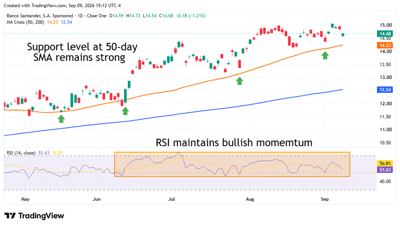
SAN shares have gained more than 20% in the last three months and could be nearing a key entry point for new positions. The 50-day moving average has kept the stock in an uptrend for nearly two years, acting as bear repellent whenever sellers coalesce. Now, the share price is once again approaching this level. With the Relative Strength Index (RSI) still showing healthy momentum, this could be another opportunity for dip buyers.
BBVA: Same Mortgage Dynamics, Bigger NII Upside
Banco Bilbao Vizcaya Argentaria S.A. (NYSE: BBVA) is another Iberian bank with tremendous upside thanks to its mortgage book and more heavily euro-denominated business. Like Santander, BBVA has a significant variable-rate mortgage book (38% floating versus 62% fixed as of Q2 2026) with a very low-risk lending profile.
The bank posted results above expectations for both earnings per share and revenue in fiscal Q2 2026, and management raised its group return on tangible equity (ROTE) guidance to approximately 21%.
The 2026 NII consensus estimate for BBVA was also revised upward by 2.3%—the largest upgrade among banks directly exposed to ECB rate moves.
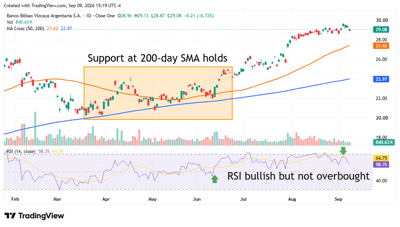
BBVA shares erased all of their 2026 gains by spring and nearly dipped into the trouble zone below the 200-day moving average more than once. However, the stock has now ripped more than 30% higher in the last three months, and the trend is pointing upward again. The RSI has also retreated from its overbought reading, which may entice buyers to resume pushing the price higher.
Deutsche Bank: Deposit Beta Upside Without the Mortgage Book
Deutsche Bank AG (NYSE: DB) was the punchline of many jokes in the wake of the Global Financial Crisis, but the German bank is finally getting its laughs in after surging more than 200% over the last five years. Unlike the two previous examples, DB doesn’t have a significant floating-rate mortgage portfolio. Instead, it has a sticky deposit base that’s growing through M&A.
Just not its own M&A. The Italian-based UniCredit S.p.A. (OTCMKTS: UNCRY) plans to close its Commerzbank merger by the end of Q4 2026, which could be advantageous for DB’s deposit beta. A company closing a merger is unlikely to start a rate-promotion war, and the integration could take longer than management anticipates. This would leave one of DB’s biggest deposit competitors on standby, allowing the bank to keep growing without offering rate promotions.
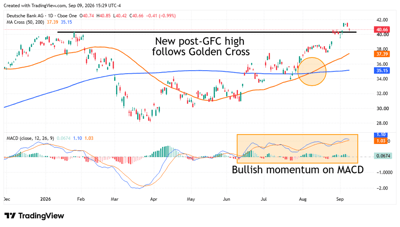
DB shares are also up 30% in the last three months and have recently notched a new high in the post-GFC era. The MACD indicator shows bullish momentum at its highest point of the year, while a Golden Cross points to a renewed upward long-term trend.
This email is a sponsored email provided by Decentralized Masters, a third-party advertiser of Earnings360 and MarketBeat.
This content is for educational purposes only. The opinions expressed are from DM Intelligence LLC, doing business as Decentralized Masters, who are not licensed financial advisors or registered investment advisors. The reader acknowledges that DM Intelligence LLC is not responsible for any losses, direct or indirect, resulting from the use of this information, including errors, omissions, or inaccuracies. Results are not typical and will vary. Success with digital currencies requires time, effort, and involves substantial risk including total loss of investment. Past performance does not indicate future results. All investments are at your own risk. You may unsubscribe at any time.
If you need help with your newsletter, please don't hesitate to email MarketBeat's South Dakota based support team at [email protected].
If you no longer wish to receive email from Earnings360, you can unsubscribe.
Copyright 2006-2026 MarketBeat Media, LLC. All rights protected.
345 N Reid Place, Suite 620, Sioux Falls, South Dakota 57103-7078. United States of America..