Hello,
Welcome to our flagship newsletter, MarketBeat Daily Ratings.
We'll deliver the latest "Buy" and "Sell" ratings from Wall Street's top-rated analysts directly to your inbox each morning.
But first, we need you to do two quick things:
1. Hit reply, and send a simple "Yes." Just one word. This tells Google (and other emails providers) that you actually want to get our newsletter.
2. After that, this link to confirm your subscription. That will tell us that you received our welcome email and that we should start sending your daily report.
Confirm your subscription here.
After you have completed these two steps, we would like to gift you a free copy of one of our most popular investing reports: 7 Stocks to Buy and Hold Forever. You can download the report with this link.
Thank you again for subscribing. We look forward to being an important part of your investing journey

Matthew Paulson
Founder and CEO, MarketBeat.
P.S. If you didn’t intend to subscribe, no problem—you can unsubscribe with this link.
(ARReply-161)
This Week's Exclusive Content Nasdaq’s $100 Million Kraken Bet Prepares It for a Market That Never ClosesSubmitted by Jeffrey Neal Johnson. Publication Date: 9/13/2026. 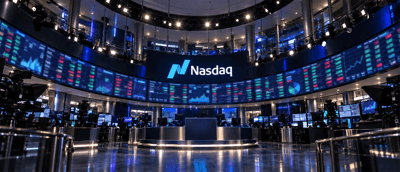
Key Points- Nasdaq invested $100 million in Payward, Kraken's parent, to launch tokenized Nasdaq Equity Tokens through the xStocks ecosystem by mid-2027.
- The deal also requires Kraken to license Nasdaq's trade surveillance software, creating a potential new recurring revenue stream beyond transaction fees.
- Nasdaq's second-quarter results showed adjusted EPS of $1.07 and 15% revenue growth, with analysts projecting a 12-month price target near $110.
- Special Report: Forget SpaceX. Buy the company Musk can't replace.
Are traditional financial exchanges at risk of falling behind as trading shifts toward continuous digital venues? For generations, U.S. equity markets have operated on rigid schedules, opening at 9:30 a.m. Eastern time and closing overnight, on weekends and on holidays. Capital, however, does not sleep. Digital asset markets have demonstrated that institutional and retail participants value continuous access to liquidity. Rather than watching independent venues capture this activity, Nasdaq, Inc. (NASDAQ: NDAQ) is moving directly onto digital rails.
Through a strategic $100 million commitment to Payward, the parent company of Kraken, which is reportedly valued at approximately $21 billion, Nasdaq is connecting established clearing rails with round-the-clock networks. This partnership represents a fundamental defense of market infrastructure. By preparing to roll out Nasdaq Equity Tokens, known as NETs, the company is building an operational framework for securities that can move across traditional and tokenized markets while preserving legal shareholder protections. To appreciate the potential financial impact of this transaction, investors should look closely at how post-trade clearing functions.
Killing the T+1 Lag: How Atomic Settlement Frees BillionsA small Colorado company has secured rights to technology that could prevent the U.S. public power grid from collapsing — and billionaire Sam Altman is now an investor.
This under-the-radar firm is drawing serious attention from those watching the energy infrastructure space closely. Click here to learn this company's name for free today Every trading day, more than $2 trillion in stock volume moves through the U.S. clearing system. Central counterparties net these trades down by about 98%, matching buy orders with sell orders so that only the residual transactions require settlement. Even with that level of netting, clearing organizations still require broker-dealers to post between $10 billion and $20 billion in margin collateral while trades await settlement.
That cash sits idle, serving as an insurance buffer against counterparty default. When the market moved from a two-day settlement window to one day in 2024, the transition released roughly $3 billion in liquidity. Taking that process onto on-chain rails could eliminate the settlement delay entirely.
Nasdaq and Payward's joint roadmap calls for the launch of Nasdaq Equity Tokens in the second quarter of 2027 through the xStocks ecosystem. On distributed rails, settlement can occur through atomic transactions, meaning the security and payment transfer occur simultaneously. When settlement is immediate, counterparty risk can decline sharply, while the need for clearinghouses to tie up billions of dollars in broker capital could be substantially reduced.
Clearing and settlement have long formed the primary competitive moat for legacy exchanges. High-frequency matching engines are relatively simple to build, but trusted, regulated clearing infrastructure is exceptionally difficult to duplicate. By linking its Digital Liquidity Networks division with Kraken, Nasdaq is protecting this clearing franchise and ensuring that future trading volume remains anchored to its settlement ecosystem.
Surveillance Software Adds Another Revenue OpportunityTrading volume fluctuates with market sentiment. During quiet summer periods or prolonged consolidation, exchange transaction fees can decline quickly. To build a more stable financial foundation, Nasdaq has spent the past decade remaking itself into a specialized enterprise technology provider.
The arrangement with Payward includes an enterprise software license requiring Kraken to integrate Nasdaq's trade surveillance architecture across its entire product lineup. That umbrella includes crypto spot trading, traditional equities, tokenized shares, futures and options. Market surveillance software serves as an exchange's operational radar, scanning continuous transaction books to detect wash sales, spoofing, front-running and artificial price distortions.
By licensing this platform to Payward, Nasdaq adds another potential source of recurring software revenue. Nasdaq has not disclosed the financial terms of the surveillance agreement. This recurring-revenue strategy mirrors Nasdaq's approach after acquiring Adenza, as well as its purchase of Dasseti in early September 2026 to enhance its private-market AI tools.
Instead of relying strictly on volatile per-trade fees, Nasdaq is positioning its technology as part of the compliance infrastructure for modern digital venues. The resulting software subscriptions could provide more predictable revenue alongside the company's transaction-driven businesses.
Software Growth Supports Nasdaq’s Broader Valuation CaseThe shift toward software and modern clearing rails is reflected in the company's fundamental performance. In its second-quarter financial results, Nasdaq posted adjusted earnings per share (EPS) of $1.07, surpassing consensus estimates of 98 cents. Total net revenue grew about 15% year over year (YOY) to $1.5 billion, supported by steady corporate adoption of its data analytics and anti-financial-crime software suites.
Key fundamental metrics demonstrate effective operating discipline:
Return on equity (ROE) sits near 18%, pointing to efficient use of shareholder capital.
Net profit margins hover around 23%, reflecting the operating leverage created by software expansion.
The debt-to-equity ratio stands near 0.71, indicating manageable leverage that allows leadership to fund strategic investments without straining liquidity.
Nasdaq stock trades at a forward price-to-earnings (P/E) ratio of around 22, while consensus analyst forecasts place the 12-month price target near $110, representing about 18% upside from current market levels.
Income-focused investors also receive tangible yield support, as the equity provides an approximate 1.3% dividend yield, with an ex-dividend date of Sept. 11, 2026, and payment scheduled for Sept. 25, 2026.
Investors should also evaluate the prospective risks. A target rollout date in mid-2027 leaves a multiyear development period during which regulatory guidelines could shift. Connecting centralized clearing entities with public or private blockchains will require precise technical execution. In addition, Payward's $21 billion private valuation means Nasdaq's investment must be matched by meaningful adoption of NETs to generate significant equity accretion.
Ringing the Midnight BellThe possible move toward 24/7 financial markets is not a fleeting trend but a natural evolution of global capital flows. By combining a direct equity position in Payward with proprietary software licensing, Nasdaq is addressing two strategic priorities at once. The firm is hedging against volume loss to continuous-trading alternatives while simultaneously securing enterprise technology revenue from an expanding, multi-asset platform.
Investors who evaluate the firm strictly as a legacy stock market operator are looking backward. Nasdaq is systematically building the operational infrastructure to clear, settle and supervise assets across both traditional and distributed rails.
Investors seeking durable exposure to modern financial plumbing might look past day-to-day share price fluctuations. Those with a patient time horizon could consider using seasonal price pullbacks to build an allocation, allowing the fundamental benefits of the 2027 tokenized equity rollout to unfold over the coming years. |