Hello,
Welcome to our flagship newsletter, MarketBeat Daily Ratings.
We'll deliver the latest "Buy" and "Sell" ratings from Wall Street's top-rated analysts directly to your inbox each morning.
But first, we need you to do two quick things:
1. Hit reply, and send a simple "Yes." Just one word. This tells Google (and other emails providers) that you actually want to get our newsletter.
2. After that, this link to confirm your subscription. That will tell us that you received our welcome email and that we should start sending your daily report.
Confirm your subscription here.
After you have completed these two steps, we would like to gift you a free copy of one of our most popular investing reports: 7 Stocks to Buy and Hold Forever. You can download the report with this link.
Thank you again for subscribing. We look forward to being an important part of your investing journey

Matthew Paulson
Founder and CEO, MarketBeat.
P.S. If you didn’t intend to subscribe, no problem—you can unsubscribe with this link.
(ARReply-161)
Exclusive Story from MarketBeat Media MongoDB’s Spending Fears Collide With a Much Stronger Growth StorySubmitted by Thomas Hughes. Article Published: 9/3/2026. 
Key Points- MongoDB’s post-earnings pullback appears tied more to profit-taking and spending concerns than to a breakdown in business momentum.
- MongoDB reported accelerating revenue growth, strong Atlas demand and wider adjusted operating margins in its fiscal second quarter.
- Analysts remain broadly constructive, but valuation risk leaves the stock vulnerable to sharp pullbacks if growth disappoints.
- Special Report: SpaceX is offering you shares. Don't take them.
MongoDB’s (NASDAQ: MDB) early-September price pullback is a buy-the-dip opportunity triggered by sell-the-news profit-taking. The key takeaway from the company’s Q2 fiscal year (FY2027) earnings report is that the business is accelerating under the influence of AI. AI is supporting not only internal operations but also the company’s offerings, which are resonating with clients, driving contract wins and increasing services penetration. Key details in the report include the factors that triggered the sell-off and its mitigating factor: jaw-dropping outperformance and profitability.
If one cause for selling stands out, it is the 12% increase in operating expenses. The increase is less unexpected than unwanted, as it cuts into cash flow and limits the company’s capacity to improve shareholder value. However, it also reflects capacity expansion to meet demand, which should ultimately improve shareholder value.
A small Colorado company has secured rights to technology that could prevent the U.S. public power grid from collapsing — and billionaire Sam Altman is now an investor.
This under-the-radar firm is drawing serious attention from those watching the energy infrastructure space closely. Click here to learn this company's name for free today The mitigating factor, however, is the margin, which expanded significantly because of increased revenue leverage and operational quality. This outpaced consensus estimates even with the increased spending. The likely outcome is that the market will quickly recognize the value presented, close the gap formed in early post-release trading, and then move higher to set a fresh high.
MongoDB Isn’t the First to Reveal SaaS-Pocalypse Fears Were Misplaced
MongoDB isn’t the first company to reveal that SaaS-pocalypse fears were overblown, but it is a critical link in the software ecosystem, highlighting systemic and accelerating growth among AI-capable winners. Revenue grew by 30.5% in Q2 FY2027, accelerating sequentially and year over year (YOY) and outpacing consensus by more than 500 basis points. Strength came from a 31% increase in subscriptions, the company’s core segment, supported by a 30% increase in services.
Atlas, the company’s unified platform for launching, managing and automating database and database-related workflows, is the primary catalyst. It grew 29%, driven by strength across geographic regions. Enterprise Advanced was also solid, growing 36% YOY and accounting for 24% of revenue.
Margin news was also positive, including the impact of increased spending, which points to higher revenue and improved margins in future quarters. Adjusted operating margin improved by 900 basis points to 24%, nearly doubling adjusted net income and free cash flow in the process. Free cash flow of $137.6 million enables value gains alongside investment, while adjusted earnings per share (EPS) rose 90% to $1.90 and outperformed by 1,800 basis points.
Looking ahead, management expects revenue growth to slow but issued a solid forecast, expecting Q2 strength to persist and Q3 to outperform analysts’ expectations. Reasons to believe results will come in at the high end of the range or better include current remaining performance obligation (RPO) and total RPO, which foreshadow further acceleration. Current RPO rose 73% during the quarter, while total RPO increased 91%.
Analysts Respond With Vigor! MDB Can Hit Multiyear Highs
The analyst response has been vigorous and bullish. MarketBeat tracked eight revisions within the first 12 hours of the report, with all affirming a consensus or higher price target. Two revisions included price-target declines, but even those align with the consensus: a solid Moderate Buy rating with about 25% upside potential relative to the post-release sell-off. Most targets, however, were raised, including a new high of $560 and several above $500. They suggest not only a return to multiyear highs but also the potential to retest all-time highs and move even higher. Assuming subsequent releases are equally solid, analyst trends will likely strengthen and reinforce the outlook for significant price gains.
Institutions will be the deciding factor, and the data suggests that downside is limited. The group owns nearly 90% of the stock and has been aggressively accumulating shares in 2026. MarketBeat data reflects an approximately $4-to-$1 trailing 12-month buying-to-selling balance as of mid-Q3, with a sizable stake taken by California’s Teachers’ Retirement System. It made a notable purchase earlier this year, lifting its stake into the high double digits and reflecting strong conviction in the outlook. Given these results, the group is more likely to buy into the sell-off than to lean into selling, and evidence of buying already exists.
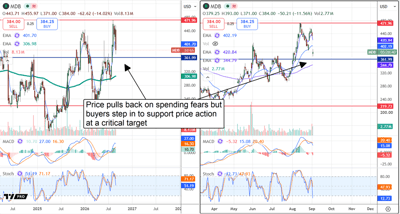
Price action plunged in early trading but did not move lower, signaling buyers at the low, before trading sideways in a sign of indecision. The near-term risk is that selling intensifies, but the more likely outcome is that support holds in the $375 region, support is reestablished and a price recovery begins over the subsequent few quarters. The bigger risk is the valuation, which prices in a robust growth trajectory. This leaves the market vulnerable to sharp pullbacks and corrections on weakness, regardless of signals that the business has traction and is gaining momentum. Short interest is not a problem right now and likely won’t be anytime soon. |