
|
You are a free subscriber to Let’s Address Virginia. Meaning your readership helps us reach more people. When you’re ready, I’d love you to join us as a paid subscriber.



Across Virginia, police departments are quietly installing a technology that tracks where we go, when we go there, and who we associate with - and the public is starting to push back. Police departments and municipalities are adopting automated surveillance systems that record our movements at scale and store them in centralized databases.
These tools are increasingly used not just for serious crimes, but for routine monitoring. In some cases, these tools aid federal immigration enforcement. As protections for protest, speech, and bodily autonomy are under attack nationwide, the expansion of mass surveillance should alarm anyone who values basic civil liberties. One of the most troubling examples of this technology is Flock. Let’s address this.
What is Flock?
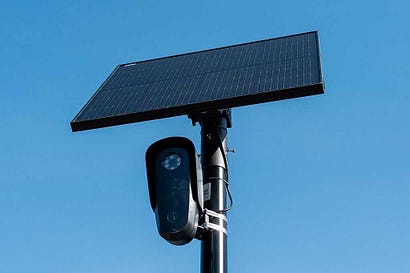
Flock is one of dozens of cloud-connected automated license plate readers (ALPR). It is one of the most used in the Commonwealth. According to its website,
“Flock Safety was founded with the mission to eliminate crime — and we’ve always believed that is possible while protecting civil liberties and encouraging positive, productive relationships with local law enforcement and their communities.”
I spoke with an elected official who stated that Flock has been incredibly helpful to the area because the region is incredibly short-staffed on police officers. They have recovered more stolen cars than they ever could. Regarding simply reading license plates, I get it. However, as with any for profit company, they can never make their money by focusing on one solution - they need to expand. Which is why the next phase of Flock, etc will have more features to sell.
 |
What rules does Virginia have for this?
Virginia has a comprehensive law for ALPRs. The law sets regulations and guidelines for the use of ALPRs. While the law states what agencies cannot do with the data, it also provides penalties for noncompliance. Any person using the system for a purpose other than its intended use or who shares the data in violation of the statute is guilty of a class 1 misdemeanor. Any information they find is inadmissible in court.
The law states the vendor or agency cannot sell or distribute the data (with some exceptions), must purge the data after 21 days, and maintain an audit trail for two years. While it’s good to see these regulations, they differ from Flock’s terms and conditions update from just this year. The ACLU found:
Flock’s previous terms included “Flock does not own and shall not sell customer data.” That language is absent.
Flock has a perpetual license on customer data, including after customers terminate their relationship with Flock.
Makes it harder for customers to terminate Flock contracts.
However, there seems to be a gap big enough for ICE to enter the field.
First off, crossing the border without documentation is not a top ten worst felony of all time - no matter what Fox News tries to tell you. It’s a misdemeanor.
The ALPR law states that the agency’s database cannot be given to another entity’s database, but it says nothing about a police officer running a query and providing one-off disclosures to ICE. Keep me honest - let me know in the comments if I’m reaching here.
The law states that local law enforcement agencies “shall take measures” to promote public awareness of ALPRs. I’m fairly active in my county and I have yet to see anything from local police sharing information about ALPRs. They just continue to pop up like a bamboo invasion. Has your local law enforcement agency done public awareness about ALPRs?
While it may have had honorable intentions before its founding in 2017, we see a common refrain here: “You either die a hero or live long enough to see yourself become the villain.” Today, Flocks works with police departments, such as the one in Medford, Oregon, to aid ICE informally by cross-referencing license plate numbers in DHS databases with the Flock database. In some cases, Flock cameras have been misused by police chiefs to track ex-lovers and spouses. Even regular police officers like Jarmarus Brown in Orange City, Florida ran the plate numbers of his girlfriend and family through his system numerous times. Flock systems were even used by Texas police for a nationwide search for a woman who allegedly self-administered an abortion, with reproductive rights groups reporting that “there is an overwhelming fear” amongst women in Texas that “they’re being tracked by the state.” Texas police responded to this by saying they only wanted to make sure her health was okay.
If they want to make sure women’s health is okay, then they should legalize abortion in Texas.
Additionally, despite claims of being a secure system, people report that they’ve easily hacked it. So if police officers are on the record doing this, imagine what random people worldwide are doing with access to a minimally secured network of cameras across Virginia and America.
Unjust Targeting
Flock cameras in eastern Virginia are found at a higher rate in Black and high poverty neighborhoods compared to White neighborhoods. As these are the evolution of red light cameras, those, too, were found to be at a higher rate in Black and high poverty neighborhoods. I’ve seen that first-hand. When I lived in Queens Village, NY, we had red light cameras throughout neighborhoods that were predominantly Black or impoverished. I rarely saw them in White neighborhoods. Flock claiming its cameras reduce bias is like saying, “This gun only shoots criminals.” The intent manifests from the user, not the tool.
Momentum in Virginia
A number of localities are ending their contracts with Flock. Including Arlington, Goochland, Lynchburg, Harrisonburg, Charlottesville, Staunton and I’m certain there are more in the works.
Here’s what you can do
You must pressure your local elected officials to revisit their contracts with Flock. They must ensure there is no cooperation with ICE.
Do you have improvements you’d like to suggest for the ALPR law? Get in touch with your House Delegate and/or State Senator within the next week to begin the conversation of amending the law. Act fast because preparation for January’s session begins now.
Check out this map to find the Flock cameras near you. Concerned now? Feel free to call and air your concerns about Flock by using the script below. I recommend reaching out to your Board of Supervisors/City Council:
Hello [OFFICIAL NAME], my name is [YOUR NAME], and I am a constituent in your district. I’m calling because I’m concerned about the city’s contract with Flock Safety, an Automatic License Plate Reader system that has been used across the country to unjustly surveil residents and possibly facilitate cooperation with ICE.
While there may be legitimate public safety uses for this technology—such as locating stolen vehicles or supporting Amber Alerts—I remain concerned about ALPRs because [state your reasons]. I urge you to review this contract, ensure there is no cooperation with immigration enforcement, and implement strong protections for residents’ privacy and civil liberties. If this is not possible, then please end the contract with Flock.
Onward and upward,
Salaam
 |
Rather than a monthly subscription, you can now make a one-time contribution to support our human rights platform at any amount that fits your budget.
Invite your friends and earn rewards
| ||||||||||


