|
The Office of Inspector General (OIG) for the Department of Homeland Security released a scathing report last Friday about the shuttered Florida concentration camp built on an abandoned airstrip known as “Alligator Alcatraz,” concluding the camp failed to meet numerous health and safety standards, and that the use of “small metal enclosures” was “unprecedented” and posed “significant risks to detainee health and safety.”
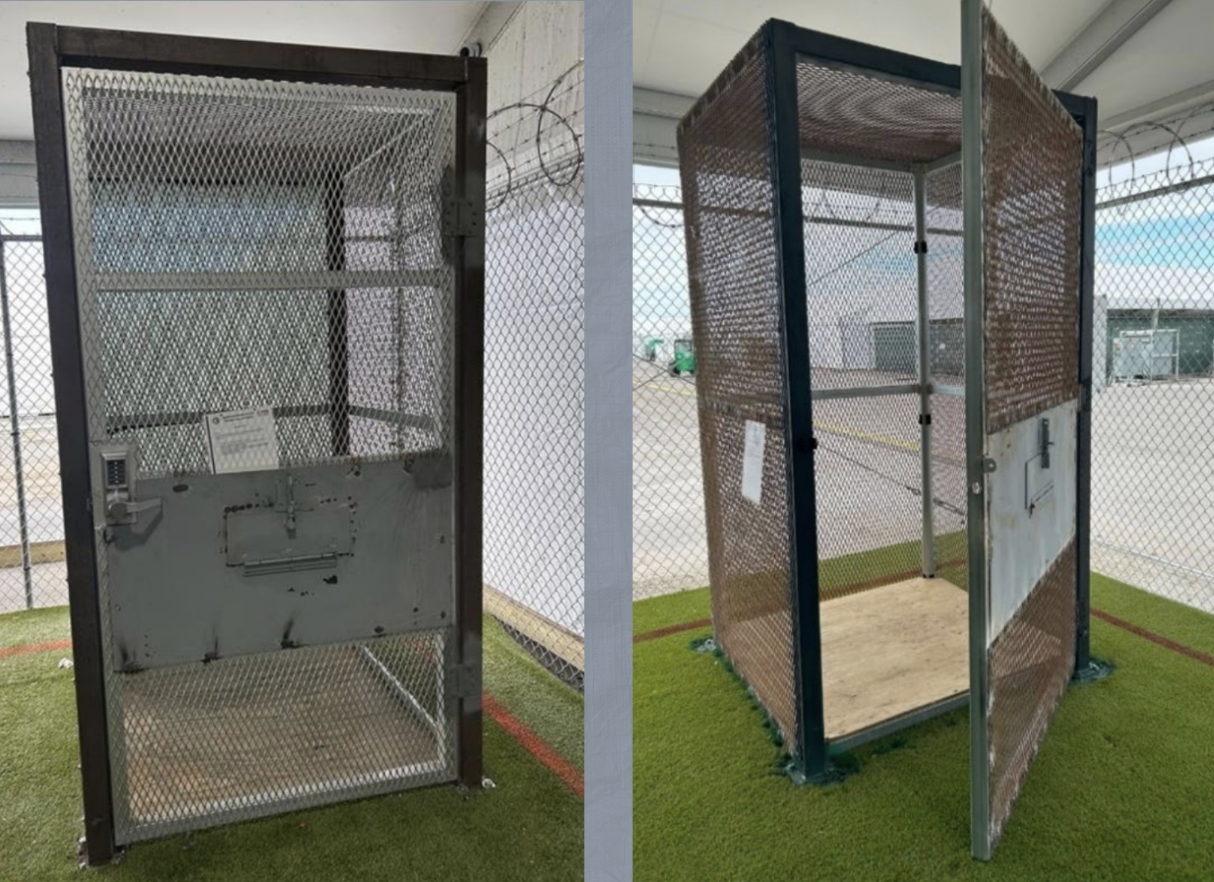
The report included photos, taken by OIG inspectors during an “unannounced” visit in January to the camp, showing a phone booth–sized cage set up outdoors under a temporary awning. Staff at the camp euphemistically described the cages as “calming areas” where detainees could “reflect on their behavior choices, manage their emotions,” and, they claimed, leave whenever they wanted. Staff records indicated 79 detainees had spent time in the cages in a two-day period, none for more than two hours, which the OIG could neither confirm nor refute, the report said.
The cage images are appalling and, at first blush, seem to confirm an Amnesty International report from last December that first alleged the use of cages at the tent prison. But a closer comparison of the two shows not agreement but evidence of a cover-up: a Potemkin Village carefully positioned to fool inspectors and hide a truth that was much, much worse.
Amnesty spoke to four people who were detained at the Everglades site in the summer of 2025 for periods of between two weeks and a month, and to local groups that had worked with former detainees there. All of them spoke of “the box”—an outdoor cage where they said they were sent as punishment for alleged infractions. They described being handcuffed in a 2′ × 2′ cage, with their ankles shackled to the floor, preventing them from sitting down or shifting positions. There was “hardly” any protection from the hot sun and sometimes no protection at all, they said. All of them told Amnesty that detainees were left in the box for hours at a time, attacked by insects and provided with little water.
“People ended up in the ‘box’ just for asking the guards for anything. I saw a guy who was put in it for an entire day,” one detainee was quoted as saying in the Amnesty report. An illustration based on detainees’ descriptions shows a man in ICE’s standard gray sweatsuit in a cage too small to stand up in.
In other interviews, former detainees have described it as a 4′ × 4′ cage, which would be consistent with the illustration, but everything else is the same: no protection from the sun, chained to the ground, left there for hours.
|