
|
 |
End of Summer Sale: For a limited time, you can lock in 30% off when you upgrade—just $1.05 a week !—Never miss an unfiltered, deep-dive political analysis from the sharpest strategists in the game when you upgrade today.
The ACA ‘Dead Pool’: Why Your Healthcare Costs Will Spike in 2027
Republicans made some big changes to Obamacare this year. But it’s going only going to get worse.
|

| |||||||||||||||


Charles Gaba is a health care analyst who tracks policy and politics at ACASignups.net. Subscribe to his Substack!
 |
Greetings, Lincoln Square readers!
First, I want to apologize for being absent since early July! This was caused by several overlapping factors which I won’t bore you with, but the bottom line is that I’m back.
In any event, with Labor Day now behind us, there are two vitally important dates which are coming up quickly, just two days apart: November 1, which is the official launch of the 2027 Affordable Care Act Open Enrollment Period, and November 3, which is, of course, Election Day across the United States.
I actually spent much of July and August painstakingly analyzing the preliminary 2027 rate filings from hundreds of insurance carriers offering healthcare policies for ACA-compliant individual market enrollees.
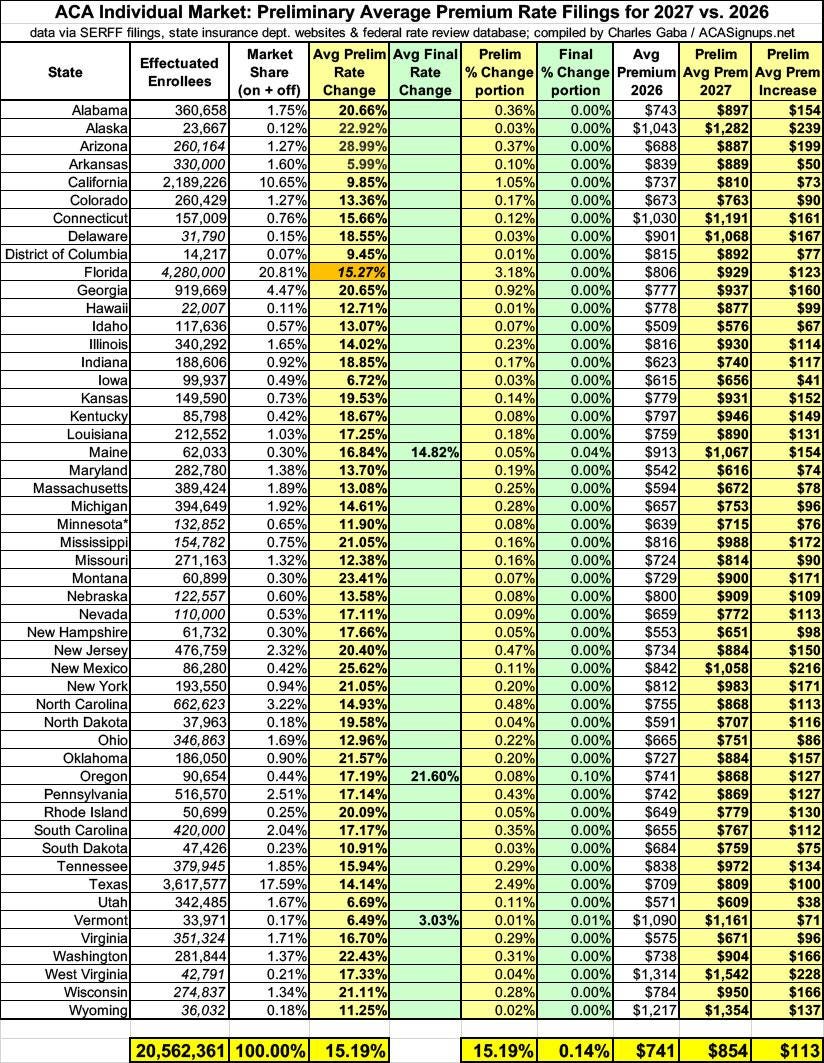
Across all 50 states (and DC), the weighted national average increase for unsubsidized enrollees will average over 15%:
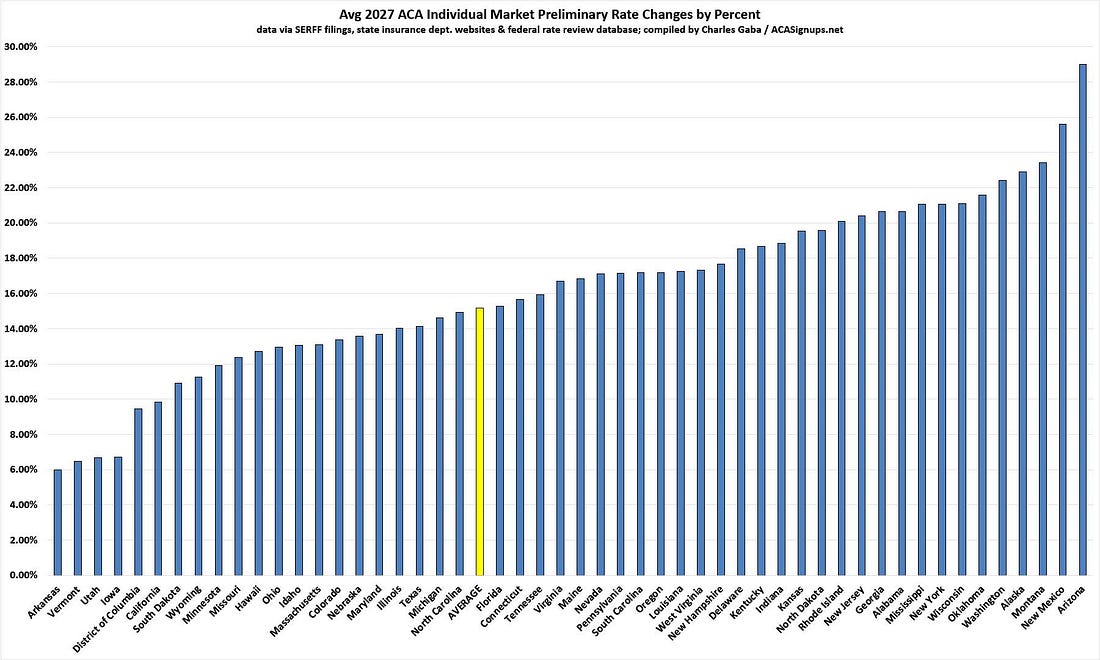
For preliminary filings, the weighted average increases being requested range from as little as 6% in Arkansas to as much as 22.9% in Arizona.
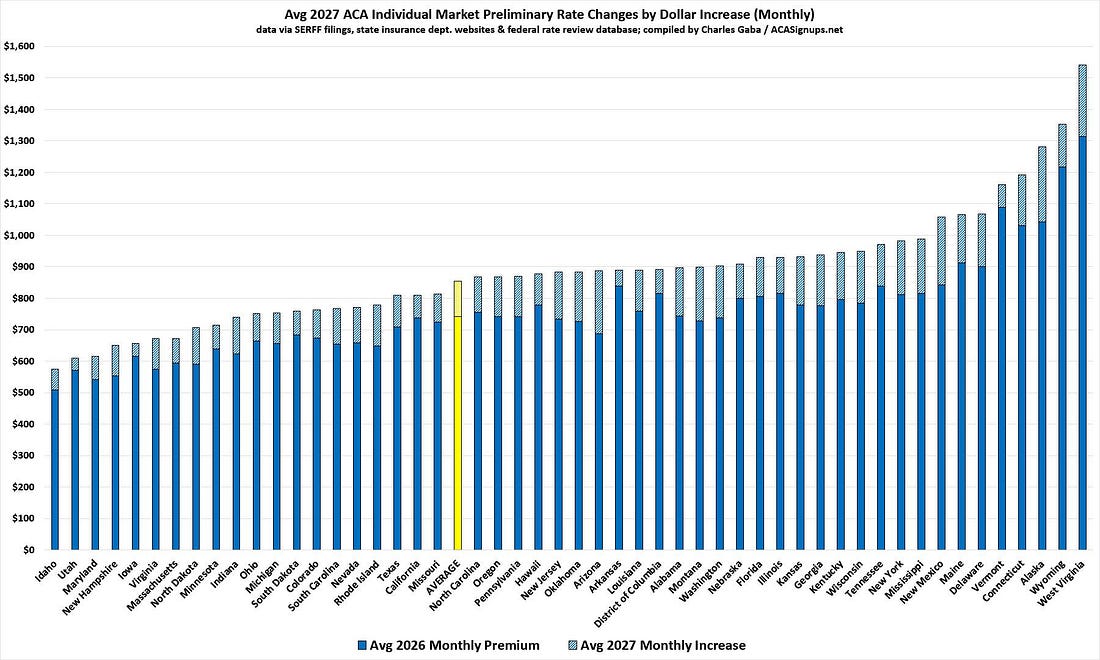
In dollar terms, average 2027 monthly premiums will range from $576/month in Idaho to as high as $1,542/month in West Virginia...nearly 2.7x as much.
In addition to West Virginia, there are several other states where the average unsubsidized premium will be more than $1,000/month next year: Alaska, Connecticut, Vermont and Wyoming.
The average 2026 premium is around $741/month, so for 2027 that would mean roughly an additional $113/month for unsubsidized enrollees, or around $854/month nationally.
That’s over $1,300/year extra per unsubsidized enrollee on average.
 |
Here’s what this looks like visually, with states ranked from lowest to highest average percent increase (click below for higher-res version):
 |
Here’s the states ranked from lowest to highest average 2027 premium in actual dollars. Again, remember, this is for UNSUBSIDIZED enrollees only:
 |
In addition to the unsubsidized disclaimer, it’s also important to keep in mind that these are preliminary filings only; state regulators often modify the rate changes before giving final approval, which sometimes means knocking down the rate hikes fairly substantially. As of this writing, I have final filings for 10 states.
Some of these haven’t changed at all, but in a few cases the 2027 premium increases have been substantially reduced (New York is the most dramatic example of this).
Final rates for other states should start being posted between now and November 1st; overall my guess is that the final national weighted average will end up coming down a bit to perhaps 13% or so overall.
Of course, that will be coming on top of this year’s full-price average increase of 19.7%, which actually translated into an effective 58% average NET premium increase when federal subsidies are taken into account.
Needless to say, the current premium spike, combined with the similarly steep increase in out-of-pocket spending, which most ACA enrollees have also had to absorb, has already priced millions of Americans out of the market entirely.
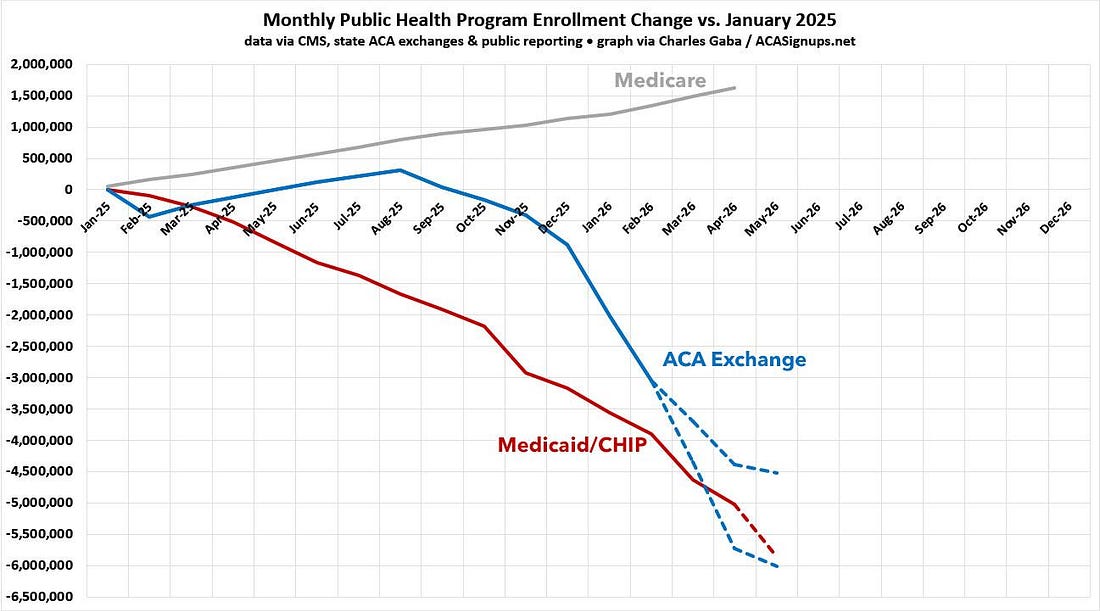
In fact, as I noted in an analysis last week, when combined with the millions of Medicaid enrollees who have already lost coverage since Donald Trump retook power back in January 2025, I’m fairly certain that OVER 10 MILLION Americans have ALREADY lost healthcare coverage so far … and this is before the major provisions of the so-called “One Big Beautiful Bill Act” (OBBBA, or H.R. 1) which was passed by Congressional Republicans and signed into law by Donald Trump last year go into effect:
 |
So, in addition to seeing average unsubsidized premiums jump by another ~13% or so next year (again, I’m assuming a point or two will be shaved off the preliminary filings overall), what else can ACA enrollees expect in 2027, cost-wise?
Well, for one thing, for those who are still eligible for federal subsidies, the formula will be changing in two ways … better in one way, worse in another.
The Good News: The official Federal Poverty Level (FPL)* will be increasing a bit next year, by between 2.0 and 2.9% depending on your household size. Here’s what this looks like for the 48 contiguous states and DC (for Hawaii, add 15% to each amount; for Alaska, add 25% to each):
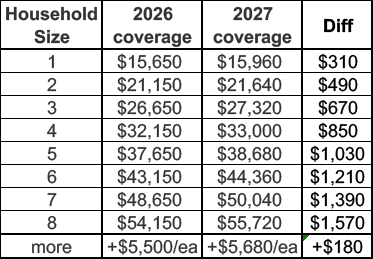 |
*(yes, I know it says this is for 2026; ACA subsidy eligibility is based on the prior year’s FPL, so 2027 subsidy eligibility is actually based on comparing 2027 household income with the 2026 FPL. Yes, I know that’s confusing.)
What this means in practical terms: The household income cut-off for subsidy eligibility will be a bit higher, which also means that many of those already eligible for subsidies will be eligible for slightly more generous subsidies due to how the sliding scale works:
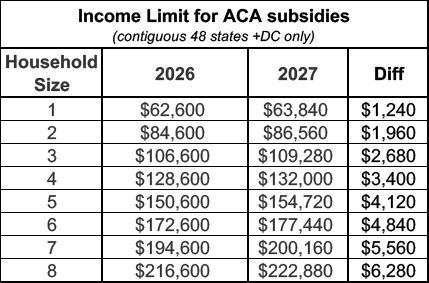 |
In other words, if you’re single/no kids, your eligibility limit will increase by $1,240 next year; for a family of four it goes up by $3,400.
The Bad News: Unfortunately, while the FPL thresholds are increasing slightly, this will be effectively canceled out by the ACA federal subsidy formula becoming slightly less generous than it is this year, due to a complex formula called the Premium Adjustment Percentage Index (PAPI).
I won’t bore you with the details, but the bottom line is that the PAPI is what determines the sliding scale for ACA tax credits. Under the enhanced subsidies which Congressional Republicans allowed to expire last year, in addition to removing the so-called “subsidy cliff” at 400% FPL, the scale was locked in at far more generous levels.
Once the enhanced subsidies expired, however, the Trump Regime didn’t simply revert back to the pre-COVID formula (which was already far less generous); they actually poured salt in the wound by changing their interpretation of that formula in a way which made it even stingier yet.
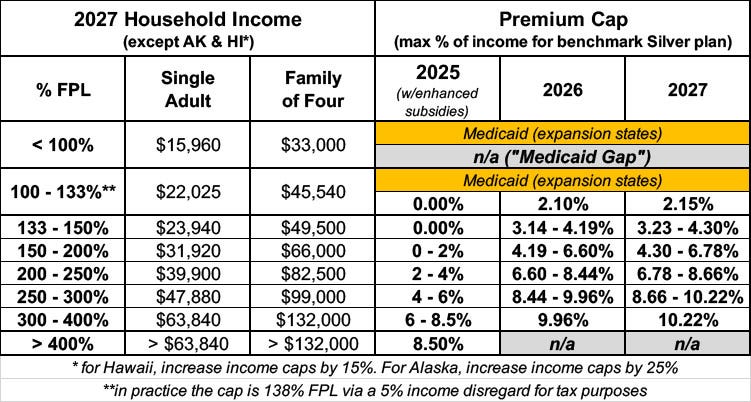
Here’s what this means: The table below compares the “Premium Caps” for ACA enrollees at different income brackets in 2025 and 2026 … and what they’ll look like in 2027 (note that the income levels are based on the 2027 FPL thresholds):
 |
What does this translate to in real world terms?
Well, let’s consider a single 50-yr old adult who earns, say, $20,000, $40,000, $60,000 or $80,000/year, enrolling in the benchmark Silver plan:
At $20,000, assuming they don’t live in a Medicaid expansion state:
In 2025, they didn’t have to pay anything in premiums.
In 2026, they’re paying 2.1% in premiums ($35/mo)
In 2027, they’ll have to pay 2.15% of their income in premiums ($36/mo)
At $40,000:
In 2025, they had to pay ~4.62% in premiums (~$154/mo)
In 2026, they’re paying ~8.61% in premiums (~$287/mo)
In 2027, they’ll have to pay ~8.68% in premiums (~$289/mo)
At $60,000:
In 2025, they had to pay ~8.50% in premiums (~$425/mo)
In 2026, they’re paying 9.96% in premiums (~$498/mo)
In 2027, they’ll have to pay 10.22% in premiums (~$511/mo)
At $80,000:
In 2025, they paid 8.50% in premiums ($567/mo)
In 2026, they’re paying FULL PRICE…which averages around $873/mo nationally for a 50-yr old.
In 2027, they’ll have to pay FULL PRICE…which should average around $986/mo nationally for a 50-yr old, assuming a 13% premium increase.
On the surface, this isn’t too much worse for subsidized enrollees, since they only see an increase of a few dollars per month (of course, that’s on top of the already-massive premium spikes they were hit with this year). For those paying full price, of course, it’s a very different story.
HOWEVER, there’s one more thing which the PAPI formula controls: How much deductibles and maximum out of pocket (MOOP) caps go up. And on that front, nearly every enrollee is about to be hit with steep increases as well:
Under 45 CFR 156.130(a)(2), for the 2027 calendar year … the 2027 maximum annual limitation on cost sharing is $12,000 for self-only coverage and $24,000 for other than self-only coverage. This represents an approximately 13.2 percent increase from the 2026 parameters of $10,600 for self-only coverage and $21,200 for other than self-only coverage.
In 2025, the MOOP ceiling was $9,200 for a single adult or $18,400 for a multi-person household.
In 2026, the MOOP ceiling was $10,600 / $21,200/household (+15.2%)
In 2027, the MOOP ceiling will be $12,000 / $24,000 (+13.2%)
This means that unless you qualify for Cost Sharing Reduction (CSR) assistance, your maximum deductible/co-pays/etc will be $1,400 - $2,800 higher than they are this year … which was already $1,400 - $2,800 higher than it was last year.
OK, but what about the 37% of ACA exchange enrollees who do receive CSR assistance (which is also down from ~50% last year)? This includes three categories:
Silver CSR 94 enrollees (those earning 100 - 150% FPL)
Silver CSR 87 enrollees (those earning 150 - 200% FPL)
Silver CSR 73 enrollees (those earning 200 - 250% FPL)
Well, I’m afraid that’s becoming less generous as well:
As indicated in Table 1, we are establishing the values of the 2027 reduced maximum annual limitation on cost sharing at $4,000 for enrollees with household income greater than or equal to 100 percent of the federal poverty level (FPL) and less than or equal to 150 percent FPL, $4,000 for enrollees with household income greater than 150 percent FPL and less than or equal to 200 percent FPL, and $9,600 for enrollees with household income greater than 200 and less than or equal to 250 percent FPL, as calculated using the 2027 premium adjustment percentage and maximum annual limitation on cost sharing.
These maximum cost sharing amounts are around $500 higher, $500 higher and $1,150 higher than in 2026 respectively.
There’s a lot of other changes coming for 2027, as well, but I’ve run out of space today so I’ll have to address those in the next issue.
Good luck to us all; we’re gonna need it.
You’re currently a free subscriber to Lincoln Square . For the full experience, upgrade your subscription today for 30% off our regular subscription rate. The Truth needs a voice. Your paid subscription helps us amplify it.
| ||||||||||


