
|
 |
Family voting is a crime. So why hasn’t anyone been charged?
291 potential breaches of secret ballot rules were logged at May's local elections. The penalty is six months in prison, an unlimited fine, or both. It has never been applied.
|

| |||||||||||||||


Emma Schubart is a Research Fellow at the Henry Jackson Society.
During last May’s local elections, Democracy Volunteers, the Electoral Commission-accredited observer group that has monitored UK elections for a decade, reported that presiding officers in Birmingham told them plainly that “it was clear that votes were being influenced.” One officer described a man directing another voter’s ballot with hand signals, blinking, and “Islamic gestures.” In Manchester, local officials logged 50 further incidents “that polling staff could clearly see.”
Since May 2024, section 62C of the Representation of the People Act 1983, inserted by the Ballot Secrecy Act 2023, has made it a criminal offence to be with, or near, another voter in a polling booth while intending to influence how they vote, punishable by up to six months in prison, an unlimited fine, or both.
Yet when the Electoral Commission published its assessment of the May elections, it concluded there were “very low levels of proven electoral fraud”, making no reference at all to the pattern documented across 50 Birmingham polling stations. Lord Hayward, the peer who sponsored the 2023 Act commented that “the commission seems to be behaving like the three wise monkeys: see no evil, hear no evil, speak no evil.”
So is the regulator simply refusing to look, or is the law actually unenforceable? It’s probably both.
Family voting is the practice of one voter, usually a male head of household, entering the booth with, or directing the ballot of, a relative, rather than each elector marking their ballot alone. In the UK, this phenomenon has been observed for years. Democracy Volunteers reported it at 25% of the 1,723 polling stations it monitored at the 2022 locals, and 48% of stations at the 2019 Peterborough by-election. MPs heard more than 70% of those subjected to it were women.
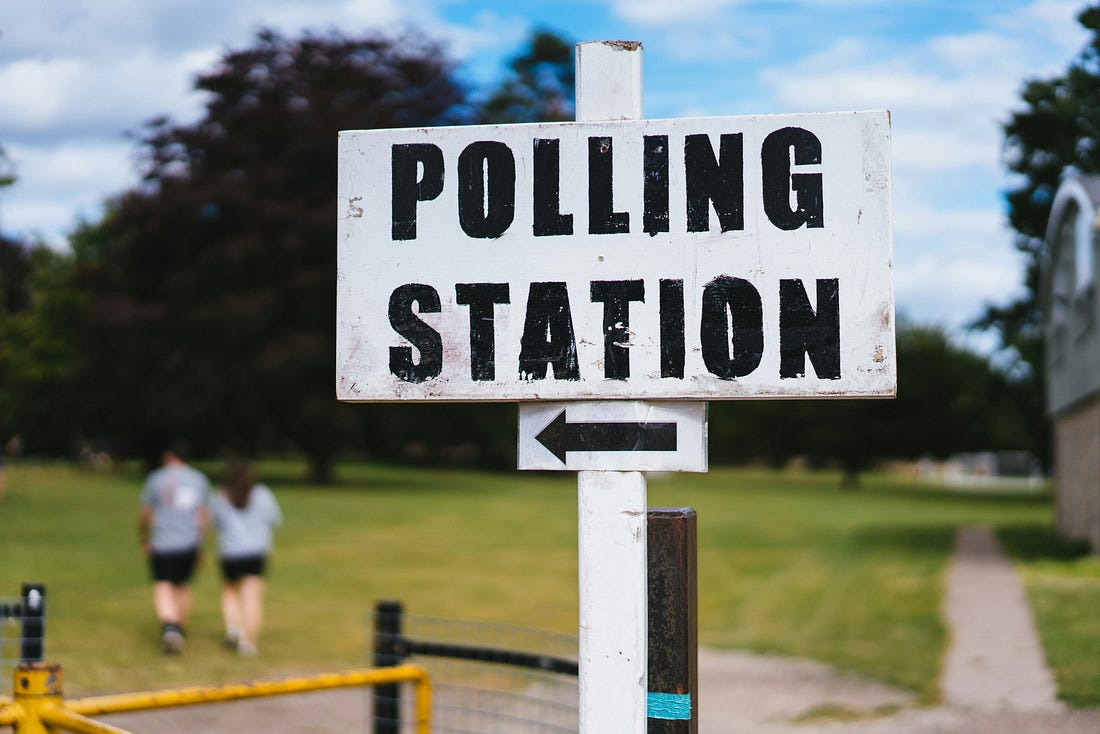
The most rigorously documented case is the Gorton and Denton by-election in February 2026. Observing 15 of 22 polling stations and 545 voters, Democracy Volunteers recorded 32 instances of family voting. The group’s director called it “the highest levels of family voting at any election in our 10-year history.” Greater Manchester Police initiated an investigation but a month later, they closed the case.
Investigators interviewed all four observers, fifteen presiding officers and the returning officer, and got CCTV from just three of 45 stations. The rest of the stations had no cameras, ironically in order to protect secrecy. But the election observers had recorded no names and no timestamps, meaning there was nothing to match a face on camera to an incident. And what they’d seen, which was people entering booths together, looking over shoulders, didn’t show the intent that section 62C requires. So the investigation concluded finding “no evidence of any intent to influence”.
 |
The irony is obvious. The secret ballot is protected by removing the very things (cameras, witnesses, a paper trail) that would be necessary to prove a violation. Observers are trained not to intervene or identify voters, and election officers aren’t law enforcement. So this means that even though the offence exists in statute, it can’t be evidenced through normal channels unless a participant names names, which, within a family, is unlikely. This means that the offence, as written, may be nearly impossible to prove.
Since it was written into law, the Ballot Secrecy Act 2023 appears never to have produced a single prosecution. If the Electoral Commission were serious about protecting the health of British elections, it would publish the Birmingham evidence alongside its “very low levels of fraud” topline and press for a workable standard. Instead, silence is covering for a law that was always going to struggle to convict anyone.
The secret ballot was fought for specifically to sever the vote from the pressure of landlords, employers, clergy and family. This is a foundational achievement of British democracy. A vote cast under a relative’s direction, disproportionately a woman’s, is not a free vote at all. And a state that criminalises this on paper and cannot enforce it in practice choosing to tolerate the corrosion of its own democracy.
 | A guest post by
|
You’re currently a free subscriber to Economic Affairs. For the full experience, upgrade your subscription.
Paid subscribers support the work of Economic Affairs and the IEA's charitable mission and receive special invites to exclusive events.
| ||||||||||


