RH, Birkenstock, and Capri Holdings shares have all declined this year despite revenue growth, as investors weigh luxury brand strength... ͏ ͏ ͏ ͏ ͏ ͏ ͏ ͏ ͏ ͏ ͏ ͏ ͏ ͏ ͏ ͏ ͏ ͏ ͏ ͏ ͏ ͏ ͏ ͏ ͏ ͏ ͏ ͏ ͏ ͏ ͏ ͏ ͏ ͏ ͏ ͏ ͏ ͏ ͏ ͏ ͏ ͏ ͏ ͏ ͏ ͏ ͏ ͏ ͏ ͏ ͏ ͏ ͏ ͏ ͏ ͏ ͏ ͏ ͏ ͏ ͏ ͏ ͏ ͏ ͏ ͏ ͏ ͏ ͏ ͏ ͏ ͏ ͏ ͏ ͏ ͏ ͏ ͏ ͏ ͏ ͏ ͏ ͏ ͏ ͏ ͏ ͏ ͏ ͏ ͏ ͏ ͏ ͏ ͏ ͏ ͏ ͏ ͏ ͏ ͏ |
| | Written by Nathan Reiff 
Luxury brands must find a delicate balance between continuing to cultivate an air of exclusivity, maintaining perceived quality even in spite of higher materials costs and inflation, and balancing price increases against customer tolerance. While retail more broadly has faced numerous challenges as consumers have tightened their belts, some high-end luxury brands have largely avoided these pitfalls.
This doesn't necessarily mean that those luxury companies are positioned advantageously looking ahead, though. In order to be truly attractive to investors, high-end brands must not only benefit from continued strength in their sales but must also demonstrate that they are likely to be resilient if those consumers with a higher degree of disposable income trim their discretionary expenses. The companies below have the former, but it will be up to investors to assess whether they also possess the latter.
RH's Decline May Be an Opportunity, Though Uncertainty LingersHigh-end home furnishings company RH (NYSE: RH), formerly Restoration Hardware, recently lost some of its luster for investors after a mixed Q2 2026 earnings report, issued in September 2026. On one hand, the company certainly outperformed analyst predictions: both revenue and earnings per share (EPS) were wins over expectations, the latter beating forecasts by an impressive $2.32 per share. Sales growth was 2.6% year over year (YOY), which is hardly exceptional but still better than analysts had estimated.
On the other hand, a confluence of factors ranging from the housing downturn to unforeseen supply chain costs are all weighing on internal forecasts going forward. RH management predicts 5.5% to 7% in revenue growth for the full fiscal year as well as free cash flow ranging from $300 million to $400 million.
Investors seem to have expected better on this front; the market sent RH stock cratering by 10% in a five-day period in mid-September, bringing total declines to about 27% year to date (YTD). Still, there are reasons why RH could turn things around.
Its luxury RH Estates line is making real progress at expanding its addressable market and is also helping to boost average price points, which are currently about 45% higher than the company's prior assortment. All of this should help boost RH's margins.
Understandably, analysts are cautious: only seven out of 20 have rated RH shares a Buy, despite the projected upside potential of 27%. After an insider sell-off earlier in the summer, investors must decide if RH shares have farther to fall.
Birkenstock's Brand May Be Its Biggest AssetBirkenstock Holding plc (NYSE: BIRK) has managed to maintain interest in its high-end sandals, selling them at full price while rivals like On Holding (NYSE: ONON) have resorted to extensive promotions. The company has one of the strongest brands and most loyal customer bases across the footwear space and may benefit from a perception that its products have not declined in quality while many competitors' have.
That's not to say that Birkenstock has been free of challenges. Shares of BIRK are down 25% YTD, and profitability is facing pressure due to tariffs, increased freight costs, foreign exchange rates, and much more.
This has brought down the firm's adjusted gross margin, which fell by 130 basis points YOY last quarter.
At the same time, though, 13.3% YOY revenue growth has given management confidence to suggest that Birkenstock may see 15% in constant-currency revenue growth with solid adjusted EBITDA for the full fiscal year.
Adjusted EPS may be struggling a bit, but broad-based growth may help Birkenstock to recover in the coming quarters.
Capri Is Not Out of Trouble, But Profitability and Reduced Debt Are Strong PointsLuxury fashion holding company Capri Holdings Ltd. (NYSE: CPRI) is best known for owning brands like Michael Kors and Jimmy Choo.
The firm has undergone brand elevation transformations that parallel RH's plan to amplify its Estates line, showing that Capri also believes that ultra-luxury consumers will be a durable source of demand (and revenue) even as other customers are squeezed.
Profitability for the latest quarter was better than expected, even as revenue declined modestly YOY. Perhaps most importantly, though, Capri management maintained a fairly ambitious fiscal year EPS outlook, even though it did lower its revenue outlook for the same period. Capri has also managed to significantly trim its debt to $224 million last quarter, compared to $1.5 billion the year prior, which may signal its financial health. However, like the companies above, Capri has seen shares shed value this year, falling 29% YTD and leaving some analysts cautious.
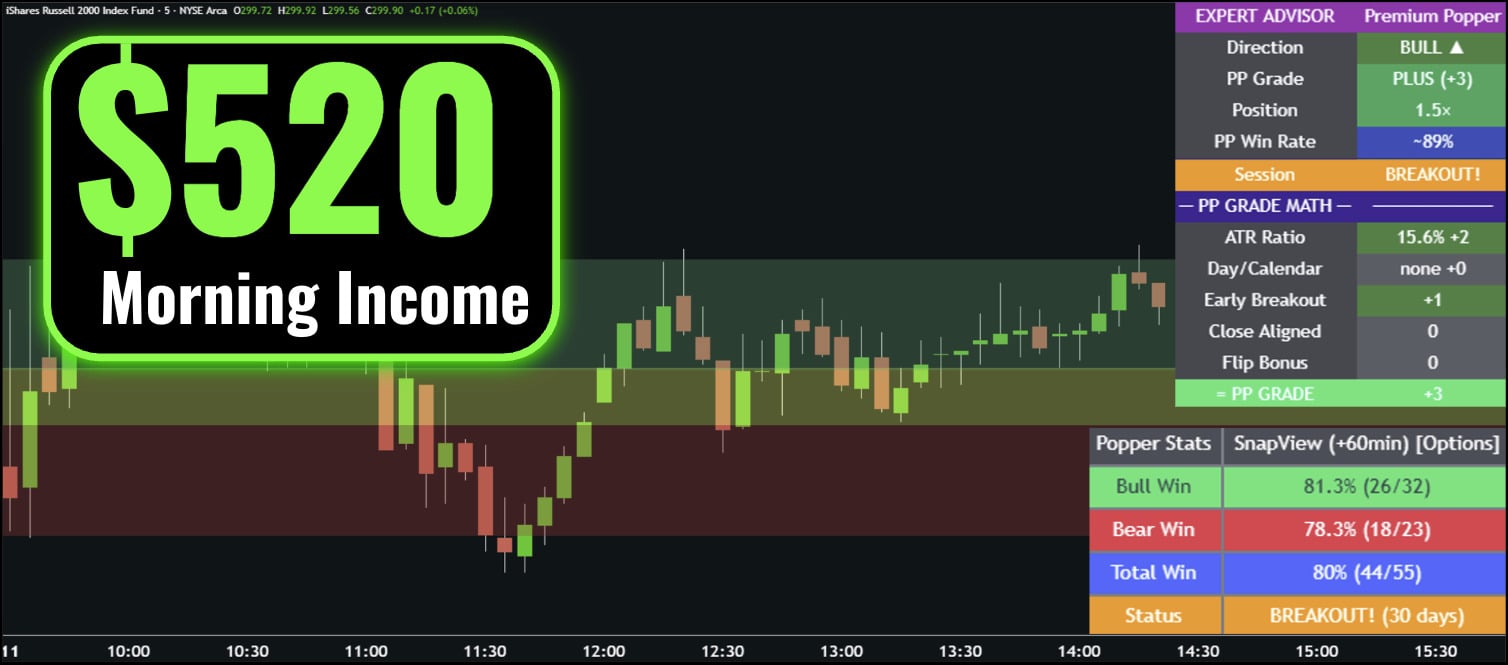
 Read This Story Online Read This Story Online |  On August 11th, a clean morning breakout reversed hard within minutes, yet the setup still resulted in a 520 dollar outcome before lunch.
The edge traces back to the first 20 minutes after the opening bell, when nearly 25 percent of the day's volume clears through institutional block orders, revealing where breakouts tend to fail or hold. Watch the free presentation before access closes for good |
| Written by Peter Frank 
When U.K.-based Prudential plc (NYSE: PUK) spun off its U.S. annuity business as Jackson Financial (NYSE: JXN) in September 2021, investors might have thought it was a complicated, hand-me-down life insurer. For its first two years, the stock barely moved.
Three years later, that has all changed. A record quarter and a significant leadership transition together make this an important moment to size up whether the company’s rally has more room to run.
With a nearly 30% increase in its stock price this year, investors need to decide whether chasing the stock now is too late for the party.
Record Earnings Drive MomentumJackson reported adjusted operating earnings of $513 million, or $7.30 per diluted share for the second quarter, a company record, comfortably ahead of the $5.72 analysts had modeled.
Excluding notable items, adjusted operating earnings per share (EPS) grew 55% year-over-year, powered by strong spread income and a shrinking share count from years of buybacks.
GAAP net income attributable to common shareholders, which can swing with derivative and hedging accounting, came in at $644 million, or $9.16 per diluted share, versus $168 million, or $2.34 per share, a year earlier.
But the GAAP figure is not the number investors most care about. The adjusted operating number, led by sales momentum, is more closely watched.
In that, retail annuity sales came in at $5.9 billion in the quarter, up 34% from a year earlier, while sales of its registered index-linked annuities (RILA) hit a record $2.3 billion, up 69%.
Capital Returns Strengthen the CaseThat shift matters because it feeds into capital returns, which is the real heart of the investment case. Jackson returned $290 million to common shareholders in the second quarter alone, split between $227 million of buybacks and $63 million of dividends, a 34% increase from a year earlier. The company has now returned nearly $3.3 billion to shareholders since becoming independent in 2021.
Management reaffirmed its full-year 2026 target of $900 million to $1.1 billion in capital return, building on the $862 million returned in 2025, itself up 47% per share from 2024.
The board also raised the quarterly common dividend 12.5% to 90 cents per share, putting the yield around 2.6%.
Analysts See Limited UpsideAnalyst sentiment is more mixed than the stock's chart might suggest. The consensus rating among seven analysts is a Moderate Buy, with one Strong Buy, two Buys, and four Holds. The average 12-month target price is $133.80, about 4% below the current share price.
The highest target is $149 per share, while the lowest is $105. Two analysts have boosted their target price since earnings were released, as one other analyst upgraded the stock.
Leadership Change Adds RiskThere are reasons for caution here, not just profit-taking concerns.
Jackson recently announced that longtime chief executive Laura Prieskorn will retire after nearly 40 years with the company. The company will hand the reins to current chief financial officer Don Cummings at the beginning of October. Leadership transitions at complex insurers always carry execution risk, even those described, as this one was, as an orderly succession.
Jackson's business also remains exposed to equity markets through its large legacy variable annuity book. The company has flagged that a significant market decline could become a headwind.
In addition, Jackson operates in a crowded field of annuity writers, including Lincoln National (NYSE: LNC), Equitable Holdings (NYSE: EQH), Brighthouse Financial (NASDAQ: BHF), Corebridge Financial (NYSE: CRBG) and F&G Annuities & Life (NYSE: FG), all chasing the same retiring-Boomer demand for guaranteed income.
Jackson's edge has been its No. 1 position in traditional variable annuities and near the top in the fast-growing RILA category. That’s been reinforced by a private-credit sourcing partnership with TPG (NASDAQ: TPG) that Jackson said is already improving new-money yields.
The Bull Case Meets a Richer ValuationFor investors, Jackson looks like a value stock for patient investors. Its share count is shrinking and has a growing dividend, double-digit adjusted operating earnings growth, and a business mix becoming less market sensitive.
In general, this is not a flashy growth stock, but a steady compounder that has quietly outperformed while a leadership change and a full valuation catch everyone's attention.
For those considering a position, the analyst consensus price target sitting today's share value below might be a signal to wait for a pullback rather than chase the stock so close to its 52-week high. A few more quarters after the leadership handoff and some additional earnings releases, while watching for net flows and capital ratios, could be the right call before committing new money.
Read This Story Online |  A Virginia dad with no coding background built an AI-powered trading engine that flags one of the market's most reliable bullish signals every day.
By the end of 2025, his system had outperformed some of Wall Street's top hedge funds.
He recently went live to walk through exactly how the tool works, start to finish. Watch the full breakdown of how this AI trading tool works |
| Written by Thomas Hughes 
Believe it or not, the holiday shopping season is here, so it's time to consider the best plays. As it stands, seasonal sales growth is expected to accelerate year over year to 4.55% to 4.8%, topping $1.7 trillion for the first time, underpinned as always by e-commerce. Digital sales are expected to top 8% seasonally and may outpace expectations as AI adoption accelerates. Hyperscalers, business services, and merchants are embedding AI throughout the digital retail stack, and it is resonating with consumers. An estimated 25% to 30% of shoppers say they will use AI this season for help with research, price comparisons, and budgeting.
While trends suggest that off-price retailers such as TJX Companies (NYSE: TJX) and big box stores, including Walmart (NASDAQ: WMT) and Costco (NASDAQ: COST), are well-positioned, Target (NYSE: TGT) looks like a more compelling play. The company has dual growth levers: overall sales are accelerating, and its turnaround is gaining traction.
Within that, Target shares present a value opportunity relative to peers—trading at approximately 15x current-year earnings and yielding 3%. The stock could double in price and still present value relative to Walmart and Costco while delivering a significantly higher yield.
Target Aims at Strong Holiday Sales With Aggressive Pricing StrategyTarget has a catalyst in the works that will likely produce market-beating results in Q3 and the holiday season.
The company lowered prices on more than 10,000 items, providing more value to shoppers without significantly impairing its cash flow outlook. The price cuts are only the first step, coming before Target’s planned October Deal Days.
Deal Days offers discounts of up to 40% on most items, and even this isn’t the end of the story. Target leads in digital sales services such as same-day delivery and curbside pickup, both expected to underpin global digital sales.
The upcoming earnings release could be a trigger for the stock, and analysts are mispricing the opportunity. They forecast revenue growth deceleration at the consensus midpoint, setting the stage for outperformance and hot guidance, which would extend the revision trend.
Analysts' sentiment and price target trends are also bullish, underpinning the stock price rise to date. While consensus is pegged at Hold, the group reflects strong conviction, with 32 analysts tracked and a 34% Buy-side bias. While the consensus price target offers little upside as of mid-September, the trend is upward and likely to continue in upcoming quarters. High-end targets extend the rally, keeping the market above an inflection point and on track to retest long-term highs.
Dividends, Buybacks, and Institutions Limit Downside in 2026Target’s risk-reducing factors include dividends, dividend growth, buyback capacity, and institutional interest. The dividend is worth 3%, is less than 50% of the earnings outlook, and has increased annually for over 50 years. The 50-year track record says it all: the company has weathered a dozen or more financial storms and sustained its payment through it all. Highlights in 2026 include a recommitment to capital allocation, aimed at improving margins over time.
Target hasn't bought back shares recently, choosing instead to invest in its turnaround, but it still has ample authorization and will likely resume repurchases in the coming quarters. Analysts view resumed buybacks as a catalyst for share prices due to the impact on earnings; earnings per share growth will accelerate with share counts declining.
Institutional data reflects confidence in Target’s long-term opportunity. The group owns approximately 80% of the stock and has been accumulating in 2026, ramping activity in early Q3 to a multi-quarter high. With it in play, Target’s price may take time to advance, but downside is limited as institutions are likely to buy on dips.
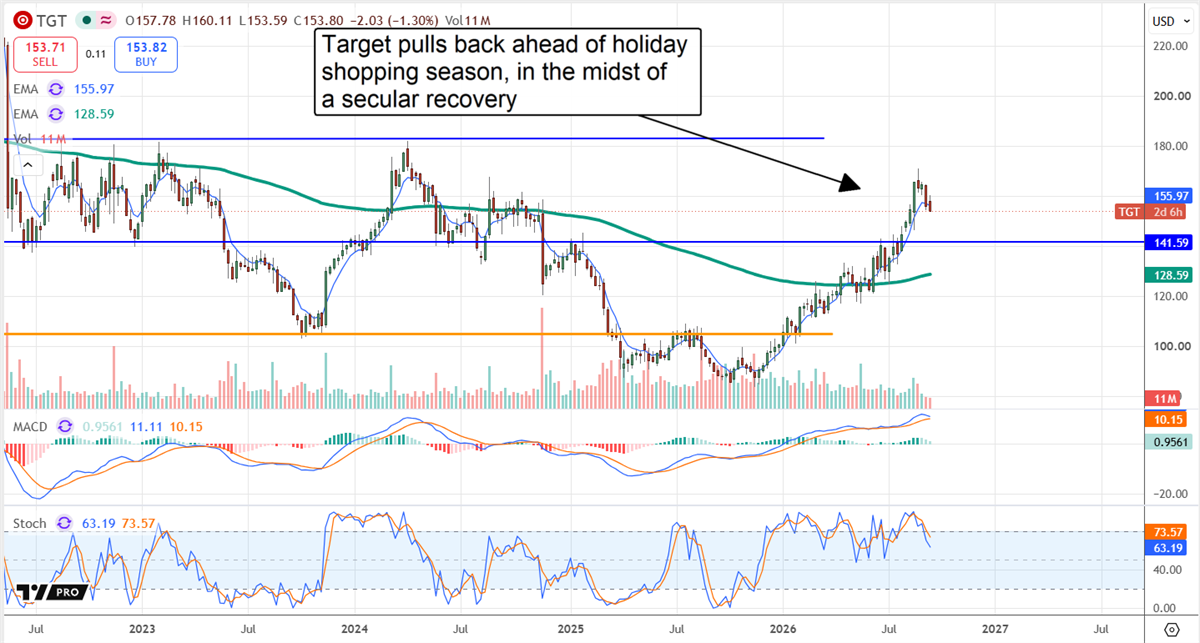
The likely support target upon pullback is near $142. This level aligns with the middle of Target’s existing trading range and is a pivot point for price action. The likely outcome is that TGT shares retest and confirm support at this level, possibly rebounding ahead of the upcoming earnings release. Q3 results are due in early November, just ahead of peak holiday shopping.
Risks include consumer headwinds and the aggressive $6 billion turnaround price tag. If lower prices and Deal Days don’t increase traffic volume, the impact on margin could be substantial. In this scenario, the cost of turnaround efforts, including the lean into Target Beauty Studio, won’t justify the return and could trigger a market reset.
Additionally, investments in wages, training, and technology are pressuring margins and may not deliver the expected gains in market share and profitability. The market gets it wrong that Target is a simple turnaround story; this is more of a secular play, with the 2nd-largest big-box retailer and Walmart competitor reclaiming share lost to managerial missteps.
Read This Story Online |  Louis Navellier says Trump's administration is quietly funding what he calls America's first sovereign AI data center, a project he claims is 1,000 times more powerful than any existing facility.
Navellier believes a public announcement could come on or before September 29, potentially moving shares of the company involved.
He calls this the biggest AI story yet, with implications for America's AI race against China. See Navellier's full research and stock ticker now |
| More Stories |
| |
|
|