
|
 |



GOLDEN, Colo. — On September 8, 2026, Yvonne “Missy” Woods stood in a Jefferson County courtroom in a blue blazer and wept as videos from her victims played to the court. Judge Andrew Poland sentenced the 66-year-old former Colorado Bureau of Investigation scientist to ten years in prison — and took her into custody on the spot. For twenty-nine years, Woods was the state’s star DNA witness. She worked the Kobe Bryant case. It turns out she was the most dangerous person in the building.
 |
The charges read like sabotage. Between 2008 and 2023, Woods deleted DNA quantification values, re-ran entire testing batches without documenting it, and concealed contamination. And in at least 32 sexual assault cases, she did something almost unspeakable: she deleted the values showing male DNA was present on a rape kit, then wrote the report that closes a case — “No Male DNA Found.”
Understand what those words mean to a survivor. A rape kit is not a form. It is hours of invasive, humiliating evidence collection a woman endures with her body still freshly traumatized, on the promise that science will speak for her when she cannot. When the report comes back “no male DNA found,” that is the state telling her there is nothing to pursue — no profile, no database comparison, no cold hit, no arrest. Woods handed thirty-two women that verdict fraudulently. Their attackers’ DNA was there. She erased it and moved on.
The damage cuts both ways. False negatives free the guilty; false confidence imprisons the innocent. KC Harney spent 27 years in prison for a 1995 Lakewood rape he did not commit — a conviction built partly on Woods’ DNA work before retesting cleared him. He sits in that courtroom at every hearing, because the same analyst who stole his decades also handled the 1985 murder of his wife Tamara’s father. And every verdict she touched as a “star witness” is now fair game for challenge.
But here is what should make every Coloradan furious: the rot does not stop at one lab bench. Say the DNA comes back positive. Say the perpetrator is caught and convicted of sexually assaulting a child. In Colorado, he can still walk out of the courtroom on probation. As former district attorney George Brauchler has documented, a man who rapes a child is eligible for probation — and remains eligible even if he goes on to rape other children, one time each, even as their teacher, coach, or clergyman. Critics of the status quo, citing state sentencing outcomes on Attorney General Phil Weiser’s watch, put the figure at 73 percent of convicted child rapists getting probation instead of prison. Republican Rep. Brandi Bradley has carried the remedy — the “Protections Against Child Rape” bill, HB25-1073 in 2025 and SB26-111 in 2026, mandating prison for class 3 and class 4 child sexual assault. Democratic majorities have killed it three years in a row, most recently in Senate Judiciary this spring. Small wonder Colorado ranks fourth in the nation in reported sex offenses per capita — and that over the past decade, for every ten rape reports, police made a single arrest.
 |
The Woods scandal shows what happens before conviction; Colorado’s sentencing laws show what happens after. Evidence erased, then evidence discounted.
Back to the lab. The bureau knew. A CBI internal affairs report shows a worker questioned Woods’ testing all the way back in 2014. In 2018, she was accused of data manipulation and temporarily pulled from DNA casework — then quietly put back on it. For five more years she kept processing rape kits while colleagues’ concerns sat in a drawer. What finally stopped her? Not supervision. Not audit. An intern, in 2023, noticed a pattern of missing data in her work. A student spotted in months what a state agency had missed for a decade. A judge found in August that this oversight failure amounted to “outrageous government conduct.”
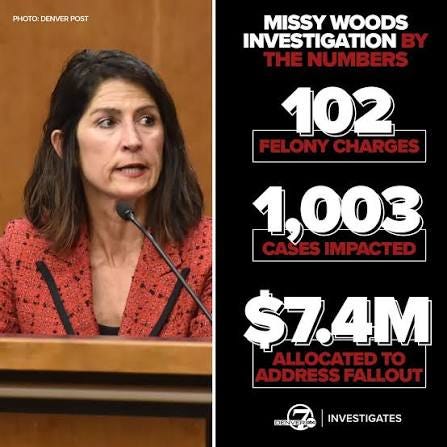
The ledger so far: CBI opened its investigation in September 2023; Woods retired that November. In January 2025 she was charged with 102 counts — cybercrime, perjury, attempted influence of a public servant, forgery. In June she pleaded guilty to four felonies; the rest were dropped. She got ten years. At least 1,045 of her cases are tainted, retesting will cost taxpayers over $11 million, and Denver police alone have reopened 13 sexual assault investigations.
Her motive? Prosecutors found no payoff and no framing. Woods said she was buried in work, trying to move cases along — to “make it go away.” That is exactly what she did: to the truth, and to thirty-two women whose cases went cold because a state scientist found them inconvenient. Some survivors waited over a decade past the first red flags for someone to read their results honestly. Some will never get a prosecution, because evidence degrades and statutes expire.
The lesson is bigger than one lab. Jurors treat scientists in white coats as infallible, and bureaucracies defend their stars rather than audit them. The Woods case argues for independent lab oversight, blind re-testing, and consequences for supervisors who paper over red flags. And Bradley’s killed bill argues for something simpler: that when a jury does its job and the evidence proves a child was raped, the sentence should mean prison. A state that erases the DNA and then shrugs at what the DNA proves is telling its victims — women and children alike — to make it go away themselves.
An intern did the right thing. The adults had a decade and declined. Every woman who ever submitted a rape kit in Colorado deserved better.
You're currently a free subscriber to Heartland Journal ®. For the full experience, upgrade your subscription.
| ||||||||||


