 A Message From Stansberry Research Dear Reader, For years, I've recommended to my readers to put a big chunk of their retirement money into one stock: Berkshire Hathaway. And for anyone who followed my recommendation, they've had the chance to do very well. But now, I may have found an even better retirement stock for the years to come—and today I'm going to show you the name and stock symbol, totally free of charge. (Click here to get the specifics.) This is a company few have heard of, yet it's at the epicenter of America's two most important industries right now. (Yes, AI is one of them.) In my new presentation, I explain everything you need to know about this incredible company, and I reveal the stock market ticker symbol, totally free of charge. No credit card or email address or anything else required. It's incredible story of a company unlike any other in America. The returns could be massive (much bigger than Berkshire in recent years)... the dividends are massive, too... and the best part of all is that I think the next few years will be even more lucrative for this stock than the past, because the assets the company owns are critical for America's two most important industries right now. That's why I believe this might be the greatest retirement stock in America right now. Click here to get the name and ticker symbol of this amazing stock, totally free of charge. Again, no credit card, or email required. Regards, Whitney Tilson
Editor, Stansberry Research P.S. One more thing. This stock is so powerful, one famous money manager put 60% his entire multi-billionaire fund into the exact same stock I'm going to tell you about today. It sounds crazy until you see exactly what this company owns and does. You'll find everything you need to know, including the stock name and ticker symbol, here.
Additional Reading from MarketBeat IBM and Lockheed Martin Turn a Swiss Defense Deal Into a Quantum Computing BetWritten by Jeffrey Neal Johnson. Article Published: 9/11/2026. 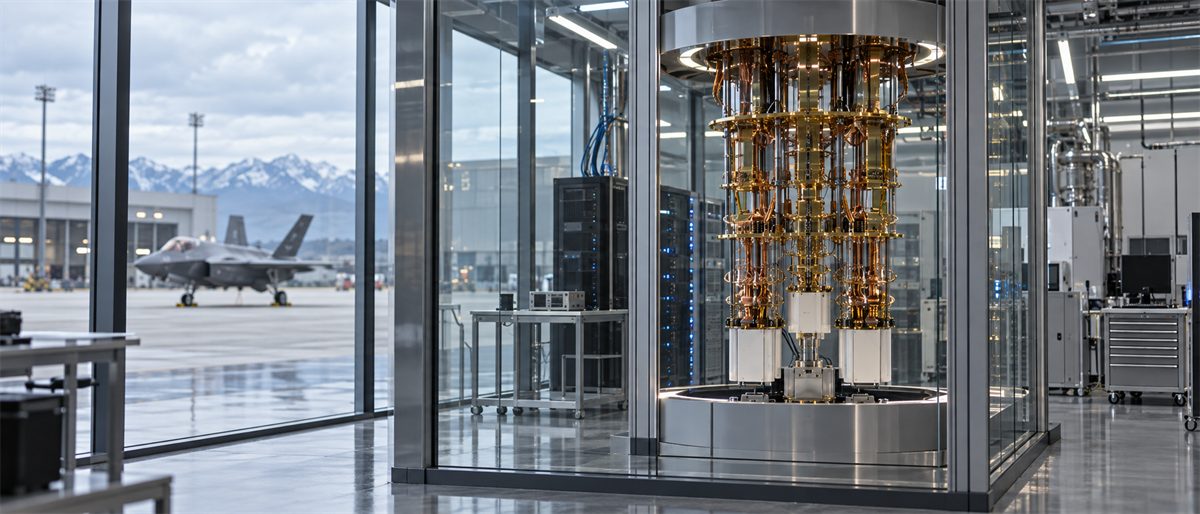
Key Points- Lockheed Martin used Switzerland's F-35A offset obligations to fund an IBM quantum computing hub at ETH Zurich instead of dilutive venture financing.
- The Swiss facility pairs IBM's 120-qubit Nighthawk r2 processor with the Alps supercomputer to research quantum navigation sensing and aerospace materials science through 2029.
- Both companies offer investors financially stable exposure to quantum research, with Lockheed Martin's $230 billion backlog and IBM's steady cash flow supporting long-term development.
- Special Report: Trump goes "all-in" on Grand Canyon energy breakthrough
When everyday market participants seek exposure to quantum computing, they often find themselves sorting through early-stage technology startups with rapid cash burn and uncertain commercial prospects. Pure-play quantum firms often rely on secondary share offerings to stay afloat, diluting existing shareholders long before their physical hardware achieves fault tolerance. A different financing mechanism is quietly emerging at the intersection of national defense and enterprise high-performance computing (HPC). When sovereign governments purchase advanced military platforms, they routinely require defense contractors to reinvest a portion of that capital into domestic industry and research. These arrangements, known as defense industrial offsets, can channel millions of dollars in non-dilutive, state-backed capital into enterprise quantum infrastructure. By teaming up to anchor a commercial quantum facility in Europe, aerospace sector prime Lockheed Martin (NYSE: LMT) and technology sector veteran International Business Machines (NYSE: IBM) are demonstrating how sovereign defense mandates can accelerate commercial quantum technology while protecting corporate balance sheets. Converting Jet Purchases Into SupercomputingUnder the leadership of armasuisse, the Swiss Federal Office for Defence Procurement, international arms agreements require foreign contractors to return economic value to local industry. When Switzerland finalized its procurement of 36 F-35A Lightning II fighter aircraft, Lockheed Martin faced an offset obligation approaching $3 billion. Rather than satisfying these terms through routine manufacturing subcontracts, Lockheed Martin partnered with IBM to deploy Switzerland's first IBM Quantum System Two at ETH Zurich. Installed at the Swiss National Supercomputing Centre (CSCS) in Lugano, the system pairs IBM's Quantum Nighthawk r2 processor with the center's Alps supercomputer. The Nighthawk r2 features 120 programmable qubits and a high-speed reset architecture capable of processing more than 100,000 circuits per second. For IBM, the offset structure acts as an institutional sales engine. It allows the company to install flagship hardware abroad under a multiyear contract extending through 2029, funded by defense procurement rather than speculative venture capital. For Lockheed Martin, the initiative fulfills its offset commitments while directing research toward computing architectures that could shape future aerospace platforms. From Molecules to MissilesCSCS's work is tailored to two operational priorities: autonomous navigation and materials science. Modern military doctrine relies heavily on satellite-based GPS for navigation, targeting and timing. In contested operating theaters, adversaries deploy electronic warfare systems, radio-frequency jamming and spoofing to degrade satellite signals. To operate in these environments, defense forces need alternative guidance systems. Quantum sensing uses the atomic-level behavior of matter to measure minute changes in gravitational and magnetic fields. By tracking these physical forces, an aircraft or naval vessel can calculate its precise position without relying on external radio signals. The Swiss innovation hub is designed to translate these theoretical physics principles into deployable sensing instruments. The second focus area is advanced additive manufacturing. Designing aerospace structures for hypersonic speeds or high-stress propulsion requires novel metallic alloys capable of withstanding extreme temperatures. Modeling molecular bonds on classical computers requires extensive computational approximations. The partners have previously demonstrated how to overcome some of these limitations by publishing research on sample-based quantum diagonalization (SQD). Using 52 qubits on an IBM processor, the team simulated the electronic properties of open-shell methylene radicals. This type of simulation allows engineers to predict how complex alloys and combustion chemistry behave under stress, potentially accelerating the development of flight-ready aerospace materials. How Defense Workforces Lock In Hardware ValueThe Swiss hub builds on an established technological pipeline between the two companies. Lockheed Martin previously integrated IBM Granite large language models (LLMs) into its internal AI Factory platform, providing development tools to more than 10,000 defense engineers. Granite LLMs assist engineers with automated software coding, language processing and system diagnostics under strict Department of Defense data-governance standards. This integration creates a multilayered software and hardware moat: Algorithmic Toolchains: Lockheed Martin's workforce uses IBM's open-source Qiskit software architecture, helping ensure that future defense applications are optimized for IBM quantum systems. Hybrid Quantum-Classical Workflows: Deploying the Nighthawk r2 alongside the Alps supercomputer enables hybrid computing, in which classical servers offload specific mathematical calculations to quantum processors. Classified Data Guardrails: Integrating commercial open-source AI frameworks with proprietary defense workflows creates high technical switching costs, making it more difficult for competitors without comparable sovereign security credentials to compete.
Multi-Billion-Dollar Backlogs Meet Patient Enterprise CapitalInvestors seeking exposure to emerging technologies often struggle to find companies with strong balance sheets. This partnership provides access to quantum innovation through two established market leaders. Lockheed Martin functions as a prime defense contractor supported by steady government cash flows. The defense contractor carries an order backlog of about $230 billion, offering multiyear revenue visibility across its aeronautics, rotary and missile divisions. Lockheed Martin's stock trades at a forward price-to-earnings (P/E) ratio of around 17x while yielding roughly 2.6%. The company converted more than $75 billion in annual revenue into $5.02 billion in net income over the trailing 12 months, indicating that its core defense business remains profitable while offset arrangements help fund its next-generation computing research. IBM provides enterprise stability from a different angle. While IBM's stock price has declined about 19% year to date to trade near $238, the technology provider generates steady cash flow from its hybrid cloud and software businesses. IBM produces around $17.50 per share in operating cash flow, supporting a 2.8% dividend yield and a forward P/E multiple near 19x. Its enterprise footprint gives it the patient capital needed to support long-term quantum hardware development. A Multi-Year Horizon for Sovereign-Backed Defense TechTranslating quantum laboratory benchmarks into operational military hardware takes time. The initial research agreement at ETH Zurich extends through 2029, and commercial returns will unfold across several hardware generations. Broader market conditions or shifting defense-budget priorities could also influence the pace of technology adoption. The collaboration shows that sovereign defense offsets can offer a practical, non-dilutive path to funding quantum research. Investors seeking exposure to advanced quantum computing without balance-sheet dilution or venture-stage volatility might consider monitoring Lockheed Martin and IBM as they combine sovereign defense procurement with enterprise hardware development.
This ad is sent on behalf of Stansberry Research, 1125 N Charles St, Baltimore, MD 21201. If you would like to optout from receiving offers from Stansberry Research please click here. | 