| Unsubscribe |
I don't write about politics. Ever.
But I'm breaking my own rule today, because of what the midterm polls have been showing all summer.
Democrats have held the lead for months. The forecasters now favor the House of Representatives to flip in November. And lately, everyone I talk to is asking me some version of the same question:
"What happens to my savings if Washington changes hands?"
My answer never changes.
The wrong time to protect your retirement is after the rules change. The right time is now — while everyone else is still arguing about the polls.
Whatever happens on Election Day, the people who prepared beforehand will sleep fine that night. The people who didn't will be making phone calls in a panic, weeks too late.
I know which group I'd rather be in.
If you've been asking yourself the same question, this is where I send people. It takes about a minute.
Sincerely,
Shanon Davis
P.S. — There is one move Americans are quietly making before the midterms. If you only ever click one thing I send you, make it this one.
3 Space Stocks: Ready for Liftoff or Burning Up on Reentry?
Written by Thomas Hughes. Date Posted: 9/1/2026.

Key Points
- Space stocks pulled back sharply after the SpaceX IPO, driven by hype rather than any underlying business failure across the sector.
- Rocket Lab, AST SpaceMobile, and Intuitive Machines are viewed as leading candidates to reach profitability after SpaceX, each backed by growing contract pipelines.
- Analysts and institutional investors are increasingly bullish on these three stocks, with consensus price targets implying substantial upside for each.
- Special Report: Forget SpaceX. Buy the company Musk can't replace.
Space stocks have been on a wild ride this year. Many, if not all, rose by 50% to 100% at their peaks, if not more, only to fall back to Earth once the SpaceX (NASDAQ: SPCX) IPO was completed. We can blame this sharp reset in space stock valuations on SpaceX—not because of any underlying failure, but simply because of the hype. SpaceX is a compelling company with an eccentric, headline-making CEO, and it unlocked the floodgates of institutional space investing. What it does not do is make space an advanced or profitable sector. Pockets of profitability exist; SpaceX’s Connectivity segment, which includes Starlink, is one example, but they are few and far between. It will take some time for these stocks to fully recover.
The opportunity in space today is to pick up the pieces left by the SpaceX IPO and put them back together into a portfolio of winners. The space industry was valued at approximately $650 billion as of late August and is expected to grow at a modest single-digit CAGR over the coming years. Growth will be driven by declining launch costs and demand for satellite constellations, with commercial applications making up the bulk of the market and defense applications representing a large but still minority share. Commercial space stations and manufacturing platforms could soon replace existing infrastructure—which is limited—and open new paths to revenue and profits.
The $15 Gold Fund That Pays Up to $1,152/Month (Ad)
Gold is hitting record highs, but most investors are leaving income on the table. A $15 fund is quietly paying out up to $1,152 a month to regular investors - no mining stocks, no options, no physical metal required.
Chief Income Strategist Tim Plaehn calls it a breakthrough strategy that transforms gold's rally into reliable monthly payouts. The next distribution is just days away.
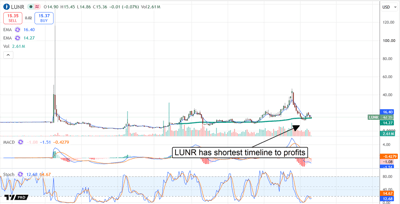
Discover the gold income fund before the next payout dateProfits are key, as most space companies, SpaceX included, face high upfront development and operating costs. SpaceX is forecast to achieve profitability soonest, potentially in the next fiscal year, followed by Intuitive Machines (NASDAQ: LUNR), AST SpaceMobile (NASDAQ: ASTS), and Rocket Lab (NASDAQ: RKLB). The question is which company is best positioned today.
Rocket Lab Accelerates Launch Schedule
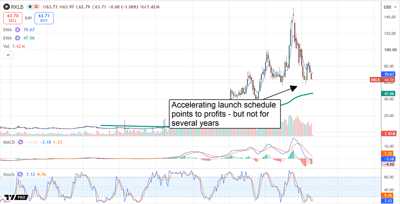
Rocket Lab is accelerating its launch schedule and has a major catalyst at hand. While its primary launch system, Electron, is ramping up, the company is preparing to bring its Neutron system to market. Its first flights are scheduled for late 2026 or early 2027, setting the stage for a gradual ramp over the following three years. Neutron is Rocket Lab's medium-lift rocket, capable of carrying more payload into space at a lower cost, and it is central to the company’s profitability outlook. As it stands, Rocket Lab has one of the longest timelines to profitability, but that timeline is increasingly de-risked. The company has a visible pipeline of contracts for future capacity; it just needs the rockets to deliver.
Revenue is ramping in step with the launch pace. Q2 results reflect year-over-year acceleration, more than 130% growth on a two-year stack, and narrowing losses. Backlog and guidance reinforced the results, pointing to sustained strength, if not acceleration, in the coming quarters.
Analyst sentiment and institutional interest are also ramping up. MarketBeat data show that analyst coverage is rising, sentiment is firming, and price targets are increasing, with consensus forecasting about 70% upside. The data also show that institutions own over 70% of the stock and increased their aggressive accumulation to record levels in early Q3.
AST SpaceMobile: On Track to Dominate 5G
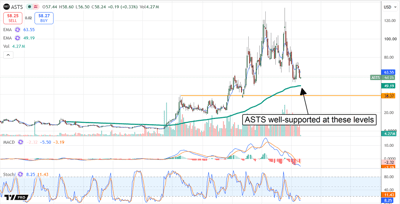
AST SpaceMobile is more of a space-based play than a space pure-play, operating a satellite constellation to support ground-based 5G operations. The constellation is populated by antenna arrays that can beam signals directly to ground-based devices, providing broad coverage. Today’s story is the cost and time required to get satellites into orbit. Tomorrow’s story is the large and growing number of contracts with global 5G service providers, enterprises, and governments. These contracts support a robust revenue and earnings outlook, with revenue in the midst of a significant ramp and profits still dependent on satellite deployment, service activation, and cost control.
Analyst and institutional activity reflect continued interest in the stock, though not without risk. While sentiment is pegged at Hold, it is improving, and consensus forecasts nearly 50% upside as institutions continue buying. Institutions show even higher conviction, owning more than 60% of the stock and buying at a pace of more than $10 for every $1 sold in early Q3. This institutional support has underpinned late-summer trading, limited risk, and provided a launchpad for rallies. The next catalyst could be the expected launch of a U.S. satellite service with major mobile network partners.
Intuitive Machines: Your Guide to Lunar Landings and Space Profits
Intuitive Machines has emerged as a mission-critical service provider with vertically integrated capabilities to support Moon-focused missions.
Recent acquisitions have increased its telemetry and communications capabilities, while its existing technologies include space infrastructure, payload protection, and lunar landers. Numerous contracts support its business, including government contracts and work related to NASA’s Artemis mission.
Results reflect accelerating demand and a path to profitability, with profitability expected in 2026 and broader earnings improvement anticipated thereafter. Upcoming results are likely to trigger price action, with analysts rating the stock a Moderate Buy, price targets firming, and consensus forecasting nearly 100% upside.
Cook Out, Silicon In: Will Ternus Trigger Apple’s Edge AI Boom?
Written by Jeffrey Neal Johnson. Date Posted: 9/1/2026.

Key Points
- Rising cloud API costs are driving developers and businesses toward running AI models locally, fueling demand for high-memory Mac desktops.
- Apple's unified memory architecture lets Mac mini and Mac Studio models handle large AI workloads affordably, causing inventory shortages and backorders.
- John Ternus succeeded Tim Cook as CEO on Sept. 1, and his hardware engineering background positions Apple to capitalize on this decentralized AI trend while the balance sheet remains strong.
- Special Report: Forget SpaceX. Buy the company Musk can't replace.
Escalating cloud-computing costs are pushing artificial intelligence users toward a breaking point. Developers, hobbyists and midsize companies are increasingly abandoning expensive monthly API subscriptions in favor of running AI models directly on their own machines—a shift made possible by “quantized” models compressed to run on everyday hardware. This migration has triggered a quiet hardware supercycle, with power users stockpiling specific types of desktop computers to support it.
As Tim Cook officially handed the CEO title to hardware engineering veteran John Ternus on Sept. 1, Apple Inc. (NASDAQ: AAPL) finds itself well-positioned to capture this demand. Wall Street remains intensely focused on the delayed rollout of advanced Siri features and may be underestimating this pivot toward decentralized computing. Under new leadership, Apple is leveraging its unique silicon architecture to transform the backordered Mac mini into a potential backbone of the personal AI revolution.
Cutting API Costs: Escaping the Rent Trap
The $15 Gold Fund That Pays Up to $1,152/Month (Ad)
Gold is hitting record highs, but most investors are leaving income on the table. A $15 fund is quietly paying out up to $1,152 a month to regular investors - no mining stocks, no options, no physical metal required.
Chief Income Strategist Tim Plaehn calls it a breakthrough strategy that transforms gold's rally into reliable monthly payouts. The next distribution is just days away.
Discover the gold income fund before the next payout dateThe financial burden of constant AI inference is fundamentally changing how businesses and developers approach computing. Relying on hyperscale cloud providers means paying for every prompt, query and token generated. Over time, these variable operating expenses can balloon, making it prohibitively expensive to scale an application or run a heavy internal workload.
A growing movement, colloquially known as tokenmaxing, is rapidly shifting momentum back toward local hardware. By downloading open-source or locally optimized large language models, users can run tasks entirely on their own machines or increasingly on dedicated AI hubs operating on their local networks. This strategy shields proprietary enterprise data from third-party cloud servers and permanently caps inference costs. Users buy the hardware once, and daily computing costs fall to little more than electricity.
This behavioral shift is driving intense demand for capable consumer and prosumer desktop hardware. Running complex neural networks locally requires immense processing power and large amounts of memory. Traditional computer architectures are struggling to meet this demand efficiently, leaving a gap in the market that a specific line of desktop computers is actively filling.
The Unified Edge: Apple’s Silicon Advantage
To understand the current hardware squeeze, investors should examine how computers handle memory. In a standard PC build, the central processor has its own system RAM, while the graphics card relies on separate, highly specialized video RAM to handle intensive visual or machine-learning tasks.
Running robust AI models locally requires vast amounts of video RAM. Replicating a heavy local-server environment with discrete graphics cards can cost tens of thousands of dollars, pricing out many independent developers.
Apple Silicon bypasses this bottleneck through its unified memory architecture. In a Mac desktop, the processor, graphics engine and neural engine all share a single pool of high-bandwidth memory. A user can purchase a Mac Studio or Mac mini configured with around 64GB to 128GB—or, for power users, up to 512GB—of memory and allocate almost all of it to running a large, localized language model. The open-source community is actively building frameworks designed specifically to leverage this silicon, accelerating adoption among power users.
This dynamic transforms these unassuming silver boxes into highly coveted, cost-effective personal AI servers. Analysts are already seeing signs of this shift. High-end configurations of recent Mac mini models are experiencing widespread inventory shortages and backorders. Developers are bulk-purchasing these units and clustering them together, effectively bypassing the cloud. What was once viewed as a mature, slowly growing consumer desktop segment is rapidly evolving into essential, high-margin enterprise infrastructure.
Ternus Takes Charge: A Return to Core Hardware
The executive succession on Sept. 1 represents a pivotal passing of the torch. Tim Cook spent a highly lucrative 15-year tenure serving as a master architect of global supply chains. His leadership transformed Apple into a company with a market capitalization of more than $4.6 trillion, while prioritizing tight logistical controls and services revenue. Handing the reins to John Ternus, a 25-year company veteran who previously served as senior vice president of hardware engineering, signals a strategic return to core silicon execution.
Ternus takes command just days before a highly anticipated September hardware event. A hardware-focused executive is well-positioned to capitalize on the localized-computing boom. While analysts worry that delayed cloud-based software functionality will be pushed to future operating system updates, a hardware engineer may recognize that dominating the physical edge-computing layer offers greater pricing power. Owning the local infrastructure where models run provides a stronger, more defensible economic moat than licensing cloud services to consumers. By focusing heavily on its devices, Ternus can capitalize on a robust upgrade cycle that fuels the bottom line.
Margin of Safety: The Core Remains Strong
Regime changes at large technology firms often introduce short-term volatility, but the underlying financial mechanics provide strong downside protection. The institutional capital base remains remarkably stable. Apple’s stock trades at a trailing price-to-earnings ratio of around 36, supported by solid profitability, including net margins approaching 28%.
The balance sheet shows a return on equity above 135% and a conservative debt-to-equity ratio of about 0.66, indicating that Apple is generating cash without overleveraging. Recent quarterly earnings included earnings per share of $2.02, beating consensus estimates, and highlighted approximately 16.4% year-over-year revenue growth. This performance gives the new leadership team plenty of breathing room to navigate supply-chain constraints and memory-chip shortages without immediately sacrificing margins.
Capital-allocation strategies provide a firm floor for equity valuation. The board recently authorized a $100 billion share-repurchase program, allowing the company to buy back up to 3.1% of outstanding shares. Aggregate short interest is approximately 0.80% of the total float, suggesting institutional bears are unwilling to bet against the new leadership. Insider trading activity remains standard, with only moderate, scheduled distributions from executives.
Harvesting the Edge: Profiting From Personal AI
The AI narrative is maturing. The initial hype cycle focused almost entirely on data centers and cloud clusters. Investors are now entering a phase in which the edge of the network—the personal desks and local server racks of small businesses—could become a primary growth driver for hardware sales.
Investors seeking exposure to this decentralized-computing shift may want to keep a close eye on Mac desktop revenue growth over the next two quarters. Monitoring how quickly the supply chain can adapt to surging demand for high-memory configurations will offer critical insight into near-term margin expansion.
Those building long-term portfolios could view this executive transition as a necessary realignment that positions Apple’s hardware segment to capture substantial value as the tokenmaxing trend accelerates. The company is setting the stage for a prolonged period of silicon dominance, and the physical computing layer looks more compelling than ever.
This email is a sponsored email for American Alternative, a third-party advertiser of MarketBeat. Why did I get this email content?.
If you have questions about your subscription, please feel free to email MarketBeat's U.S. based support team at [email protected].
If you would no longer like to receive promotional emails from MarketBeat advertisers, you can unsubscribe or manage your mailing preferences here.
Copyright 2006-2026 MarketBeat Media, LLC.
345 N Reid Place #620, Sioux Falls, South Dakota 57103. United States of America..