
|




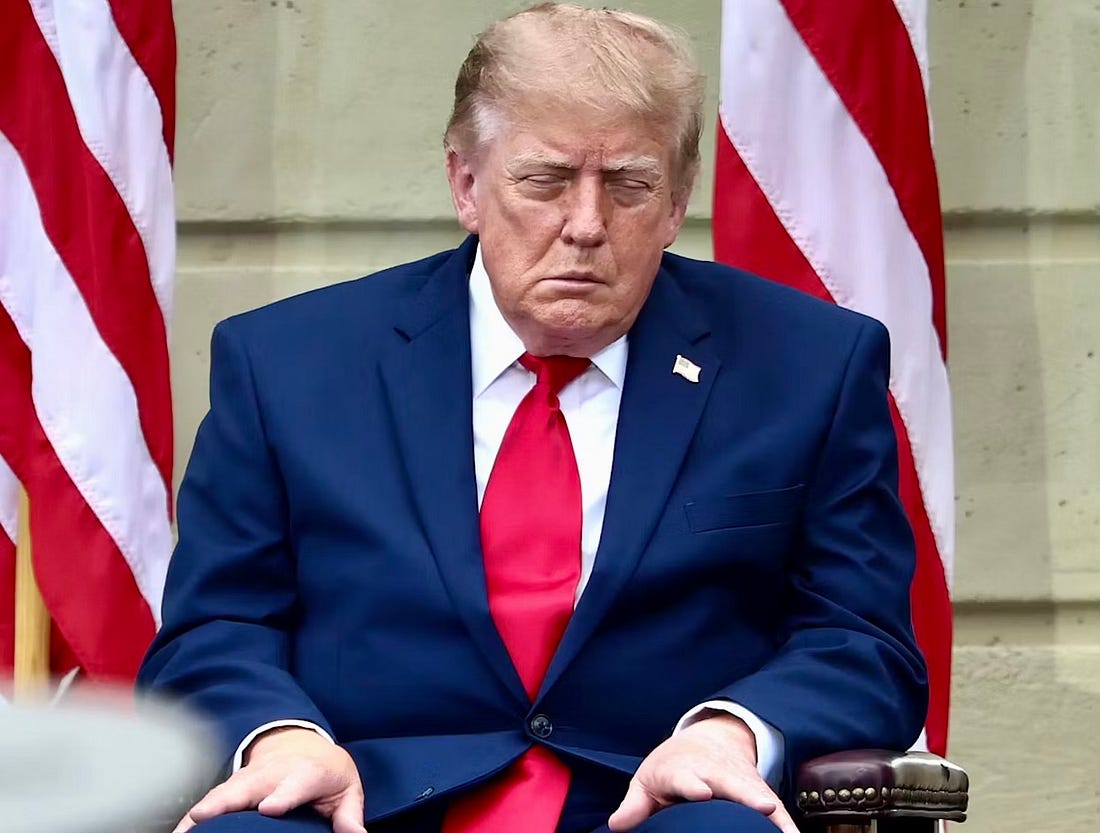 |
The anniversary of 9/11 always brings a dreaded rush of awful memories, but this year brought a little something more: a reminder of how much the world has changed in the last quarter-century. One thing that hasn’t changed much is Donald Trump. From bragging about having the tallest tower in New York in an interview on the afternoon of September 11, 2001, to telling tall tales of being at Ground Zero (and falling asleep at the Pentagon’s memorial service) this week, he’s been consistently odious for the past 25 years.
Maybe that’s why I’m feeling so uncharacteristically cynical today. What follows isn’t a very hopeful piece, and that’s unlike me. I’m usually pretty good at finding the silver lining, and there was plenty of silver to be found this week, if you looked. But I’ll admit that I’ve struggled to mine much of it myself. So please bear with me.
9/11
This year, more than any year since 9/11, I can’t shake the haunting belief, built up over time, that, as a country, we’ve let down every single person who lost their life in the attacks, the rescuers who died then and since, and the troops who lost life, limb, and innocence over decades in battle. To my mind, there’s always been a straight line from 9/11 to Trump, from 2001 to 2016, from a free people to a nation so deranged by trauma, they could be manipulated by such an obvious conman. 2016 was barely forgivable. But 2024? 2025? 2026? What the hell are we even doing?
Where is the country those of us who are old enough knew on September 10, 2001? I know it’s politically fashionable to say it never existed at all, and that’s probably true in some ways. But I don’t care what anyone says—I lived 29 years in that America, and this one is different. And by different, I’m not referring to our greater diversity now. On the contrary, that aspect of our society feels the most like who we used to be. No, the difference is most keenly felt in white communities, some that wouldn’t recognize who they were at the turn of the century, and not just because they weren’t habitually attached to their phones back then. There is a palpable difference, and not a good one.
Also at the top of my mind during this year’s observances was how much the world assisted us after that horrifying day. Canada, our BFF to the north, launched Operation Yellow Ribbon, diverting thousands of international flights and giving shelter and comfort to stranded travelers when air traffic was shut down. Our NATO allies in Europe, for the first time ever, invoked Article 5 of the treaty, stipulating that an armed attack against one NATO member is an attack against all members. Australian Prime Minister John Howard invoked the ANZUS Treaty (a security pact between Australia, New Zealand, and the U.S.) to show immediate support for America.
Together, these countries helped protect U.S. airspace and Americans abroad, and many later joined the global “War on Terror.” Honestly, it brings tears to my eyes now, 25 years later, as I recollect not only the way Americans came together in the aftermath of that tragedy, but also how the free world stood in solidarity with us. And there is anger now too—so much anger—because we’ve utterly squandered that good will with our allies. A pointless and increasingly stupid trade war with Canada in the wake of the trade agreement Trump himself brokered in 2020. Continuing threats to annex European land that does not belong to us. Accusing Australia of “extortion” over its own social media laws. General disrespect for the sovereignty of other nations. And so much more.
The Epstein Files
But when it comes to our allies, we apparently don’t do “help” anymore. Or “allies,” for that matter. In Trump’s world, everything is transactional. If he gets something out of a deal with some rogue nation, who cares if that country murders American journalists, jails people for tweets, carries out mass executions, and funds terror (as one brave 9/11 family member pointed out at the annual ceremony in New York)? All that matters is what Trump and a cabal of oligarchs get out of the deal. Usually that’s money, but sometimes it’s protection.
Take the case of Jeffrey Epstein. The notorious pedophile has long been dead, but his network of wealthy, powerful friends and, ahem, clients are still out there, presumably still doing whatever wealthy, powerful perverts do. European law enforcement agencies aren’t sitting on their hands. They’ve been busy investigating leads from the Epstein files that have been released thus far, since Congress forced the Justice Department’s hand. It’s been a full year since the first tranche of files was made public, but lo and behold, the DOJ isn’t cooperating with foreign requests for investigative help.
European law enforcement officials in Poland, Norway, Latvia, and Great Britain—allies all—have said that Todd Blanche’s department has not responded to their requests for mutual legal assistance, which would permit investigators overseas to obtain additional evidence, information, and testimony from the U.S. This is pretty standard stuff in other types of cases. But with the Epstein files? Bupkis. Not that it’s surprising. American lawmakers haven’t been able to get everything the DOJ owes them either, with millions of relevant documents still unreleased and some of the publicly disclosed material unnecessarily redacted. Where the heck is QAnon when you need them, right? (Just kidding. But seriously, QAnon fell off the map pretty quickly as soon as they realized the “global pedophile ring” might include their favored politicians, too.)
Germany
Speaking of QAnon, far-right populist movements were in the news this week internationally. Last Sunday, the far-right German party Alternative für Deutschland (AfD) had a successful night in the legislature elections for the eastern state of Saxony-Anhalt. While it fell a little short of winning an absolute majority, AfD scored the biggest victory for any extreme-right party in Germany since World War II, proving once again that far-right parties remain on the march.
Trump has long been called a symptom more than a cause of sustained right-wing, anti-establishment fervor around the world, but for a symptom, he’s awfully virulent. As the global liberal order rapidly breaks down during the Trump era, a new spheres of influence model is likely to take its place. As Charles A. Kupchan, a professor of international affairs at Georgetown University, writes:
“The coming international system will be not only decentered but also politically and culturally diverse. Each center of power and governance will play by its own norms and reflect its own civilizational and cultural attributes. The diffusion of power and devolution of authority and responsibility to diverse regional groupings will naturally produce a world that is polycentric and multiorder.”
None of this is in and of itself bad, and might actually produce peaceful, mutually beneficial coexistence. But that is, of course, largely contingent upon who runs these spheres. If it were up to Trump, the European sphere would include a return to an influence we thought we vanquished there long ago, setting up the global system as we knew it.
Like MAGA, AfD is organized around grievance rather than pure ideology, which is why, as Garry Kasparov points out, it’s able to be all things to all people. For example, it is anti-woke and seeks to ban Pride flags, while its party co-chair is openly lesbian. It is also publicly pro-Israel, while embracing antisemitic influences. And it is anti-immigrant, while its leader in the Bundestag, Alice Weidel, shares two children with her partner, a Sri Lankan immigrant. It all sounds so familiar, doesn’t it? But it’s exactly what makes these parties so durable, despite their uncanny inability to actually govern.
Dallas
Which brings us to Trump’s midterm convention in Dallas this past week. What a tawdry, humiliating spectacle. Trump constantly finds new ways to embarrass the hell out of Americans who possess at least half a brain—and make utter fools of his followers. That anyone is still following Trump at this point is a testament to the remarkable persistence of bias (and in many cases, if not most, rank bigotry). He rolled out the old favorites, repeatedly calling Democrats communists, blaming Joe Biden for the appalling results of his own policies, making oddly homoerotic references, yelling at female reporters, and asking his followers to pledge to him that they’ll cheat in the upcoming election. Yada, yada, yada, Trump-style.
The highlight (or, more accurately, lowlight) of the whole sordid affair was Trump offering a bribe to Americans to vote for Republicans in the midterms. He promised every American adult $5,000 if the GOP maintains control of both chambers of Congress. How pathetic: a president who has failed so completely that he has to pay people to vote for his party. The reality is, he has driven up prices and public misery in any and every way he possibly can, and now he figures he can just dangle a few thousand dollars in front of desperate people to purchase their vote.
Too many talking heads this week remarked on the “implausibility” of the offer, as if the fact that it is economically unviable is somehow enough. It seems to me we should be focusing on the fact that it’s a vote-buying scheme that’s, at best, completely unethical, and, much more likely, illegal. Not to mention the fact that Trump has already promised Americans rebates from tariffs and DOGE that never materialized. If he actually cared about helping Americans, he could do it at any time. Right now. Alas, that would be the boogeyman “socialism,” which Trump pretends to hate, but which he isn’t actually against when it serves him. It’s only when socialism serves the American people that it magically becomes anti-American. Funny that.
AI
The simmering backdrop to all this news of the past week was artificial intelligence, and specifically, the sudden revelations by AI researchers and developers at some of the top AI companies, including OpenAI and Anthropic, that the technology is evolving faster than they can control. Most alarmingly, these same researchers and developers are making actual predictions about when AI might destroy humanity. Yep, we ignored The Terminator at our own peril.
I don’t know enough about this technology to comment on it with any expertise, but I do know that, like a lot of people, I’ve had instinctual concerns about it for a long time now—from mass job losses, to threats to democracy, to the environmental impacts of data centers. My position has always been the same. The history of the world is one long story of societies developing and adapting to new technologies, and they can bring great benefits to mankind. BUT (and this a Sir Mix-a-Lot size ‘but’), regulation and plenty of informed public input are absolutely essential to ensuring that this tech is harnessed to serve human beings, not harm them.
Trump’s reaction? He’s doesn’t have any concerns about AI at all. In fact, he’s calling those who do have concerns “very negative forces.” His attitude toward AI reminds me very much of his approach to the COVID-19 pandemic. Remember this?
“It’s going to disappear. One day—it’s like a miracle—it will disappear. And from our shores, we—you know, it could get worse before it gets better. It could maybe go away. We’ll see what happens. Nobody really knows.” —Donald Trump, February 27, 2020
It did not, in fact, go away.
AI isn’t going away, either. The genie none of us asked for is out of the bottle. Unfortunately, we could not ask for a worse possible leader right now than a guy who spends the better part of his weekends posting AI photos depicting himself as Elvis, George Washington, the Pope, and Jesus, and who finds ways to profit off every sketchy technology that comes down the pike. And yet it’s grimly appropriate, too, isn’t it? He’s an artificial leader for an artificial era: a man wholly unfit to lead anything, much less the final seismic transition from the industrial era to the digital age. As the liberal democracies that oversaw international governance for decades find themselves deeply destabilized by this transformation, leading the way is a demented, pathologically self-interested man who appears to be both physically and mentally ill.
What could possibly go wrong?
You're currently a free subscriber to The Outsiders. For the full experience, upgrade your subscription.
| ||||||||||


