| I'm going to be honest with you — sending this makes me nervous.
We traveled into the Utah desert to film what we thought was the dying breath of American energy. |  | What our cameras caught on the other side of that site is something we've been legally discouraged from describing in writing. Three separate people told us not to publish this footage. We're publishing it anyway — because what's coming out of that ground could represent the largest economic revival this country has seen in a century, and the people who stand to lose the most from that are counting on you never finding out. Click to learn more | | | |
|
|
| The ECB Just Hiked to 2.5%. The Decision Was Unanimous. President Lagarde Called It a No-Brainer. | | Written by Evan Brooks · September 13, 2026 | |
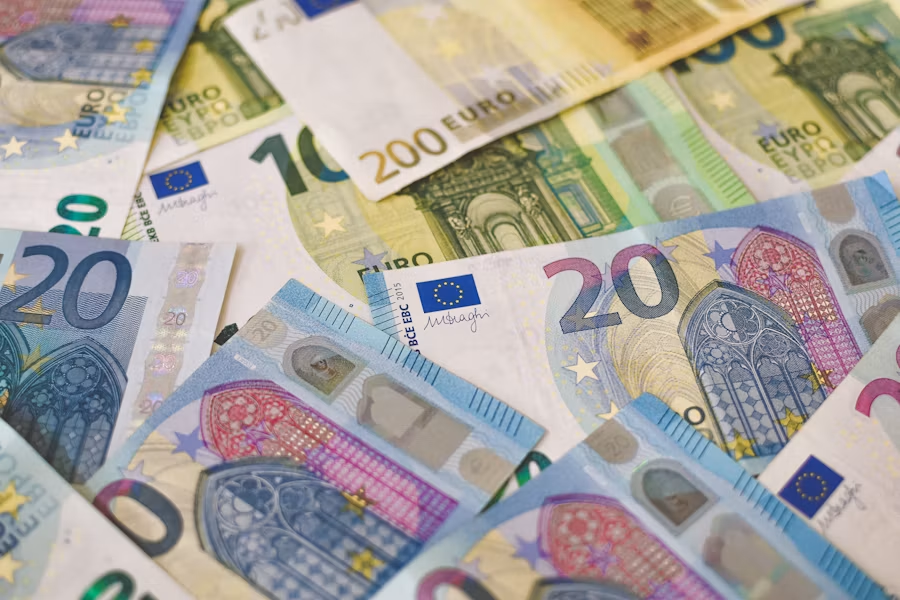
| The Decision | - The European Central Bank raised all three key interest rates by 25 basis points on September 10, 2026. The deposit facility rate rose to 2.50%, the main refinancing rate to 2.65%, and the marginal lending rate to 2.90%, effective September 16. The decision was unanimous. ECB President Christine Lagarde described it as a no-brainer.
- The ECB revised its inflation forecasts upward for 2027 and 2028 — to 2.5% and 2.1% respectively — while holding its 2026 forecast at 3.0%. The 2026 forecast is unchanged from June; the upward revisions to 2027 and 2028 are the operative signal that the ECB no longer expects the energy shock to be fully absorbed by next year. Eurozone headline inflation hit 3.3% in August, driven by a 14.3% annual rise in energy prices. Core inflation excluding energy was 2.2%.
- This is the ECB's second hike since the US-Iran war began and the shortest hiking campaign in 15 years if, as most economists expect, it stops here. A Reuters poll of 65 economists published September 3 found all 65 expected the September hike — and the majority expected no further move after it. EUR/USD dipped below 1.1600 on the decision and recovered to near 1.1610, as the hike had been fully priced.
| | | What Lagarde's "No-Brainer" Language Is Actually Communicating | | Calling a rate decision a no-brainer is central bank communication, not casual speech. Lagarde's framing serves a specific purpose: it closes the debate about whether the September hike was contested inside the Governing Council and simultaneously signals that the threshold for a further hike is higher than the threshold that justified this one. A no-brainer move is one that required no deliberation — which means the next move, by implication, will require deliberation. That framing is consistent with the Reuters survey outcome: 65 of 65 economists expected September; almost none expected October or November. Lagarde reinforced this by stating the council had not debated the path ahead — a formulation that European Central Bank watchers have historically read as pushback against market pricing for additional hikes. She added that markets were doing their job, a phrase the ECB has used when it wants yield movements to do some of the tightening work without a rate commitment. | | The 2027 inflation revision is the part of the ECB's September decision that carries more durable information than the rate itself. A central bank that expected its September hike to solve the inflation problem would not simultaneously revise 2027 and 2028 forecasts higher. The upward move in the 2027 projection — from 2.3% in June to 2.5% in September — reflects the ECB's own assessment that the energy shock is not resolving on its prior timeline, that Brent above $107 will feed into services prices through transportation and input costs, and that second-round wage effects cannot yet be ruled out. Emeritus Professor Joe Nellis of MHA captured the central paradox precisely: a central bank cannot reopen a shipping lane or refill a gas storage facility before winter. More restrictive monetary policy is not an effective response to short-term, supply-driven inflation — and yet the ECB is moving in exactly that direction to combat inflation that is becoming more structural. | |
| | Trump is now pouring the full support of the federal government into a new type of AI that could soon be worth 500 times more than ChatGPT.
It works 10,000 times faster than human PhDs... and Elon Musk calls the underlying tech "the most disruptive force in history."
And it turns out... without the public knowing it... billionaire Sam Altman was behind this all along.
Click here to learn about the #1 stock to own as Trump backs Sam Altman's Next Venture
| | Ad by Stansberry Research | | | | |
| Why EUR/USD Fell After a Rate Hike — and What That Price Action Tells You | | A rate hike that is fully priced before it arrives does not deliver fresh yield support in the currency markets, and EUR/USD's immediate dip below 1.1600 is the textbook expression of that dynamic. The euro had already appreciated in the run-up to September 10 as markets priced the hike with near-certainty. Once the decision confirmed what was already embedded in the forward curve, the catalyst for further euro strength disappeared — and the pair settled near 1.1610 as attention shifted back to the US CPI print and the oil move that were simultaneously driving global markets. The ECB's own projections for 2027 and 2028, which were revised higher, are the data point that matters more for EUR/USD over a multi-month horizon than the September 10 decision itself. If the ECB is projecting 2.5% inflation in 2027 — above target, and above its June estimate — markets will at some point have to price the possibility of another hike in the first half of 2027. That repricing, when it comes, will be the EUR/USD driver that the September 10 decision did not provide. | | The 2011 Parallel — and Why Lagarde Is Aware of It | | The Reuters poll description of this as the ECB's shortest hiking campaign since 2011 is not coincidental. In 2011, the ECB raised rates twice in response to sharply rising oil prices — moves that most policymakers now regard as a policy mistake. The parallel is imperfect: the 2011 rate increases came against a backdrop of a eurozone sovereign debt crisis and weak underlying growth, while 2026 eurozone growth, at 0.9% per Goldman Sachs's forecast, is not that fragile. But the structural similarity — hiking in response to an energy shock rather than demand-driven inflation — is close enough that Lagarde's decision to frame September as a no-brainer and explicitly avoid discussion of the path ahead reads as institutional memory of 2011. A central bank that learned from hiking into a supply shock would design its communication to give itself maximum optionality to pause. That is precisely what the September 10 language delivered. The ECB has hiked, preserved its credibility on inflation, and kept its hands free for October — which is a better outcome than the one the 2011 committee managed. | | | | Sources: CNBC · Euronews · EBC Financial Group · TIO Markets · FXStreet · RTE · Trading Economics · Reuters · MHA | |
|
|
© 2026 Alpha One Marketers LLC. All rights reserved. |
|
| |