| Unsubscribe |
 |
| September 13, 2026 |
| View online ↗ |
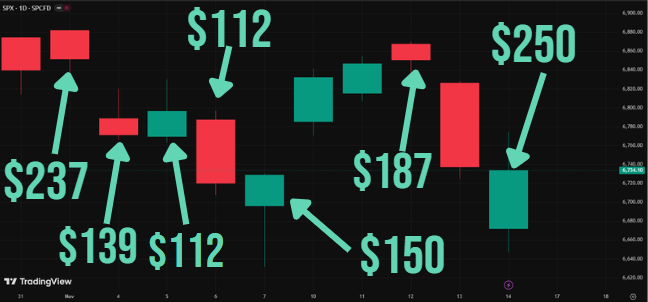
| A note from our friends at Media Pub(ad) Most traders have never noticed the weird market anomaly that happens at 9:35 AM every morning. They're too busy with lagging indicators trying to predict the next move... when the market makers have already set the tone for the trading day. It's this weird anomaly that points us to the market maker's key levels above and below. And by playing the move within that range... Regular folks like you have been able to reach for $100 or more (on a $1K stake) over 600 times in the last 2 years.
We've seen this straightforward approach play out whether the market broke out... broke down... or stayed choppy. Granted, I can't make trading guarantees here. But I've opened up the data behind those trades, as well as how you can get in on the very next morning opportunity. You'll find the full details right here. See you in the market. Chris Pulver Bonus Article Valero Turned $714 Million in Profit Into $3.7 Billion. Oil at $108 Keeps the Clock Running.
Brent crude sat at $108 a barrel last week. Futures for international benchmark Brent crude for November delivery gained to $108.21 a barrel. For Valero Energy, higher crude is not the risk. Higher crude, combined with constrained refining capacity and tight product inventories, is the business model. Why This Stock NowValero surged 142% year-to-date on nearly doubled refining margins. That number understates the Q2 story. Valero reported net income attributable to stockholders of $3.7 billion for Q2 2026, driven by exceptional operational and commercial performance across all segments. One year earlier, the same company earned $714 million. That is not a margin expansion. That is a structural reset of what the refining business is worth in an era of geopolitical supply disruption. The BusinessValero is one of the largest independent petroleum refiners in the United States, operating across 15 refineries in the U.S., Canada, and the U.K. It does not drill for oil. It buys crude at market rates, processes it into gasoline, diesel, and jet fuel, and sells the output at whatever the crack spread dictates. In normal markets, that spread compresses. In the current market, it has not. The company's refining segment benefited from strong margins, low global product inventories, and resilient demand, with management pointing to a bullish outlook on higher mid-cycle margins. Management's argument is that the mid-cycle has shifted permanently upward because European refining is setting the floor. COO Gary Simmons said mid-cycle refinery crack spreads are now being set by hydroskimming margins in Northwest Europe, which are subject to higher carbon credit costs and inflationary pressures, resulting in a higher floor for margins. Why Wall Street Is Paying AttentionAdjusted EPS came in at $12.54, up from $2.28 a year earlier. Revenue reached $44.48 billion, up from $29.89 billion in Q2 2025. Net income attributable to stockholders was $3.7 billion, up from $714 million. The beat was not narrow. The adjusted EPS of $12.54 represented a 27.1% earnings surprise. The board increased share repurchase authorization on July 16, 2026 by adding $5.0 billion to its February 2026 program. With $7.9 billion in cash on the balance sheet and a net debt-to-capitalization ratio of 11%, Valero has the financial capacity to execute that program aggressively. What's Driving the OpportunityValero said it expects another solid quarter in Q3, with refining margins and capture rates looking stronger than in Q2. Management said the biggest tailwind is improved feedstock costs, as delivered crude is being bought at discounts to benchmarks rather than at premiums. The $230 million Charles FCC optimization project is expected to be completed in 2026, increasing production of high-value alkylate and gasoline. That project adds higher-margin output on top of already-favorable market conditions. The Iran conflict underpins all of this. In its July 2026 Short-Term Energy Outlook, the U.S. Energy Information Administration said it expects most crude oil production to return to near pre-conflict averages by the end of 2026, with the majority of shut-in crude oil production back online in the first quarter of 2027. That supply path still keeps product markets exposed to renewed disruption and slow inventory rebuilding. What Could Go WrongRefining margins are the business, and refining margins can move fast in either direction. Investors should not treat one exceptional period as a permanent run rate. Refining-margin normalization, renewable-policy changes, and repair execution remain the main durability tests. The Port Arthur refinery fire earlier this year has required repairs, and the company has said it expects repair-related capital spending in 2026 that should be covered by insurance, subject to its self-insured retention. A ceasefire or diplomatic resolution in the Middle East would likely send crude lower and crack spreads with it. WTI has already swung from about $55 to about $114 over the past 52 weeks, a reminder that geopolitical risk premiums unwind as fast as they build. The Bottom LineValero is not a growth stock. It is a capital-return machine operating in the best refining environment in a generation. Valero is experiencing significant earnings momentum, supported by tight refined product markets and upward revisions in estimates. With Brent above $100, an expanded buyback authorization, a COO arguing the margin floor has structurally risen, and Q3 commentary pointing to margins and capture rates stronger than Q2, the risk-reward favors staying long until the geopolitical backdrop changes. Watch for any signs of de-escalation in the Gulf. Until then, the refining clock keeps running. |