Key Points
- Chewy’s Autoship business remains a major source of revenue visibility despite weaker pet-category spending.
- Chewy raised its full-year outlook after second-quarter revenue and adjusted EBITDA improved year over year.
- Chewy’s valuation now depends on whether investors look past near-term consumer headwinds and focus on recurring revenue, cash flow and buybacks.
- Special Report: This 15 Dollar Gold Fund Pays Investors Every Friday
Chewy, Inc.'s (NYSE: CHWY) 2026 price weakness, including its early-September sell-off, looks increasingly disconnected from the company’s operating strength and may give long-term investors an opening. While near-term headwinds cloud the market’s judgment, Chewy is not your typical, cyclical retailer. It is a sticky digital ecosystem built around an Autoship feature.
Autoship accounts for about 85% of quarterly revenue, a recurring revenue stream that provides exceptional visibility and a wide moat. Autoship is supported by recurring necessities such as food, health care products and medicines that pet owners are unlikely to cut quickly. Therefore, Chewy displays inflation-resistant qualities, can generate value gains throughout business cycles, and is currently performing well.
Chewy Raises Guidance on Strong Q2
Chewy posted a strong quarter, with revenue up 7.4% to $3.33 billion, outpacing the industry average by about 300 basis points (bps). Revenue also beat consensus by a slim margin, supported by strength in Autoship. Autoship accounted for 84.6% of sales, up 160 bps year over year. Margin is another strength, with gross margin flat despite economic headwinds and adjusted margins improving. Critical details include mid-to-high-single-digit growth in adjusted EBITDA, adjusted net income, and adjusted earnings, with adjusted earnings impacted by a share count reduction.
Other pertinent details include Chewy’s profitable and cash-flow-positive status. This supports sustained financial health, reinvestment, and capital returns through share buybacks. Quarter-ending balance sheet highlights reflect the capital return, with cash and equity down, but no red flags were raised, as leverage remains at ultra-low levels and cash flow is expected to remain strong. The likely outcome is that Chewy rebuilds cash as the year progresses and sustains buybacks. As it stands, the share count is down approximately 4.3% on average for the quarter and 2.8% year to date, providing ample leverage for investors.
Looking ahead, Chewy expects strength to continue and has lifted its full-year outlook. The company expects revenue and earnings in a range slightly above the consensus, sufficient to sustain the capital return outlook. The risk with guidance is sentiment, as analysts responded favorably but with a note of caution. Initial responses highlight industry-leading strength and margin gains but cite industry headwinds as a concern. Sluggish overall pet spending is seen as problematic and may keep Chewy’s stock price under pressure until consumer habits shift.
Chewy’s Headwinds Create Deep Value in 2026
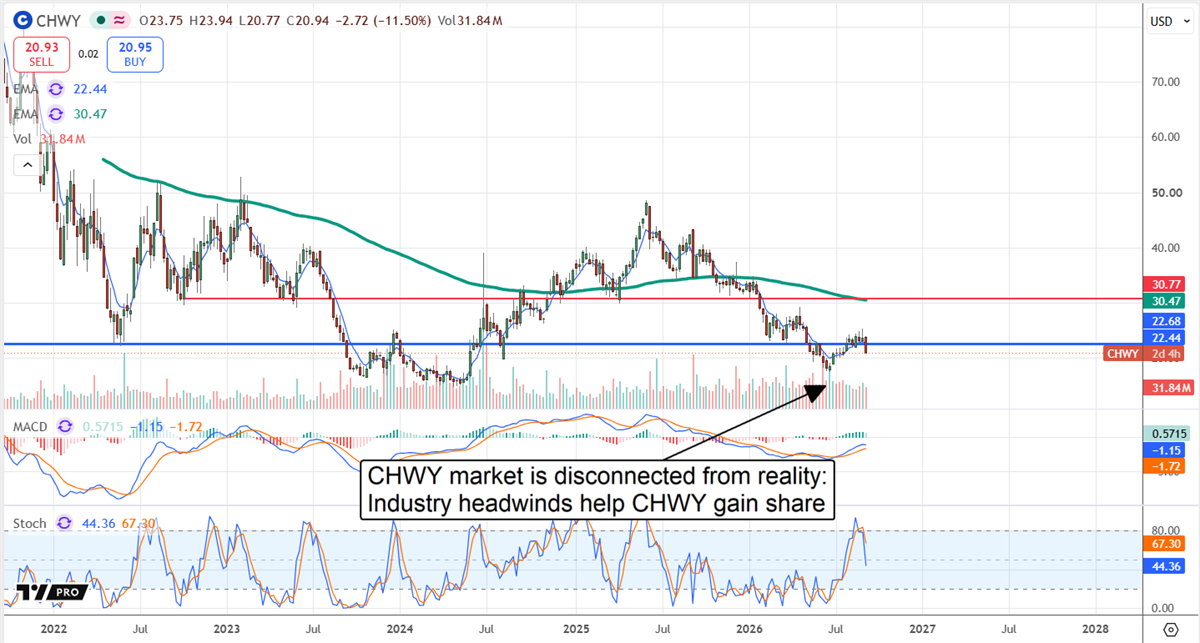
For better or worse, Chewy’s headwinds have created a deep-value opportunity that analysts' trends reflect. While responses and price-target trends show caution, summer reductions bottom out well above CHWY’s early September trading levels, and sentiment is far from bearish.
In this scenario, CHWY trades well below the consensus price target, which implies more than 50% upside if catalysts emerge. Until then, 26 analysts reflect relatively firm conviction in the Moderate Buy rating; no Sell ratings are logged, and the data shows a bullish bias. Institutions, likewise, reflect confidence in CHWY’s long-term value, owning about 93% of the stock and accumulating aggressively with shares near long-term lows.
Valuation metrics suggest the long-term potential is far greater than analysts' forecasts imply. Assuming the 15x current-year earnings is a fair valuation, CHWY appears closer to reasonably valued than deeply discounted on current-year estimates, making the longer-term upside case dependent on future earnings growth. If current forecasts prove too cautious, the upside potential could be greater.
Chewy Is at a Bottom, But How Long It Stays There Is the Question
Price action is weak but not altogether bearish. Chewy is moving lower after the release, but is also trading within a range near its bottom and showing signs of reversal. CHWY may continue lower in the near term but will likely bottom out near the summer lows, if not at higher levels. The risk is that CHWY persists within its range indefinitely, not breaking out until sometime in 2027 or later. In this scenario, investors can start small if they don’t already have exposure and slowly build a position over time.
Several catalysts may trigger a price recovery sooner rather than later. Among them is the pivot to higher-margin pet health, insurance, and telehealth, which collectively increase customer value over time. They not only provide additional income streams but also create numerous recurring opportunities to rechannel consumer dollars to CHWY products, creating a flywheel already showing momentum. Other catalysts include leaning into next-gen technology, including the efficiency and automation that AI provides.
Among the risks Chewy faces, one amplified by consumer headwinds, is competition and, more specifically, competitive pricing. Competitive pricing helps keep consumers coming back but cuts into margins. One way that Chewy mitigates this is with private labels. They provide lower-cost-to-consumer, higher-margin sales and are central to the cash flow outlook.
Read this article online ›

The best investment opportunities don't wait. Get our research and stock ideas delivered straight to your smartphone—so you never miss a market-moving opportunity. Our text alerts ensure you see timely stock ideas and professional research reports instantly, whether you're in a meeting, commuting, or away from your desk.
Get Text Alerts from American Market News (free)


