| Unsubscribe |
Below is an important message from one of our highly valued sponsors. Please read it carefully as they have some special information to share with you.
Dear Reader,
California tried to threaten Elon’s NEXT MOVE.
For years, Newsom made California a war zone for Elon’s companies.
(This is nothing new to Elon.)
They taxed them harder than anywhere in the country.
Buried them in regulations.
State regulators even voted to cap how often SpaceX could launch, and they even went after his politics in the hearings.
Newsom boxed him in at every turn.
So Elon packed up. Took SpaceX to Texas and never looked back.
But now…
I Believe Elon’s NEW PLAN for SpaceX Has Just Surfaced…
All inside an FCC filing I just got my hands on.
And Trump is tearing down every roadblock in Washington to help him do it fast.
Want to get in on the action?
Because this could be Elon’s biggest project to date.
Bigger than Paypal…
Bigger than Tesla…
And even bigger than SpaceX itself.
And with Newsom out of the picture (and California losing out on billions)…
The profit potential could be ENORMOUS.
Which is exactly why it is crucial you watch my FREE Millionaire Maker Masterclass.
(I call it that because Elon’s plan could create 1,806,000 new millionaires.)
I'll show you what's inside that FCC filing.
And how to get positioned in the one company sitting at the center of all of it.
A company trading for less than $100 that I believe could help you become one of the new “Musk Millionaires” over the next decade, if you position yourself NOW.
Just click here and watch it now.
It's 100% FREE. No credit card. No purchase. Not even an email needed to watch.
Click this link now, and I’ll see you on the inside!
Sincerely,
James Altucher
Ollie's Bargain Outlet Stock Falls on Weak Comps Despite Margin Gains
By Thomas Hughes. First Published: 9/6/2026.

Key Points
- Ollie's shares fell after weak comparable-store sales overshadowed margin gains, with adjusted EPS of $1.42 beating expectations by 30 cents.
- The company is converting former Big Lots stores into new locations, driving nearly 12% store growth and a path to margin recovery through dark rent conversion.
- MarketBeat tracks 17 analysts rating OLLI a Moderate Buy with roughly 40% upside, citing expectations for easing headwinds and accelerating share buybacks.
- Special Report: The company SpaceX cannot operate without
Ollie’s Bargain Outlet (NASDAQ: OLLI) shares fell after its Q2 release as near-term headwinds overshadowed the company’s structural improvements.
The primary near-term headwind is weak comparable-store performance, with comps declining unexpectedly as basket sizes contracted. The weakness runs counter to industry trends, as other retailers—particularly off-price and discount retailers—continue to perform well. As a result, the weakness may prove to be more of a one-off than a lasting trend.
Moderna Doubled in One Day. This Medical Stock Could Be Next (Ad)
Moderna's stock doubled in a single day after its cancer vaccine hit key Phase 3 goals, and Merck jumped too. But according to a former Steve Cohen fund manager, the next big opportunity is not Moderna or Merck.
It is a different kind of company tied to a technology already backed by Elon Musk, Sam Altman, Jeff Bezos, and Peter Thiel. Nvidia's Jensen Huang says it will have a dramatic impact on daily life, while Anthropic's CEO believes it could unlock a century of medical progress in just ten years.
Nature Magazine estimates its potential value at $367 trillion globally, and it is already rolling out across the United States.
Click here to learn about this new era of medical technologyManagement cited weather, consumer headwinds and an increasingly promotional selling environment as the reasons for the top-line miss. Investors should focus on the fact that Ollie’s provides value to its customers, as reflected in its growing loyalty membership base.
The membership base grew 12.7% year over year as of Q2, and it is not the company’s only structural improvement worth noting.
Ollie’s growth strategy involves converting former Big Lots facilities into new Ollie’s Bargain Outlets. The strategy requires high upfront costs, including significant dark rent, but it enables rapid growth and provides a path to margin recovery.
The company grew its store count by nearly 12% over the 12 months leading up to the release and expects to maintain that robust pace through year-end. The path to margin recovery involves turning dark rent into revenue-producing floor space and leveraging scale. Ollie’s business is expanding rapidly, enabling stronger relationships and better deals with its supply-chain partners.
Ollie’s Mixed Q2 Was Strong Where It Counts
Ollie’s Q2 report was not without disappointments. Revenue growth missed expectations, but the 9.1% advance still outpaced that of most retailers. New stores drove growth, offsetting weak comps, and the quarter also featured several strengths.
The main driver was the conversion of dark rent into revenue-producing space, which benefited margins, cash flow and profits. Key details included a 330-basis-point (bps) improvement in adjusted EBITDA margin, a nearly 40% increase in net income and a 43% increase in adjusted earnings per share (EPS). Adjusted EPS of $1.42 was 30 cents higher than expected.
Guidance is a near-term hurdle for the stock, but profitability blunts its impact. Ollie’s reduced its full-year revenue outlook, putting the midpoint below MarketBeat’s consensus estimate. Improved margins and a stronger earnings forecast, however, should cushion the top-line miss and reinforce the case for capital returns. While growth is critical, cash flow and the capacity to return capital matter even more—and Ollie’s is on track to return ample cash over time.
Investment catalysts include buybacks, which are expected to accelerate based on the updated guidance. Trailing 12-month activity reduced the share count by more than 2.5% in Q2 on average, giving investors significant leverage. The full-year guidance update also includes a 40% increase in expected annualized buyback spending.
Analysts Stay Bullish Despite Mixed Reactions
Analysts’ responses to the release were mixed, much like the results. Some analysts focused on headwinds, while others emphasized margin expansion. Several lowered their price targets, others raised them, and some reaffirmed the consensus rating and price target.
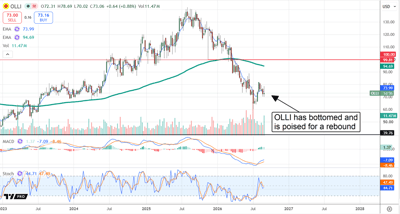
MarketBeat currently tracks 17 analysts rating OLLI a Moderate Buy. The data shows a bullish bias and indicates approximately 40% upside relative to the stock’s post-earnings price. Key takeaways include expectations that headwinds will ease, comps will improve and margins will expand over time. Institutional ownership also reflects confidence in the long-term outlook and capital returns, with institutions owning more than 99% of the shares and accumulating moderately in 2026.
Ollie’s Strong Balance Sheet Fuels Growth Strategy
Ollie’s Bargain Outlet’s balance sheet presents no red flags for investors. Highlights at the end of the quarter included lower cash tied to buybacks, higher inventory and increased investments, offset by smaller increases in liabilities and improved equity despite the share repurchases.
Leverage remains very light, with long-term, non-lease debt below 0.1 times equity, total liabilities below 1 times equity and cash flow improving. Looking ahead, Ollie’s is positioned for accelerated earnings growth even without an improvement in consumer spending habits. A recovery in consumer spending would accelerate both revenue and earnings growth.
This year’s catalysts include completing and opening two new distribution centers. These centers will enable the company to serve more than 800 locations seamlessly before additional infrastructure is needed. This sets the stage for profitable growth over the next two years without significant additional capital expenditures. The biggest risks are consumer headwinds, inflation and gasoline prices, all of which are pressuring Ollie’s lower-income customers.
Investors should remember that Ollie’s Bargain Outlet is an off-price merchant akin to TJX Companies (NYSE: TJX), not a discount retailer or dollar store. It is not locked into any single product or category and can respond to trends by opportunistically offering shoppers bargains as they emerge. The only downside is that its treasure-hunt strategy does not mesh well with digital sales, a pillar of today’s retail environment.
Intel’s ASML Milestone Gives Investors a New Reason to Revisit the Stock
By Jeffrey Neal Johnson. First Published: 9/9/2026.

Key Points
- Intel’s latest rally reflects a combination of reported CPU pricing power and verified manufacturing progress with ASML.
- Intel Foundry and ASML said more than one million wafers have now been processed using high-NA EUV equipment.
- Intel’s second-quarter results and insider buying support the turnaround case, but analyst targets still show a wide range of expectations.
- Special Report: The company SpaceX cannot operate without
For enterprise hardware buyers, securing adequate computing capacity has become an ongoing challenge. High-performance data centers face persistent server constraints, and chip manufacturers are adjusting their commercial strategies accordingly.
Two major developments converged, signaling a structural shift in the semiconductor landscape. Intel Corporation (NASDAQ: INTC) confirmed a 10% across-the-board price increase for enterprise central processing units (CPUs) and announced a manufacturing milestone with lithography partner ASML Holding N.V. (NASDAQ: ASML).
Moderna Doubled in One Day. This Medical Stock Could Be Next (Ad)
Moderna's stock doubled in a single day after its cancer vaccine hit key Phase 3 goals, and Merck jumped too. But according to a former Steve Cohen fund manager, the next big opportunity is not Moderna or Merck.
It is a different kind of company tied to a technology already backed by Elon Musk, Sam Altman, Jeff Bezos, and Peter Thiel. Nvidia's Jensen Huang says it will have a dramatic impact on daily life, while Anthropic's CEO believes it could unlock a century of medical progress in just ten years.
Nature Magazine estimates its potential value at $367 trillion globally, and it is already rolling out across the United States.
Click here to learn about this new era of medical technologyThe dual announcement answers a central question that has hovered over years of fab investment: when would capital spending translate into commercial pricing power and production yields? With shares up nearly 10% on higher volume, the market is reassessing the timeline for this turnaround. This operational progress marks a clearer transition from structural development to active yield realization.
Pricing Power Meets Fab Execution
Intel Corporation shares traded up around 10% to hover near $105, with intraday dollar volume surpassing $11 billion. This single-session move builds on a broader advance that has lifted the equity by around 185% year-to-date (YTD). For a company that traded near $37 at the beginning of 2026, the current valuation reflects growing institutional confidence in its operational roadmap.
Market reactions of this magnitude rarely result from one news item alone. Instead, they occur when independent operational threads align. The first thread is pricing discipline.
Raising enterprise CPU prices by 10% suggests that customers cannot easily substitute alternative suppliers in an infrastructure-constrained environment. The second thread is execution. Intel and ASML confirmed that Intel Foundry has processed more than one million wafers using next-generation extreme ultraviolet (EUV) equipment.
When a manufacturer demonstrates that it can raise prices while clearing technological hurdles, valuation models adjust. According to consensus analyst ratings, the 12-month average price target for the company sits near $108, with street-high targets reaching $200. The latest developments show why sentiment across the technology sector is firming around domestic manufacturing capabilities.
1 Million Wafers Later: Intel Lithography Hits the Mark
At the SPIE Photomask Technology and Extreme Ultraviolet Lithography conference, Intel Foundry and ASML presented data on their joint deployment of high numerical aperture (High-NA) EUV systems. The headline milestone is substantial: Intel has now run more than one million wafers through High-NA equipment across certification, testing and active logic production.
To appreciate why this matters, it helps to understand the lithography process. Traditional EUV scanners use a 0.33 numerical aperture lens system to etch circuit patterns onto silicon wafers. Next-generation High-NA systems increase that lens aperture to 0.55. This higher resolution allows chipmakers to print finer circuit lines in a single exposure, reducing the need for complex multi-patterning steps that add cost and defect risk.
Intel installed the industry's first commercial High-NA system in 2024. That early operational commitment is now translating into production silicon. Intel confirmed that it is deploying High-NA tools on select layers for its upcoming Panther Lake architecture, marketed as the Intel Core Ultra Series 3 and built on the Intel 18A process node. These production layers match or exceed the yields and performance of existing 0.33 NA systems.
The companies also addressed an engineering challenge that had caused concern across the industry: reticle field size. High-NA optics cut the traditional exposure field in half. Intel developed proprietary process design kit (PDK) solutions and reticle-stitching techniques that allow chip designers to produce large enterprise dies using standard 6-inch photomasks. By solving this constraint with current masks, the company enables immediate production ramps while collaborating with ASML on the long-term transition to larger 6x12-inch formats.
Inelastic Compute Drives Operating Leverage
A technology lead only translates into shareholder value if enterprise customers pay for the end product. Intel's recent and reported price increases highlight a more favorable demand environment in commercial computing. Enterprise data centers and cloud service providers are expanding their server infrastructure to handle complex AI workloads, and standard server CPUs remain indispensable for orchestrating these distributed compute clusters.
In semiconductor manufacturing, incremental pricing gains create significant operating leverage. Semiconductor fabrication plants carry high fixed capital costs. Once a fab reaches baseline volume, a substantial portion of each additional dollar generated by price increases can flow to operating income and earnings before interest, taxes, depreciation and amortization (EBITDA).
This dynamic is already evident in reported financial results. In its Q2 2026 earnings release, Intel reported earnings per share (EPS) of 42 cents, surpassing analyst consensus estimates of 21 cents. Revenue expanded by about 25% year-over-year (YOY) to reach an annual run rate of approximately $52.85 billion. With projected earnings growth above 40%, higher enterprise average selling prices should support gross-margin normalization.
Corporate insiders appear to share this perspective. Public filings track an uptick in insider buying, led by Chief Executive Officer Patrick Gelsinger and Chief Financial Officer David Zinsner, who both added shares following earlier cyclical pullbacks.
ASML Keeps Its Place at the Center of the Next Chip Cycle
The Intel-ASML collaboration also carries broader implications for equipment suppliers. ASML currently trades at a forward price-to-earnings (P/E) multiple of nearly 39 times, with net profit margins exceeding 30%. Because peers such as Taiwan Semiconductor Manufacturing Company (NYSE: TSM) and Samsung (OTCMKTS: SSNLF) are also committing to High-NA tools, ASML retains visibility across the entire semiconductor supply chain. Intel's early adoption, however, gives its foundry operations roughly two years of real-world operational learning that competitors must now replicate.
Navigating capital-intensive semiconductor cycles requires balancing patience with verified milestones. Trailing numbers still reflect the heavy depreciation associated with building out new fab infrastructure. The combination of commercial pricing power and verified High-NA wafer volume shows that the turnaround is shifting toward execution.
Investors tracking the semiconductor space may want to keep Intel on their watchlists as second-half enterprise shipments ramp and gross margins reflect the updated pricing structure. Watching Panther Lake yields progress will provide practical insight into how durable this manufacturing advantage becomes.
This email message is a paid advertisement for Paradigm Press, a third-party advertiser of Earnings360 and MarketBeat.
If you need assistance with your subscription, please feel free to email our South Dakota based support team at [email protected].
If you no longer wish to receive email from Earnings360, you can unsubscribe.
© 2006-2026 MarketBeat Media, LLC. All rights protected.
345 North Reid Place, Sixth Floor, Sioux Falls, South Dakota 57103-7078. USA..