| Unsubscribe |
Dear Reader,
If you've built a solid nest egg or retirement account…
You already did the hard part.
You earned it. Saved it. Invested it.
Now comes a different question:
How do you make that capital work harder… without creating another job for yourself?
You probably don't want to become a day trader or spend retirement staring at charts.
That's why Tuesday's FREE Investor Briefing is worth seeing.
Former Wells Fargo Senior Financial Advisor Brian Jackson will reveal a suite of 12 automated futures algorithms with a historical compounded track record of 2,232.11% since 2020.*
The algorithms do the trading.
No hunting for trades. No six monitors. No trying to predict the next bull or bear market.
→ SEE HOW IT WORKS TUESDAY AT 8 PM EST
You built the capital.
Now come see another way to put it to work.
Tuesday, September 15th
8:00 PM EST
Live Online + Q&A
*Past performance does not guarantee future results. Futures trading involves substantial risk of loss.
Amazon’s Robot Push Raises a Bigger Question About Its Next Margin Lever
Authored by Sam Quirke. Article Published: 9/3/2026.

Key Points
- Amazon is reportedly exploring Project Tetromino, an early-stage plan to automate delivery stations before packages reach drivers.
- The project could strengthen Amazon’s long-term logistics efficiency if robotics can reduce the cost of final-mile package handling.
- The stock remains under near-term pressure as investors weigh automation upside against capital spending, execution risk and labor scrutiny.
- Special Report: Forget SpaceX. Buy the company Musk can't replace.
Amazon.com Inc. (NASDAQ: AMZN) has built its empire on a relentless obsession with doing things faster and cheaper, so news that it is quietly working to automate one of the last stubbornly manual parts of its operation should surprise no one. What might raise an eyebrow is just how ambitious the plan appears.
The project, known internally as Tetromino, is reportedly an effort to bring AI and robotics to the final stretch of Amazon's delivery network: the fiddly business of sorting packages and preparing them for the vans that carry them to customers' doors. It is precisely the kind of labor-intensive work that has so far resisted mechanization, and cracking it could make the entire system dramatically more efficient.
Moderna Doubled in One Day. This Medical Stock Could Be Next (Ad)
Moderna's stock doubled in a single day after its cancer vaccine hit key Phase 3 goals, and Merck jumped too. But according to a former Steve Cohen fund manager, the next big opportunity is not Moderna or Merck.
It is a different kind of company tied to a technology already backed by Elon Musk, Sam Altman, Jeff Bezos, and Peter Thiel. Nvidia's Jensen Huang says it will have a dramatic impact on daily life, while Anthropic's CEO believes it could unlock a century of medical progress in just ten years.
Nature Magazine estimates its potential value at $367 trillion globally, and it is already rolling out across the United States.
Click here to learn about this new era of medical technologyThe news arrives at a somewhat awkward moment for the shares, which have slipped roughly 10% from the record high they touched last month and appear vulnerable to further declines. That backdrop makes the question all the more pointed: Could a deeper push into automation be exactly the kind of long-term catalyst the stock needs, or is it a distraction from more immediate concerns?
Project Tetromino Targets Amazon’s Last-Mile Cost Problem
According to reports based on an internal planning document, Tetromino aims to automate the tricky task of organizing packages and preparing them for delivery vehicles. This step still relies heavily on human labor. The document reportedly calls for a pilot facility in 2028, with the system processing packages at roughly two and a half times the rate of Amazon's existing delivery stations.
It is worth emphasizing that the project remains in its early stages, and Amazon has been quick to manage expectations. The company disputed the financial projections and timeline in the reported internal document, describing Tetromino as a concept whose plans could change substantially. In other words, this is a glimpse of a potential direction rather than a finished blueprint.
Even so, the project fits a clear pattern. Amazon has said it expects to more than double the number of robotic arms across its network this year alone, and Tetromino would extend that drive into territory the company has not yet conquered. The ambition is unmistakable, even if the details remain unclear.
Automation Could Unlock Amazon’s Next Margin Lever
To understand why any of this matters for the stock, investors must first consider the sheer scale of Amazon's e-commerce and logistics operation. Moving billions of packages around the world is enormously expensive, and much of that expense is tied to labor. Anything that reduces the cost of handling each package can have an outsized impact when multiplied across such enormous volumes.
That is the heart of the bull case. If Amazon can automate a step that currently requires substantial manual work, it could lower its cost per package and generate more profit from its vast retail machine as volumes grow. With an installed base of more than a million robots, the company has both the scale and the expertise to make automation a powerful competitive weapon.
There is a second, subtler prize, too. A more automated network would not only cut costs; it could also be rented out to others. Amazon has been opening its logistics capabilities to outside merchants, and the more efficient that network becomes, the more profitably the company can monetize its capacity, potentially turning a cost center into an additional source of revenue.
Execution Risk Still Clouds the Robotics Bull Case
For all that promise, the bears have some fair objections, starting with the simple fact that this is far from a done deal. Automating the messy, unpredictable final steps of delivery is much harder than deploying robots in a warehouse, and there is no guarantee that Amazon will solve the problem—or that the savings will justify the investment if it does.
That leads to the broader concern about spending. Amazon is pouring staggering sums into AI, robotics and infrastructure, and some investors worry that this relentless capital intensity could weigh on cash generation if the returns disappoint. Expensive equipment that fails to deliver durable savings would be a poor trade, no matter how impressive the technology may be.
Then there is the delicate matter of jobs. Amazon insists that its automation efforts are designed to support workers rather than replace them. Still, reports based on internal documents suggest that greater use of robots could slow warehouse hiring over the coming decade. That is a difficult balance to strike, and one that could invite scrutiny as the technology spreads.
AMZN Pullback Puts the Long-Term Catalyst in Focus
So what should investors make of it all? On its own, a single early-stage project, however clever, will not transform a company the size of Amazon overnight, and the disputed timeline means any meaningful benefit is likely years away, at best.
Viewed through a wider lens, however, Tetromino is a useful signal of where Amazon is heading. It underscores a long-term strategy focused on steadily reducing costs and improving efficiency across an already formidable logistics network—precisely the kind of relentless self-improvement that has made the company so dominant.
For investors, the project is best viewed not as a reason to buy the shares today, but as a reminder of the powerful long-term forces still working in Amazon's favor. With the stock under some near-term pressure, investors looking to build or add to a long-term position may have a fresh reason to be slightly more bullish.
Snowflake’s AI Momentum Is Forcing a Fresh Look at the Stock
Authored by Thomas Hughes. Article Published: 9/4/2026.

Key Points
- Snowflake’s fiscal second-quarter results beat expectations, but the bigger catalyst was management’s stronger product revenue outlook.
- AI adoption is increasing demand for Snowflake’s data, governance and coding tools rather than reducing the need for enterprise software.
- Valuation and dilution remain real risks, but improving margins, cash flow and guidance give bulls a stronger case.
- Special Report: Forget SpaceX. Buy the company Musk can't replace.
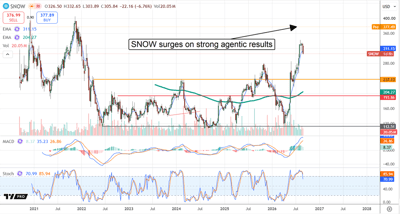
Snowflake’s (NASDAQ: SNOW) stock surged more than 20% following its Q2 fiscal year 2027 (FY2027) release, driven by its guidance, and it could continue to rise based on what lies ahead. Strong as the results were, the outlook suggests the SaaS-Pocalypse sell-off was not only misguided but also too broad. AI poses a threat, and disruption is possible, but established, enterprise-grade software companies that provide utility for clients are better positioned to deploy and monetize AI than AI is to create entirely new software industries. AI is complex and requires massive infrastructure, governance and security resources that the average business cannot manage.
The market got agentic AI wrong: It did not reduce workloads or data needs; it only accelerated them.
Moderna Doubled in One Day. This Medical Stock Could Be Next (Ad)
Moderna's stock doubled in a single day after its cancer vaccine hit key Phase 3 goals, and Merck jumped too. But according to a former Steve Cohen fund manager, the next big opportunity is not Moderna or Merck.
It is a different kind of company tied to a technology already backed by Elon Musk, Sam Altman, Jeff Bezos, and Peter Thiel. Nvidia's Jensen Huang says it will have a dramatic impact on daily life, while Anthropic's CEO believes it could unlock a century of medical progress in just ten years.
Nature Magazine estimates its potential value at $367 trillion globally, and it is already rolling out across the United States.
Click here to learn about this new era of medical technologySnowflake’s strength lies in data pooling, management and security, complemented by its rapidly advancing coding capabilities. Tools such as Snowflake Cortex Code assist with legacy and vibe coding, which uses natural-language prompts to direct AI to write code, while incorporating governance. This allows nontechnical users to write code within specific corporate compliance rules. Context is another strength. Snowflake’s tools enable AI to access and understand proprietary data and policies, improving outcomes while reducing hallucinations.
Snowflake’s Q2 Beat Gives Way to Stronger Guidance
Snowflake’s Q2 FY2027 results topped expectations, with revenue rising 35% year over year to $1.55 billion. Growth accelerated both sequentially and year over year, and management expects the momentum to continue into the upcoming quarter. Product revenue drove the strength, rising 37% on customer wins and deeper penetration.
Snowflake added 692 net new customers during the quarter, up 32% year over year, and reported 828 customers with trailing 12-month product revenue of more than $1 million, up 27%. Net revenue retention was 126%.
Margins provided another source of strength. Snowflake significantly widened its non-GAAP operating margin by 430 basis points despite continued investment, helping adjusted earnings grow faster than revenue. Critical details included an 87% increase in adjusted operating income and a 36% increase in adjusted free cash flow.
Looking ahead, Q3 FY2027 and full-year guidance indicate that this strength will continue, with product revenue expected to accelerate to the 37% to 38% range in the third quarter. Full-year product revenue guidance was raised to $6.07 billion. Given the early stage of the agentic rollout, Snowflake will likely continue building momentum in the coming quarters, with room to outperform if adoption accelerates.
Analysts Say Snowflake’s AI Proves Its Worth
The analyst response has been overwhelmingly bullish, with numerous firms issuing positive commentary and raising price targets after the report. The key detail is that new targets place the stock in the high $300s to low $400s, with a new high of $450. If reached, that would represent a new all-time high. Post-release price action aligned with the shift in sentiment, pushing the stock into the high $300s. That move brings Snowflake closer to Wall Street’s targets, but the updated estimates still suggest room for upside if the company continues to deliver stronger product revenue growth and margin expansion.
Valuation is a concern. Trading well above 100 times current-year earnings, Snowflake is not a cheap stock. However, the market is pricing in a solid outlook that leaves room for growth. The forward-looking 10-year estimate puts the stock’s price-to-earnings (P/E) ratio in the mid-teens, setting the stage for it to double over time.
One risk Snowflake investors face is dilution. The company uses share-based compensation at a high rate, diluting shareholders and contributing to GAAP losses even as adjusted results improve. As a result, the stock remains susceptible to execution risks, including slowing growth or a failure to capture operating-margin gains. Another risk is short interest. Short sellers are not leaning heavily on Snowflake, but interest rose over the summer and may cap gains near the existing all-time high. Catalysts include strategic partnerships with Amazon's (NASDAQ: AMZN) AWS and CrowdStrike (NASDAQ: CRWD). These partnerships can improve consumption while expanding the ecosystem, providing a dual lever for growth.
The company’s balance sheet does not present a significant risk. Snowflake is well-capitalized despite the impacts of acquisitions and investments; it has net cash, and equity is increasing. The 11% quarterly increase in equity more than offsets the impact of share-based compensation, leaving shareholders in a better position than before. With revenue growing, growth accelerating and cash flow improving, investors can expect cash balances to rebuild and equity to continue growing, barring the occasional acquisition and its impact on cash and cash flow.
This message is a paid advertisement provided by Vincere Portfolios, a third-party advertiser of Earnings360 and MarketBeat.
If you need assistance with your subscription, feel free to email our South Dakota based support team at [email protected].
If you no longer wish to receive email from Earnings360, you can unsubscribe.
© 2006-2026 MarketBeat Media, LLC. All rights reserved.
345 N Reid Pl., Sixth Floor, Sioux Falls, SD 57103. U.S.A..