| Unsubscribe |
If we’ve learned anything from President Trump’s second term, it’s that his jokes have a funny way of happening.
When he floated putting his own face on American currency, it sounded like just another one of his vain musings.
The U.S. Mint is now striking $1 coins bearing his portrait – the first living president to appear on American money since Abraham Lincoln.
When he boasted about hosting a UFC cage fight on the White House lawn, late-night hosts had a field day.
Then the octagon went up on the South Lawn.
And when recently asked point-blank whether Greenland would be under U.S. control by the end of his term. His answer: "Yeah, you should make that bet, actually."
Again, the press laughed it off as another Trump provocation – a quip to agitate Brussels and rattle NATO.
But I believe Trump’s declaration to control Greenland is not only real, it’s part of something far bigger and more consequential for all of us.
This strange story has resurfaced again and again since 2019, in defiance of every diplomatic embarrassment it causes.
There is a reason for that persistence – and once you see it, you will start to see the same reason behind a dozen other stories the press has been reporting as separate events.
Greenland sits on one of the largest untapped deposits of rare-earth minerals on the planet – the metals without which not a single advanced semiconductor, AI data center, or American fighter jet can be built. Its deposits contain dozens of the minerals Washington officially classifies as critical to national security.
Now hold that thought, and look at what else this administration has been doing.
Trump has signed an executive order creating a $12 billion strategic stockpile of critical minerals. The administration calls it Project Vault.
The government has taken direct equity stakes in American mining companies – MP Materials, Lithium Americas, Trilogy Metals. Washington now co-owns the miners.
Trump secured $500 billion in mineral rights from Ukraine as a condition of continued American support.
Shuttered nuclear plants are being reopened across the country, and permitting for new reactors has been slashed from years to months – because the AI buildout requires more electricity than the American grid can currently produce.
The CEOs of Nvidia, Apple, Microsoft, and BlackRock have been shuttling between Washington, Riyadh, and Beijing alongside the President – cutting deals that have committed more than a trillion dollars of Gulf money to American AI infrastructure.
And on December 12, 2025, representatives of 13 nations quietly signed a pact at the State Department that almost no one in the financial press has covered.
The tariffs… The threats to annex Canada… The strike on Venezuela… The obsession with Greenland…
They are not separate stories – they are one story.
Every single one of these moves secures the same thing: American control over the critical resources and energy that the next century's economy will run on. The materials Russian President Vladimir Putin was talking about when he said whoever leads in this sphere will "become the ruler of the world."
And the reason Trump is moving this fast, this aggressively – and on this many fronts at once – is the biggest part of his grand plan, the part that connects all of it:
He needs these resources to instigate an emergency reset of the U.S. dollar.
For 50 years, America's currency has been anchored to Saudi oil – the petrodollar arrangement Henry Kissinger struck in the desert in 1974. That arrangement quietly expired in June 2024.
Since that expiration, Central banks have been dumping U.S. Treasuries at a pace not seen in decades.
China has cut its holdings by 45% from their peak. The BRICS nations offloaded $47 billion of American debt in a single month earlier this year. And the dollar's share of global reserves has sunk to its lowest level this century.

Source: Bloomberg
Everything about our way of life – the low interest rates, the cheap mortgages, the government's ability to borrow trillions without collapsing – all of it rests on one privilege: the world's willingness to hold our money.
Take that away, and the entire American standard of living is in peril.
The Trump administration is painfully aware of this. It is the crisis lurking behind every move I've just described and why they are moving heaven and earth to give the world a new reason to need the dollar.
What's being assembled is a new monetary order – anchored not to oil, but to the critical minerals, energy, and AI infrastructure this administration is now racing to lock up on every continent. A reset already signed and sealed in the back rooms of Washington, bypassing Congress entirely.

And it is the first reset of America's money in half a century.
When Kissinger struck that deal with the Saudis, it minted more than a thousand new millionaires a day for 50 years – and quietly hollowed out the savings of the millions who never understood what was happening.
I've laid out the whole story in my new documentary – including the five companies sitting at the chokepoints of the new monetary order, and one move to gain immediate exposure to what's unfolding.
And I'd urge you to watch it soon… because this December, when the leaders of the world's 20 largest economies gather at Trump's own resort in Miami, I believe the President could unveil his new monetary order to the world.
The dividing line is being drawn now and which side of it you end up on may depend on what you do before then.
Good investing,
Porter Stansberry
Radar Anomaly: Draganfly’s Options Surge Signals Strategy Shift
Reported by Jeffrey Neal Johnson. Date Posted: 9/1/2026.

Key Points
- Unusual call option volume and heavy trading drove Draganfly shares up around 22%, signaling institutional accumulation rather than retail speculation.
- Draganfly is pivoting toward U.S. defense contracting, marked by a retired Marine general's appointment, the Skip Dynamix acquisition, and an Army counter-drone contract.
- Draganfly beat quarterly revenue estimates despite an EPS miss, while a low float and 18.4% short interest could amplify further price moves.
- Special Report: Forget SpaceX. Buy the company Musk can't replace.
A surge in call-option volume recently triggered a repricing of drone manufacturer Draganfly Inc. (NASDAQ: DPRO). Sudden spikes in derivatives markets often stem from retail speculation or fleeting rumors. However, a closer look at Draganfly’s underlying fundamentals reveals a different story.
This recent momentum appears to be anchored by a verified pivot into the U.S. defense sector, punctuated by strategic military leadership appointments and accelerating institutional accumulation.
These gold assets are priced for $1,800 gold [it's over $4,000] (Ad)
Gold's major miners are generating record free cash flow, with margins as high as 75 percent even after gold's pullback from highs above 4000 an ounce.
Yet top junior mining assets remain priced as if gold were still stuck near 1800 an ounce, a gap analyst Garrett Goggin calls the Golden Anomaly.
With record cash on hand, majors may soon be forced to buy juniors to secure future production.
See the junior gold assets majors may target nextFor investors tracking the militarization of unmanned systems and the escalation of global gray-zone conflicts, understanding the mechanics behind this breakout is essential. The combination of structural market constraints and verifiable business execution offers a textbook example of how micro-cap equities can reprice when institutional investors identify a fundamental shift.
Redefining the Airspace: A Strategic Defense Pivot
The macro environment for defense technology is undergoing a structural transformation. Modern conflicts rely heavily on unmanned aerial systems, counter-drone technology and sophisticated intelligence, surveillance and reconnaissance payloads. Defense budgets worldwide are shifting away from legacy hardware and toward agile, deployable drone infrastructure.
Draganfly has traditionally operated in the commercial and agricultural drone sectors, providing enterprise-grade mapping and surveillance solutions. The market is now witnessing a deliberate pivot toward mission-critical government and military contracting. This transition fundamentally expands Draganfly’s total addressable market and changes how institutional investors value the underlying equity. By moving into the defense space, Draganfly enters an arena with stickier contracts, higher barriers to entry and more resilient government spending.
Derivatives on the Radar
The initial signal of this shift appeared in the derivatives market. Options chains recently registered a volume anomaly, with roughly 5,100 October $6 call contracts trading in a single session. For perspective, existing open interest at that strike stood at just over 2,000 contracts.
When call-option volume greatly exceeds open interest, it can indicate that new directional positions are being initiated rather than existing positions being closed. The vast majority of these contracts traded at the ask. When traders buy at the ask, they accept the market maker’s premium instead of waiting for a better price, signaling urgency and conviction.
This options flow acted as a primary catalyst for Draganfly, sending the stock up around 22% during a single-day volume spike of more than eight million shares, dwarfing the historical average of roughly 1.7 million. Retail traders rarely possess the capital to move markets this aggressively. Flow data of this magnitude can serve as a leading indicator of institutional accumulation ahead of a perceived catalyst. In addition, when market makers sell these calls, they may need to buy the underlying stock to hedge their exposure, creating a feedback loop of upward price pressure known as delta hedging.
Boots on the Ground: Executing the Defense Mission
Derivatives anomalies can fade quickly without fundamental backing. The market is aggressively repricing Draganfly as the company takes tangible steps to secure a foothold in the U.S. defense apparatus.
The most prominent catalyst arrived with the appointment of retired USMC Brigadier General AJ Pasagian as President of Draganfly Defense USA Operations. Navigating the Department of Defense procurement pipeline requires deep institutional relationships and an intimate understanding of military acquisition protocols. Placing a former brigadier general at the helm of U.S. operations helps bridge the gap between commercial engineering and formalized military contracting.
This leadership overhaul pairs with the recent $7.5 million acquisition of Skip Dynamix. The defense industry is notoriously capital-intensive, often leading to severe margin pressure for emerging contractors. The Skip Dynamix acquisition specifically targets the low-cost defense-drone portfolio. By focusing on cost-effective, scalable systems, Draganfly positions itself to meet the military’s growing demand for expendable, asymmetric drone-warfare tools while protecting its profit margins.
The strategy is already yielding verifiable government ties, highlighted by a recent contract with the U.S. Army Combat Capabilities Development Command to develop next-generation counter-drone systems and integrate new payload technologies.
Refueling the Engine: Low Float Meets High Demand
Draganfly’s structure amplifies the recent price action. The company operates with a highly restricted free float of just under 22 million shares. Compounding this supply constraint is an elevated short interest of around 18.4%. Based on historical average trading volumes, short sellers would need nearly five days to cover their positions.
When a low-float, heavily shorted stock encounters a barrage of institutional call buying and positive fundamental news, a supply shock can occur. Short sellers may be forced to buy back shares on the open market to limit their losses, adding fuel to institutional buying pressure.
Recent regulatory filings suggest that institutional investors recognized this asymmetric setup. Mid-August filings revealed active positioning from major institutional players, including Citadel Advisors LLC and CVI Investments Inc. This quiet accumulation occurred just days before the Pasagian appointment and the subsequent surge in the options market.
Landing the Approach: The Defense Contractor Transition
The convergence of strategic military appointments and explosive options flow paints a compelling picture of an organization rapidly maturing into a legitimate defense contractor. The market mechanics of a tight float and high short interest act as accelerants to the underlying thesis.
Cautious investors may prefer to monitor how the newly appointed defense leadership monetizes the existing Army pipeline before committing capital. Those with a higher risk tolerance might add Draganfly Inc. to their watchlist as defense-sector momentum builds.
Snowflake’s AI Momentum Is Forcing a Fresh Look at the Stock
Reported by Thomas Hughes. Date Posted: 9/4/2026.

Key Points
- Snowflake’s fiscal second-quarter results beat expectations, but the bigger catalyst was management’s stronger product revenue outlook.
- AI adoption is increasing demand for Snowflake’s data, governance and coding tools rather than reducing the need for enterprise software.
- Valuation and dilution remain real risks, but improving margins, cash flow and guidance give bulls a stronger case.
- Special Report: Forget SpaceX. Buy the company Musk can't replace.
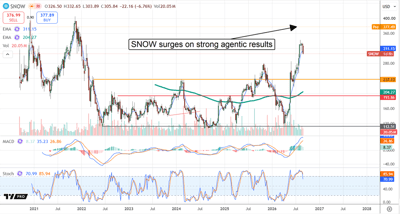
Snowflake’s (NASDAQ: SNOW) stock surged more than 20% following its Q2 fiscal year 2027 (FY2027) release, driven by its guidance, and it could continue to rise based on what lies ahead. Strong as the results were, the outlook suggests the SaaS-Pocalypse sell-off was not only misguided but also too broad. AI poses a threat, and disruption is possible, but established enterprise-grade software companies that provide utility for clients are better positioned to deploy and monetize AI than AI is to build entirely new software industries. AI is complex and requires massive infrastructure, governance and security that average businesses cannot manage.
The market got agentic AI wrong: It did not reduce workloads or data needs; it only accelerated them.
These gold assets are priced for $1,800 gold [it's over $4,000] (Ad)
Gold's major miners are generating record free cash flow, with margins as high as 75 percent even after gold's pullback from highs above 4000 an ounce.
Yet top junior mining assets remain priced as if gold were still stuck near 1800 an ounce, a gap analyst Garrett Goggin calls the Golden Anomaly.
With record cash on hand, majors may soon be forced to buy juniors to secure future production.
See the junior gold assets majors may target nextSnowflake’s strength lies in data pooling, management and security, supported by its rapidly advancing coding capabilities. Tools such as Snowflake Cortex Code assist with legacy and vibe coding, which uses natural-language prompts to direct AI to write code, while incorporating governance. This allows nontechnical users to write code within specific corporate compliance rules. Context is another strength. Snowflake’s tools enable AI to access and understand proprietary data and policies, improving outcomes while reducing hallucinations.
Snowflake’s Q2 Beat Gives Way to Stronger Guidance
Snowflake’s Q2 FY2027 results topped expectations, with revenue rising 35% year over year to $1.55 billion. Growth accelerated on both a sequential and year-over-year basis, and management expects the momentum to continue into the upcoming quarter. Product revenue drove the strength, increasing 37% on client wins and deeper penetration.
Snowflake added 692 net new customers during the quarter, up 32% year over year, and reported 828 customers with trailing 12-month product revenue of more than $1 million, up 27%. Net revenue retention was 126%.
Margins provided another source of strength. Snowflake significantly expanded its non-GAAP operating margin by 430 basis points despite continued investment, helping adjusted earnings grow faster than revenue. Critical details included an 87% increase in adjusted operating income and a 36% increase in adjusted free cash flow.
Looking ahead, Q3 FY2027 and full-year guidance indicate that strength will continue, with product revenue expected to accelerate to the 37% to 38% range in the third quarter. Full-year product revenue guidance was raised to $6.07 billion. Given the early stage of the agentic rollout, Snowflake will likely continue building momentum in the coming quarters, with room to outperform if adoption accelerates.
Analysts Say Snowflake AI Proves Its Worth
The analyst response has been overwhelmingly bullish, with numerous firms issuing positive commentary and raising price targets after the report. The key detail is that fresh targets put the stock in the high $300s to low $400s, with a new high of $450, which would represent a new all-time high if reached. Post-release price action aligned with the shift in sentiment, rising into the high $300s. That move brings Snowflake closer to Wall Street’s targets, but the updated estimates still suggest room for upside if the company continues to deliver stronger product revenue growth and margin expansion.
Valuation is a concern. Trading at well above 100 times current-year earnings, Snowflake is not a cheap stock. However, the market is pricing in a solid outlook that leaves room for growth. The forward-looking 10-year estimate puts the stock’s price-to-earnings (P/E) ratio in the mid-teens, setting the stage for it to double over time.
One risk Snowflake investors face is dilution. The company uses share-based compensation at a high rate, diluting shareholders and causing GAAP losses even as adjusted results improve. As a result, the stock is susceptible to execution risks, including slowing growth or a failure to capture operating-margin gains. Another risk is short interest. Short sellers are not leaning heavily on Snowflake, but interest rose over the summer and may cap gains near the existing all-time high. Catalysts include strategic partnerships with Amazon's (NASDAQ: AMZN) AWS and CrowdStrike (NASDAQ: CRWD). These partnerships can improve consumption while expanding the ecosystem, providing a dual lever for growth.
The company’s balance sheet does not present a risk. Snowflake is well-capitalized despite the impact of acquisitions and investments; it has net cash, and equity is increasing. The 11% quarterly increase in equity more than offsets the impact of share-based compensation, leaving shareholders in a better position than before. With revenue growing, growth accelerating and cash flow improving, investors can expect cash balances to rebuild and equity to continue growing, barring the occasional acquisition and its impact on cash and cash flow.
This message is a paid advertisement for Porter & Company, a third-party advertiser of MarketBeat. Why was I sent this message?.
If you have questions about your account, please email MarketBeat's U.S. based support team at [email protected].
If you would no longer like to receive promotional emails from MarketBeat advertisers, you can unsubscribe or manage your mailing preferences here.
© 2006-2026 MarketBeat Media, LLC.
345 N Reid Pl. #620, Sioux Falls, SD 57103. U.S.A..