
|
 |


 |
“This electoral result scares us! What path is Germany following? The path it has already taken?”
These are not my words, but those of Eva Umlauf, a Holocaust survivor and President of the International Auschwitz Committee. Umlauf was reacting to this weekend’s election results in Saxony-Anhalt, in which the Alternative für Deutschland (AfD), a party classified as “confirmed right-wing extremist” by the German domestic intelligence services, won 43.8% of the vote share. That’s 39 seats in the state parliament, only three seats short of the absolute majority in last Sunday’s election. It’s the AfD’s best result in a German state election and the best result of any party in a state election in the last ten years.
At the time of writing, many questions about the future of Saxony-Anhalt and its government remain unanswered, especially since forming a state government will prove extremely difficult. Even though the AfD did not win an absolute majority, it’s still possible that Ulrich Siegmund, the AfD’s candidate in Saxony-Anhalt, will become state governor, or “Ministerpräsident” for German speakers.
Even before the elections - when polls consistently showed strong support for the AfD - it was clear that this state election would change German politics dramatically: for better or for worse. Political earthquake, watershed moment, turning point - those are just some of the words used by political commentators and politicians alike leading up to Sunday.
It is natural in a democracy that the party you support will not win every election. And it is also natural to be disappointed by that. But what many Germans - myself included - are feeling is something else.

While AfD supporters and politicians are celebrating their victory, cheered on by Russia, the radical right across Europe and MAGA, many people in Germany are scared of what is to come. Heidi Reichinnek, co-leader of the Left Party in Parliament, described it best: “In Saxony-Anhalt many people live in fear now - people with migrant backgrounds, queer people, people who understand themselves as ‘left’, people with disabilities.” A message that was echoed by many parties.
Are they sore losers unable to admit defeat? No. Their reaction is a testimony to the far-reaching consequences this election could have and the threat AfD poses.
In the days leading up to the election and in the reactions to the result, a remarkably broad coalition emerged: all voicing the same concern, all sounding the alarm. From faith communities to business leaders and universities, large swathes of German civil society warned about the consequences of an AfD government. Here is just a selection:
An educational organisation supporting vocational training for people with disabilities says the result “is a warning signal for all people with disabilities and everyone who speaks up for an inclusive society”,
Church leaders, too, appeal to the AfD to remember the “dignity of every human being, regardless of heritage, religion, way of life, achievement, or position”,
Jewish communities are calling on the state to protect minorities,
The German Refugee Council says: “We don’t know what kind of government will come, but we already know which fear these results produce.”
The Turkish Community in Germany warns of the consequences of the AfD’s victory for refugees and stressed “people with migrant backgrounds no longer have time for theoretical debates about security”. Instead, it called on the government to “actively protect them from right-wing extremists”,
From the business world, an association warns that many central positions of the AfD are hostile to business, to Germany’s attractiveness as a location for investment, and to employment. They added: “Extremism threatens freedom, the rule of law, and social cohesion - and with it the foundations of our prosperity.”
Leading voices from the higher education sector call for “freedom of science, freedom of art, and the autonomy of universities to be preserved”.
It is not just organisations sounding the alarm. Ordinary people are frightened, too. People living in Saxony-Anhalt who do not conform to the party’s view of what a German is because of their family situation, sexuality or ancestry are seriously thinking about moving away, fearing for their safety.
 |
These are not normal reactions after an election. No election in Germany’s recent past comes to mind after which minorities felt compelled to ask for the most basic thing - to be protected. But this was not a normal election.
“The fact that - again - in a German state parliament a right-extremist party takes their seats as the strongest party, we as survivors of the Holocaust would not have deemed possible. This election result fills us with shame,” said Eva Umlauf, the survivor we heard from at the start of this article. This is a damning indictment of what has happened in German politics, both in the past and present. 43.8% of voters chose the AfD, a party classified as “confirmed right-wing extremist”. That stat should alarm us all.
We have to acknowledge a difficult reality: some of the AfD’s voters are lending this party their vote because of - not despite - the party’s hard-line positions on immigration. When Ulrich Siegmund declares that “from day one, we will deport”, we are naive to think that most of their voters did not listen to it. ZEIT columnist Sasan Abdi-Herrle writes: “Everyone in this country knows very well who and what this party is, what it wants. There’s no mistaking it.”
This demands a reckoning, a wrestling with an ugly truth.
For me, growing up in Germany meant growing up inside a culture of remembrance (Erinnerungskultur). The shadows of Nazi Germany, the horrific crimes committed in the name of the German people, hang over Germany to this day, rightly so.
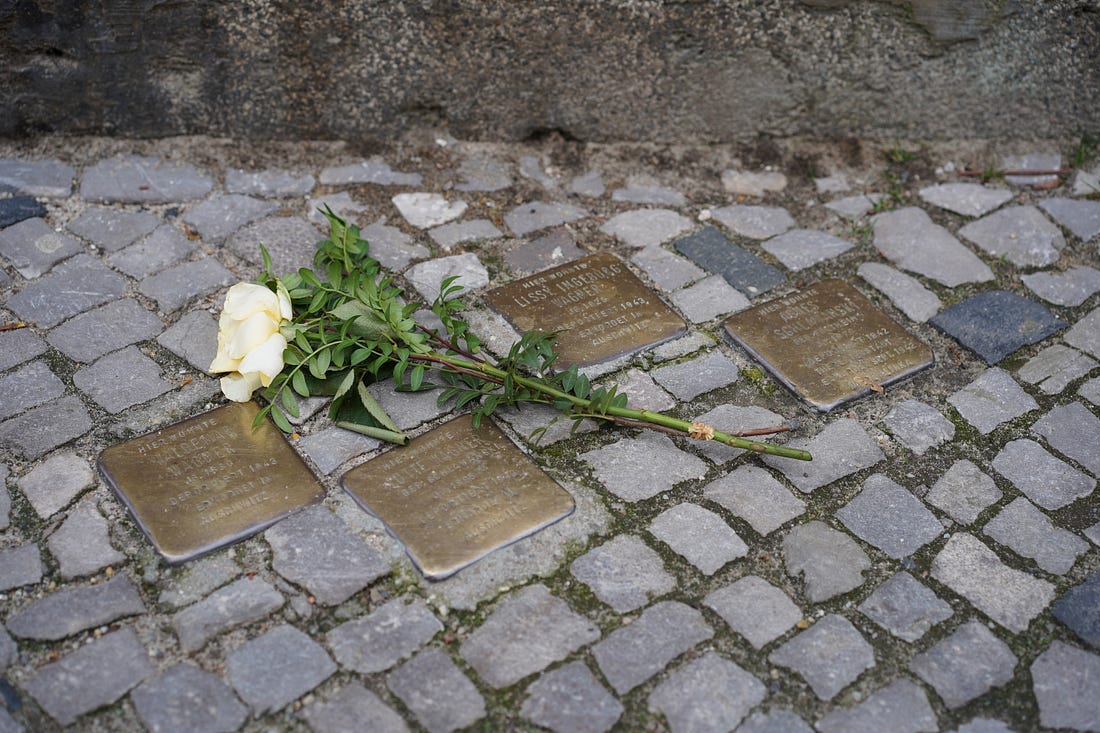
Germany did not hide its dark past. It presented it clearly. Just walking through our capital, Berlin, you can see the traces of history everywhere. In the middle of Berlin stand 2,711 concrete slabs, rising into the sky. It’s the memorial for the murdered Jews of Europe during WWII. All across Germany, you can find little gold plates on the ground, so-called “Stolpersteine” (stumbling stones), engraved with the names of people who were persecuted by the Nazis. There are more than 116,000 Stolpersteine across the continent, most of them in Germany.
German schools did not treat Nazi history as something children needed to be shielded from. Instead, we read the diary of Anne Frank in German class, and in history class we were taught how Hitler managed - over years - to get ordinary Germans to believe the lies that they were ‘superior’ and that others were to blame for their own struggles.
One of my most vivid memories from my school days was when a Holocaust survivor visited our school and, without sparing any details, told us how he had to strip naked in front of an SS soldier, terrified that the soldier would discover he was Jewish. He told us of friends who - after the war ended - never returned to Germany or uttered a word in their mother tongue, German, out of revulsion at what their friends, colleagues and neighbours had done to them - or looked away from.
This is the Germany I grew up in, not the kind of Germany the AfD envisions with “more Bismarck, less Hitler” in our schools. “The anti-fascist consensus about our Nazi past is fundamental to German democracy. But that, shockingly, is being shattered,” writes the German journalist Jörg Lau in The Guardian.
 |
So where do we go from here? The rise of the AfD is down to many factors, and there is no magic button that politicians can press to win back AfD voters.
But in Germany and across the Western world, where right-wing populism is on the rise or already in power, centrist forces need to understand that they can’t out-right the radical right. In Germany, the AfD has fundamentally changed the political discourse, pushing parties further to the right. Positions that were once unthinkable are suddenly discussed on talk shows, in newspapers, and parliament.
It’s time for left and centrist parties in Europe to unequivocally stand up for human dignity, all the while relentlessly working to improve the living standards of voters to staunch the breeding ground of radical-right parties. We need more than just words; we need concrete actions.
If we fail to do that, we cannot be surprised if more federal states in Germany elect the AfD as the strongest party, or if more radical right parties across Europe rise to power.
It’s time to act.
Laurena Rodrigues is Social Media Manager at Best for Britain.
You’re currently a free subscriber to The Best for Britain Wire. For the very latest analysis, expert commentary and political intrigue, upgrade your subscription.
| ||||||||||


