
|
You are a free subscriber to Let’s Address Virginia. Meaning your readership helps us reach more people. When you’re ready, I’d love you to join us as a paid subscriber.
Virginia Celebrates Labor Day. It Doesn’t Do Much Else for Workers.
Virginia is a right-to-work state without full collective bargaining...but for how much longer?
|

| |||||||||||||||


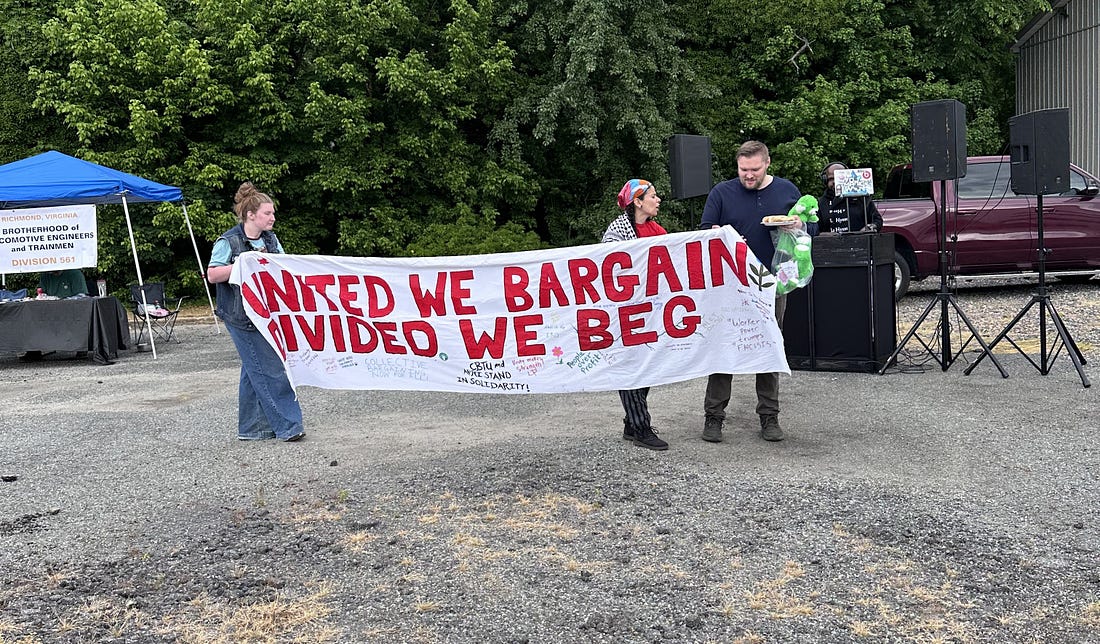
For decades, Virginia has trailed the national average in terms of workers in unions. The national average hovers around 10%. Virginia comes in at 5.4%. Efforts have been underway to make Virginia a better state for workers, with major progress taking place this year when collective bargaining legislation passed the General Assembly with every Democrat voting for it - only to be vetoed by Governor Abigail Spanberger, a Democrat. Meanwhile, legislation to repeal right-to-work didn’t even get heard. There’s a lot to unpack here, so let’s address this.
What is the Right-to-Work?
This is a classic example of deceptive phrasing. “Right-to-work” makes people think that this is a pro-worker law. It’s as pro-worker as pro-life is “pro life”.
The Economic Policy Institute describes right-to-work as:
Right-to-work laws prohibit any requirement that workers covered by a union contract either join the union or contribute toward the cost of union representation. Because RTW laws make it more difficult to form and sustain unions, RTW states have lower unionization rates, which translate to lower wages, fewer benefits, and greater inequality for all workers.
That’s a reason why Virginia may be a top state for businesses (CNBC), but it ranks 19th for workers (Oxfam’s Best States to Work).
 |
Right-to-Work has a racist history
State Senator Jennifer Carroll Foy carried legislation to repeal Virginia's right-to-work laws. Last year, she said,
We understand that right-to-work laws are a vestige of Jim Crow, because many people wanted to stop Black workers from being able to join a union, because that was the fastest, most efficient way to the middle class. We're done with that. We're ready to move forward and move forward with affordability and improve the lives of all workers.
Senator Foy is right. In the early 1940s, Vance Muse, a white supremacist and anti-Semite, led the right-to-work movement. Muse was a lobbyist, so he partnered with employers and pushed for right-to-work laws to make it harder to organize, thereby putting a wrench in the works for civil rights.
In 1946, Virginia stripped public sector workers of collective bargaining rights after a group of Black workers organized a union at the UVA hospital. Governor Bill Tuck (D) signed the right-to-work act into law in 1947.
Dr. Martin Luther King, Jr. called right-to-work out for the nonsense it is when he coupled the fight for civil rights with workers’ rights.
In our glorious fight for civil rights, we must guard against being fooled by false slogans, such as ‘right to work.’ It is a law to rob us of our civil rights and job rights.
Its purpose is to destroy labor unions and the freedom of collective bargaining by which unions have improved wages and working conditions of everyone…Wherever these laws have been passed, wages are lower, job opportunities are fewer and there are no civil rights. We do not intend to let them do this to us. We demand this fraud be stopped. Our weapon is our vote.
Collective Bargaining
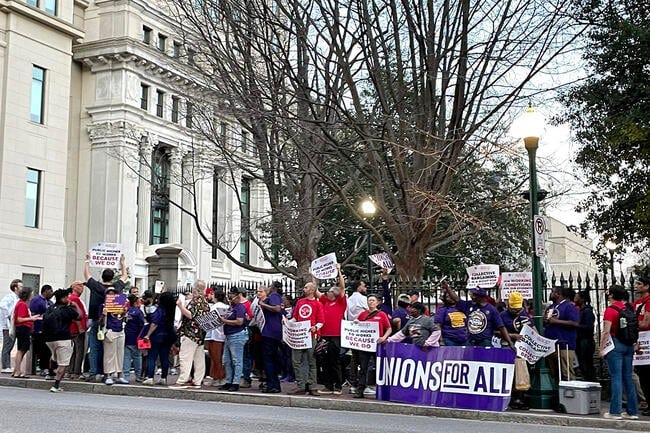
In 2021, after a 75-year ban, the General Assembly cracked the door open for workers in local governments to collectively bargain, and about a dozen localities walked through it. This year, the legislature tried to open it all the way. Every single Democrat in both chambers voted to restore bargaining rights to more than 500,000 public workers. These include teachers, firefighters, EMTs, and home care aides. Governor Spanberger vetoed it. She says she did so because the General Assembly rejected her amendments, though the Economic Policy Institute found those amendments would have made bargaining optional, which is a longer way of saying no. Glenn Youngkin vetoed the same idea last year. The difference is that nobody knocked doors for Youngkin believing he would sign it.
Spanberger’s veto caused a massive flare-up from unions who worked hard to get her elected. She has a lot of work to do over the next 3 years to regain their trust before following the Virginia tradition of running for Senate after serving as Governor (Virginia bars Governors from consecutive terms).
 |
Benefits of a Union
“Unionized workers in the private sector have wages about 25% higher.” (LA Times) Considering that union dues are approximately 1-2% of an employee’s income, that’s not a bad ROI at all. Consider that working families with money typically spend money (rather than hoarding it offshore); this means we have a society with a better economy for all.
Unionized workplaces offer more benefits, such as paid family leave, paid sick leave, and vacation, and are safer.
That is why actions like repealing right-to-work in Virginia, supporting collective bargaining for public sector workers, and supporting legislation such as the Protecting the Right to Organize (PRO) Act nationally are so crucial for a future centered on the people, not the donor class.
Three Things You Can Do Today
Message Governor Spanberger. Oxfam America has put together a tool to help you send an email. Celebrate Labor Day by urging the Governor to commit to signing collective bargaining legislation and to prioritizing the repeal of right-to-work next session.
Contact your Congressmember. Urge them to support the Protecting the Right to Organize (PRO) Act with these talking points. Find your Congressmember’s contact information by clicking below.
In the Richmond area or want a reason to come? Lewis Ginter Botanical Garden workers have been on strike since September 2. The average wage is $17.52. The workers are demanding a living wage, which is a $2 raise across the board. Management said the best they can do is a 3% raise, which is 52 cents. This is after 2 years with no raises. Stop by and show your support for the workers on strike.
Onward and upward,
Salaam
 |
Rather than a monthly subscription, you can now make a one-time contribution to support our human rights platform at any amount that fits your budget.
Invite your friends and earn rewards
| ||||||||||


