| Unsubscribe |
Ian Cooper here...
It’s devastatingly simple.
But it’s working.
It’s a simple trade where we target a triple-digit return in just 9 days.
It doesn’t work every single time, of course. But the win rate (73%) and the return on capital (2,671%) stand on their own.
I’ll show you the strategy AND I’ll even give you my newest report at no charge right here:
The Simple Path: Target triple-digit returns in just 9 days
In your corner,
Ian Cooper
Walmart and Home Depot Earnings Show the K (Shaped Economy) Is Here to Stay
Authored by Dan Schmidt. First Published: 8/24/2026.

Key Points
- Walmart shares fell 9% after earnings despite beating estimates, as decelerating comps revealed consumers trading down to cheaper items rather than buying more.
- Home Depot posted its best comp sales growth since 2022, driven by higher-income, equity-rich homeowners spending more per trip, while overall transaction volume declined.
- Diverging results from both retailers reinforce the K-shaped economy narrative, with lower-income shoppers cutting back while wealthier consumers continue big-ticket spending.
- Special Report: The company SpaceX cannot operate without
The S&P 500 may have hit a new all-time high this month, but that doesn’t necessarily mean consumers are feeling good about the economy. While consumer sentiment has rebounded from its historic lows, July retail sales surprised to the downside at $763.6 billion, down 0.6% from the previous month. One data point doesn’t create a trend—and the number was still up 5% from July 2025—but it was the first month-over-month retail sales decline since October 2025. Investors have been watching retail sector earnings closely over the last week.
Walmart Inc. (NASDAQ: WMT) and Home Depot Inc. (NYSE: HD) were two bellwethers that reported this week, and both beat estimates and posted comparable-store sales growth. But the market reaction couldn’t have been more different, and a deeper dive into the numbers shows that the dreaded K-shaped economy is still very much with us.
Walmart Earnings: High Traffic, Lower Tickets
The Rumors About Elon’s Next Move Are Spreading Fast (Ad)
Rumors are circulating that Elon Musk is preparing to acquire three publicly traded companies.
Dr. Mark Skousen, who met Musk in person and called the SpaceX listing months early, says he has identified all three targets in what he calls Elon's $2.1 Trillion Hit List.
See the three companies before the rumors become headlines.
Get the details on all three companies nowWalmart released its fiscal Q2 2027 results before the market opened Aug. 20, and the stock was promptly smacked down 9% despite a top- and bottom-line beat. U.S. comps grew 2.6% during the period, the company added 96 basis points (bps) of gross margin and raised full-year sales guidance. However, the headline numbers don’t tell the whole story.
The margin gains were boosted by $2.9 billion in tariff refunds, which the company plans to return to customers through price reductions. Management noted that 750 bps of operating income growth was attributable to tariff refunds, and that benefit will not be repeated in Q3.
But the real question mark in the numbers came from comps, which decelerated significantly from 4.1% and 4.6% in fiscal Q1 2027 and Q4 2026, respectively. Management blamed 125 bps of the decline on new drug regulations affecting pharmacy sales, but the real culprit appears to be a step down in transaction size, not volume.
Sam’s Club provides the clearest example: comps rose 4.4% excluding fuel, but the average ticket declined 2.5% despite a 7% increase in transactions.
Consumers are trading down to value, which isn’t typically a sustainable way to build comps. Q3 operating income growth was guided to a range of 2% to 4%, so the headline guidance lacks teeth and helps explain why the stock dropped 9% after the release.
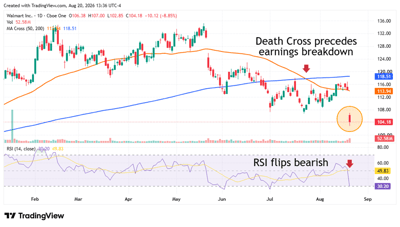
The stock fell below its 50-day moving average on the day of the release, reversing the momentum that had been building, as indicated by the Relative Strength Index (RSI). The RSI has now plunged to 30, which is typically the threshold at which a stock is considered oversold. This raises the question of how much downside remains.
Home Depot Earnings: Slower Traffic, Higher Tickets
Home Depot reported its fiscal Q2 2026 earnings on Aug. 18, and the market reaction was far more nuanced.
Home Depot also reported a tariff refund-aided headline double beat along with growing comps, but its 1.7% comp sales growth was the company’s best result since Q3 2022. The breakdown of those comps also offers another clue about consumer sentiment.
The 1.7% comp came with 2.8% ticket growth and a 1% decline in transaction volume. Big-ticket items continue to dominate sales: Transactions over $1,000 grew 2.4% during the quarter, and average spending per trip rose from $90.01 to $92.50. Affordability continues to limit turnover in the housing market, but current homeowners have plenty of equity to fund renovations.
A smaller cohort of wealthier clients is carrying Home Depot’s comps, which likely explains why management chose to reaffirm Q3 2026 guidance rather than raise it after tariff refunds boosted profitability.
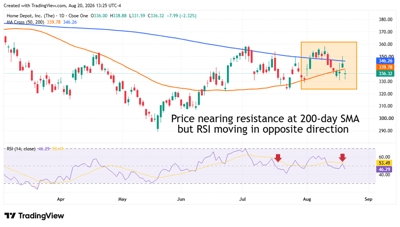
The stock rose slightly after the earnings release and is now locked in a tight range between its 50-day and 200-day moving averages. But the RSI is trending below the bearish threshold, hinting that the momentum from the post-earnings pop will struggle to sustain itself.
Value Trade-Downs and Big-Ticket Spending Highlight Diverging Consumer Behavior
Earlier this month, U.S. Treasury Secretary Scott Bessent said he was “sick and tired” of hearing about the K-shaped economy. But unfortunately for Bessent, these earnings results show that the K is likely to remain a talking point through the end of the year. Walmart’s comp sales growth is slowing despite booming traffic because consumers higher up the income ladder are now trading down on essentials and groceries. At the same time, equity-flush homeowners have plenty of capital to deploy on home improvement projects, while renters and do-it-yourself customers stay away.
Moving forward, investors should monitor a few sentiment-related factors. August retail sales numbers will be released on Sept. 16, along with any revisions to the previous month’s data. Walmart’s Q3 earnings will also be in the spotlight after its Q2 drawdown, and the market will watch whether tariff-aided price cuts increase spending per trip. For now, the K-shaped economy continues to inform sentiment and guide behavior, with lower-income households bearing the brunt of the trade-offs.
Marvell Takes a Shot a Broadcom's Throne With Google Deal
Authored by Leo Miller. First Published: 8/24/2026.

Key Points
- Broadcom shares have fallen more than 10% from a recent high, partly due to Marvell Technology's new custom chip deal with Google.
- Marvell's agreement with Google includes warrants tied to up to $120 billion in potential purchases, signaling a possibly significant long-term relationship.
- Broadcom's upcoming earnings report, particularly its fiscal year 2027 AI semiconductor guidance, is seen as key to restoring investor confidence.
- Special Report: The company SpaceX cannot operate without
Semiconductor giant Broadcom (NASDAQ: AVGO) has seen its share price tumble significantly in recent weeks, with concerns about diversification in custom AI chips weighing on investors.
From a recent high of about $428, Broadcom shares have fallen more than 10%. This decline is partly attributable to broader weakness in AI semiconductor stocks, with NVIDIA (NASDAQ: NVDA) also down moderately over the same period. However, news surrounding Broadcom’s largest customer and a top custom-chip competitor has accelerated the decline in Broadcom stock.
The Rumors About Elon’s Next Move Are Spreading Fast (Ad)
Rumors are circulating that Elon Musk is preparing to acquire three publicly traded companies.
Dr. Mark Skousen, who met Musk in person and called the SpaceX listing months early, says he has identified all three targets in what he calls Elon's $2.1 Trillion Hit List.
See the three companies before the rumors become headlines.
Get the details on all three companies nowAlphabet (NASDAQ: GOOGL) subsidiary Google is well known as Broadcom’s largest and longest-standing buyer of custom AI chips. Marvell Technology (NASDAQ: MRVL) has thrown a wrench into this relationship by signing its own deal with Google to develop custom semiconductor products. Furthermore, Marvell isn’t the only chip company threatening Broadcom’s position, making its upcoming earnings report a key opportunity to restore investor confidence.
Marvell and Google Enter Custom Chip Collaboration
A recent Marvell SEC filing states that at the end of July, it “entered into a commercial agreement relating to the Company’s development of custom semiconductor products to Google.” It notes that the partnership “spans a comprehensive range of custom silicon programs that attach to the TPU ecosystem, including AI inference accelerators, storage controllers, network interface controllers, memory interface controllers, and near-memory compute.”
Some have characterized this agreement as Broadcom effectively losing share in Google’s Tensor Processing Unit (TPU) development pipeline. However, the wording of Marvell’s filing is more ambiguous. Marvell refers to “custom silicon programs that attach to the TPU ecosystem” rather than saying that it will develop TPUs outright.
Still, its programs with Google include “AI inference accelerators,” which aligns with Google’s description of chips such as its TPU 8i. In this sense, Marvell may be developing chips that serve a purpose similar to inference TPUs, potentially eroding Broadcom’s AI chip share at Google.
Despite this, it is important to note that Broadcom signed a TPU and networking deal with Google through 2031 in April. This deal demonstrates that Broadcom is likely to remain a key Google TPU partner for years to come.
On the other hand, the Marvell-Google deal includes potential equity investments that could tie the firms more closely together and indicate that the relationship could become massive.
Marvell Warrant Structure Indicates a Huge Revenue Opportunity
Marvell has issued warrants to Google that allow it to buy nearly 59 million shares of Marvell stock. With approximately 876 million shares outstanding, exercising all of these warrants would give Google more than 6% ownership in Marvell. This economic alignment could give Google an added incentive to direct business to Marvell. In turn, Google’s spending at Broadcom could suffer.
However, the second part of the warrant structure is more notable. The majority of the warrants vest only after Google makes discretionary purchases of custom products. They vest in 240 equally sized tranches, with each tranche requiring $500 million in product purchases. In turn, Google would need to make $120 billion in cumulative purchases from Marvell to gain access to all of the warrants.
Google has from Marvell’s fiscal Q3 2027 through the end of its fiscal year 2033 to make these purchases. (Note that Marvell’s fiscal reporting period is several quarters ahead of the calendar year; the company is currently in its fiscal Q2 2027.)
The incredible size of this figure makes it difficult to believe that it will fully materialize. For reference, $120 billion is more than 13 times Marvell’s last 12 months of revenue, which totaled $8.7 billion, and more than 11 times Broadcom’s $10.8 billion in AI semiconductor revenue last quarter. Nonetheless, it highlights that the Marvell-Google relationship could be very material.
Still, there is no clear dollar figure that provides a baseline for how large Marvell’s relationship with Google could become. This makes it difficult to assess how much of a negative impact the deal could have on Broadcom.
The deal is another clear signal that competition in custom chips is intensifying, particularly around Google’s TPUs. Analysts believe that MediaTek (OTCMKTS: MDTKF) is one of Google’s alternate TPU partners. Meanwhile, rumors have surfaced that Advanced Micro Devices (NASDAQ: AMD) is working with Google on future TPU generations. For incumbent leader Broadcom, it is difficult to see these developments as anything but negative.
AI Chip Guidance Increase Could Get Investors Back on Broadcom’s Side
Amid this heightened competition, there is one particularly powerful lever that Broadcom could pull to quell investor fears: raising its guidance. Broadcom’s decision not to raise its fiscal 2027 AI semiconductor revenue guidance was one of the main reasons shares tanked after its latest earnings report. (Note that Broadcom’s fiscal reporting period is ahead of the calendar year; the company is currently in its fiscal Q3 2026.)
There is reason to believe Broadcom was simply being conservative. However, intensifying competition, highlighted by the Marvell-Google deal, has raised concerns. Could Broadcom be uncertain about its growth prospects because of this, leading it not to increase guidance? Questions like these are likely swirling in investors’ minds.
Raising its 2027 guidance significantly could go a long way toward putting these fears to rest, although it would not dispel broader competition concerns. This makes Broadcom’s fiscal 2027 AI semiconductor guidance likely the biggest factor to watch in its upcoming earnings report.
This email is a paid advertisement sent on behalf of TradeWins, a third-party advertiser of Earnings360 and MarketBeat.
NOTICE: Auto-trading, or any broker or advisor-directed type of trading, is not supported or endorsed by Ian Cooper. The information provided by Ian Cooper in its various materials, including trading recommendations, newsletters and educational publications is not customized or personalized for any particular person or risk profile. Past results are not necessarily indicative of future results. Results presented can vary and may not be typical for all subscribers. There are substantial risks involved with investing in the stock and options market, including the risk of total loss. You should only trade or invest "risk capital" - funds you can afford to lose.
If you have questions or concerns about your subscription, please contact our U.S. based support team at [email protected].
If you no longer wish to receive email from Earnings360, you can unsubscribe.
© 2006-2026 MarketBeat Media, LLC. All rights protected.
345 N Reid Place #620, Sioux Falls, S.D. 57103. United States of America..