| Unsubscribe |
Oil doesn't need to stay elevated forever for traders to find opportunity.
It simply needs a catalyst.
With renewed tensions involving Iran creating fresh uncertainty around global oil supplies, energy markets are beginning to attract attention again.
History has shown that when supply concerns emerge, certain energy stocks often respond before the broader market catches on.
That's why we created a new report:
Trading the Oil Supply Shock: Top 3 Energy Stocks Emerging From Global Supply Disruptions
One of these companies is already benefiting from today's environment.
The other two may not be on your radar yet.
Click here to see which three energy stocks made our list.
Best regards,
The Wealthiest Investor Team
By following the link above you're choosing to opt in to receive insightful updates from The Wealthiest Investor plus 2 free bonus subscriptions! Your privacy is important to us. You can unsubscribe anytime. See our privacy policy for details.
AST SpaceMobile Is Down 54%—Can FCC Progress and BlueBirds Reverse the Slide?
By Jessica Mitacek. Published: 8/31/2026.

Key Points
- AST SpaceMobile shares have fallen nearly 54% since their May 28 all-time high amid concerns over cash burn, dilution, and insider selling.
- The company's Q2 earnings missed EPS and revenue estimates, marking its sixth consecutive EPS miss and seventh revenue miss in eight quarters.
- AST SpaceMobile's recovery hinges on FCC-approved direct-to-device testing, carrier partnerships with AT&T and Verizon, and its Rakuten joint venture in Japan.
- Special Report: The company SpaceX cannot operate without
Pumpkin spice latte season is upon us, and perhaps no company is looking forward to turning the page on summer more than Midland, Texas-based AST SpaceMobile (NASDAQ: ASTS).
Since the space-based cellular broadband network provider’s stock hit its all-time high on May 28, it has fallen nearly 54%.
The Rumors About Elon’s Next Move Are Spreading Fast (Ad)
Rumors are circulating that Elon Musk is preparing to acquire three publicly traded companies.
Dr. Mark Skousen, who met Musk in person and called the SpaceX listing months early, says he has identified all three targets in what he calls Elon's $2.1 Trillion Hit List.
See the three companies before the rumors become headlines.
Get the details on all three companies nowAs the company continues to build out its constellation of low Earth orbit (LEO) BlueBird satellites, numerous headwinds and tailwinds could work against it or in its favor. But the SpaceX (NASDAQ: SPCX) competitor will have to overcome some challenges—and embrace certain catalysts—as it aims to work its way back into investors’ good graces.
Concerns Mount Over AST SpaceMobile’s Burn Rate, Dilution, and Heavy Insider Selling
Like any company expanding at the scale of AST SpaceMobile, the speed at which it spends its cash reserves can be alarming.
Those outlays are necessary to achieve the company’s objectives, but that doesn’t quell critics’ concerns.
Analysts are forecasting a full-year cash burn rate of between $1.5 billion and $1.8 billion.
That spending is being driven by research and development, vertically integrated BlueBird satellite production, and costly rocket launch service fees. SpaceX charges around $55 million to $65 million per launch.
To address that last expense, the company is exploring a partnership with or potential acquisition of a launch services provider, but that strategy has come with strings attached. In a Form 8-K filing on July 15, AST SpaceMobile noted that its $1 billion private offering of convertible senior notes due 2034 was intended to “further vertically integrate its business and mitigate risks associated with third-party launch providers.”
As ambitious as that is, the $1 billion offering raises the specter of shareholder dilution.
AST SpaceMobile ultimately raised $1.15 billion through the convertible notes, which carry an initial conversion price of $79.57 per share. However, the company also entered into capped call transactions designed to reduce potential dilution, resulting in what AST says is an effective conversion price of $149.20 and effective dilution of less than 2%.
Another headwind comes in the form of heavy insider selling. Over the trailing 12 months, insiders have liquidated more than $450 million worth of ASTS shares while buying only $187,240 worth of stock. All of those purchases came in the fourth quarter of 2025; there were no insider purchases in the first or second quarters.
The company has also strung together a chain of disappointing earnings reports. Most recently, AST SpaceMobile’s Q2 report on Aug. 10 resulted in its sixth consecutive earnings per share (EPS) miss and its seventh revenue miss in eight quarters.
EPS of negative 77 cents missed the consensus estimate of negative 32 cents by a wide margin, while revenue of $31.52 million came in below expectations of $34.53 million.
Concerningly, Q2 adjusted operating expenses, excluding the cost of revenues, rose to $95.9 million, while capital expenditures reached approximately $610 million. Q3 adjusted operating expenses are expected to increase to a range of $105 million to $115 million.
A Reversal Will Largely Depend on the Success of AST SpaceMobile’s FCC Test and Its Partnerships
The rollout of AST SpaceMobile’s direct-to-device (D2D) network depends in part on regulatory approvals and testing, as well as the roughly 60 strategic partnerships it already has in place.
Earlier in August, the U.S. Federal Communications Commission (FCC) granted the company a temporary 30-day authorization to test D2D connectivity using 800 MHz spectrum on up to 100 commercially available devices through Sept. 12.
That testing comes amid a broader push by major U.S. carriers to expand satellite-based D2D coverage. On May 14, AT&T (NYSE: T), T-Mobile (NASDAQ: TMUS), and Verizon (NYSE: VZ) announced an agreement in principle to form a joint venture that aims to expand satellite-based D2D wireless coverage in the United States by pooling spectrum resources, improving D2D capacity, and creating a more unified platform for satellite providers. Among the three carriers, only T-Mobile currently uses Starlink to fill coverage gaps, while AT&T and Verizon have agreements in place with AST SpaceMobile.
The company also has an agreement in place with Tokyo-based Rakuten (OTCMKTS: RKUNF).
In its Aug. 10 update, AST said the Rakuten-AST joint venture had been preliminarily selected by Japan’s Ministry of Internal Affairs and Communications for the J-LEO initiative, with a total expected value of up to approximately $1 billion in non-dilutive, non-debt government capital. Rakuten has said it is targeting the launch of domestic service in Q4 2026.
While the stock remains highly volatile, with a current beta of 2.75 and short interest at 18.67% of the float, or $4.08 billion worth of ASTS shares, institutional investors taking the long view are buoying the stock. Over the past 12 months, inflows from institutional buyers have totaled more than $5 billion, while institutional sellers’ outflows have been limited to less than $400 million.
AST SpaceMobile continues to work toward its target of 45 BlueBird satellites in LEO by early 2027. A company press release confirmed that it is well on its way to achieving that goal, with “production advancing through BlueBird satellite 42” as it continues to scale its constellation.
Wendy’s Rally Fades After Trian Steps Back: Was It Ever Real?
By Chris Markoch. Published: 9/2/2026.

Key Points
- Wendy’s surged on take-private speculation tied to Trian Fund Management, then gave back the rally after Reuters reported Trian had no current plans to bid.
- Wendy’s second-quarter results showed a 7% decline in U.S. same-restaurant sales, lower net income and a withdrawn 2026 outlook.
- Wendy’s still has unusually high short interest, which could keep the stock volatile even if the turnaround remains unproven.
- Special Report: The company SpaceX cannot operate without
For a few days in mid-August, Wendy's (NASDAQ: WEN) traded like a company about to be taken private. Reports surfaced on Aug. 12 that Trian Fund Management, Nelson Peltz's activist firm and a roughly 16% shareholder in Wendy's, was assembling a consortium to explore a buyout.
The stock ripped nearly 15% higher. That briefly pushed shares toward the $9 mark, putting WEN in the green for 2026.
The Rumors About Elon’s Next Move Are Spreading Fast (Ad)
Rumors are circulating that Elon Musk is preparing to acquire three publicly traded companies.
Dr. Mark Skousen, who met Musk in person and called the SpaceX listing months early, says he has identified all three targets in what he calls Elon's $2.1 Trillion Hit List.
See the three companies before the rumors become headlines.
Get the details on all three companies nowThe move didn't last. Reuters reported that Trian had no current plans to bid, and the stock gave back the entire rally in a single session, sliding back toward the high-$7 range. Trian's stated reasoning—including concerns about performance, valuation and strategic direction—read less like a passing decision and more like a well-capitalized insider declining to catch a falling knife.
That reversal landed at a time when Wendy's was already struggling. In its Q2 2026 earnings report, delivered on Aug. 7, Wendy's reported a 7% drop in U.S. same-restaurant sales, a 41% decline in net income and a withdrawn full-year 2026 outlook. CEO Bob Wright didn't sugarcoat it, telling investors performance was "not at our potential."
But that's not quite where the story ends. In the weeks since, WEN has quietly clawed back most of that decline. That recovery is why the rally deserves to be taken seriously, not dismissed rhetorically.
Why WEN Started Trading Like a Meme Stock
Five years ago, Wendy's was trading at an all-time high of around $25. Since then, WEN has been in a steep decline, bringing the stock to around $6.22 per share in June 2026. That put it perilously close to penny-stock territory.
The decline hasn't been without merit. The quick-service restaurant industry has been struggling to find the right mix of price and value for an increasingly stretched core consumer. Wendy's hasn't helped matters with execution errors.
So why did WEN soar 15% in such a brief time? It wasn't all about Trian. More than 32% of its float was sold short. Savvy traders saw an opportunity to force some of those short sellers to cover their positions. The move may not technically qualify as a short squeeze, but that term does a better job of explaining why the stock moved so sharply.
This is an important distinction for investors. A stock with substantial short interest can move dramatically on relatively little new information. When sentiment is already heavily skewed to the bearish side, even a temporary positive catalyst can force traders to reassess their positions.
That doesn't necessarily mean the underlying business has improved.
It does, however, mean that WEN can remain unusually volatile as investors debate whether the worst of the company's decline has already been priced into the stock.
Wendy's Stock Technical Analysis Shows a Bullish Setup, But Not a Confirmed Turnaround
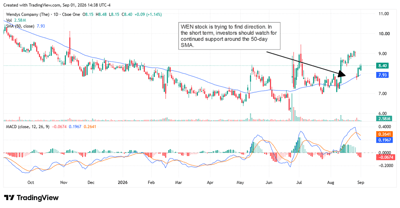
However, just as it did in early July, investors considering a position in WEN should watch the chart. The stock appears to be finding support at an ascending 50-day simple moving average. That could be the start of a bullish move.
The technical picture is particularly interesting because WEN has managed to recover after the initial Trian-related reversal rather than simply falling back to its June lows.
That creates a potential test for the bulls. If shares can continue holding above the 50-day moving average and establish higher lows, traders will have a technical argument that the longer-term downtrend may be losing some of its force. Conversely, a decisive break below that moving average would weaken the bullish setup and suggest that the recent recovery was another temporary bounce.
The MACD may be the deciding factor. In the last few months, momentum has clearly been on the bulls' side. The coming weeks will determine whether that momentum was due to the Trian news or whether investors see a genuine opportunity.
For technical traders, the distinction matters. Momentum that survives the removal of a major catalyst is generally more meaningful than momentum that disappears as soon as the catalyst does.
Why Betting Against WEN May Be the Wrong Bet
Wendy's is giving investors a genuinely mixed picture. At around 12 times earnings, WEN is overvalued by some measures.
Many investors won't get excited about the stock until the company starts showing positive year-over-year earnings.
That said, Wendy's has been clearing a low bar for earnings over the past several quarters.
Institutions have also been buying the stock. That wouldn't happen if they believed the company's outlook was hopeless. Instead, it appears to be a calculation that the sell-off has been overdone.
That buying activity is directly contradicted by analyst sentiment, which leans bearish with a consensus Reduce rating. Furthermore, of the 21 analysts that MarketBeat tracks, six have a Sell rating on WEN.
So, Was the Rally Ever Real?
The honest answer is yes—partly. The initial 15% pop was driven mostly by enthusiasm for the deal and short covering. That part of the move was always likely to unwind once Trian stepped back.
The subsequent recovery to the mid-$8 range looks different. It looks more like value buyers and technical traders stepping in at a level where the stock had already priced in a lot of bad news.
The catch is that without Trian as a backstop, there's no buyout floor left under the stock. Whatever happens from here rests entirely on Wright's turnaround plan actually working. The chart says momentum currently favors the bulls. The fundamentals say that momentum still has something to prove.
This email content is a sponsored message from Darwin, a third-party advertiser of The Early Bird and MarketBeat.
If you need help with your subscription, feel free to contact MarketBeat's South Dakota based support team at [email protected].
If you no longer wish to receive email from The Early Bird, you can unsubscribe.
© 2006-2026 MarketBeat Media, LLC. All rights reserved.
345 N Reid Place, Sixth Floor, Sioux Falls, South Dakota 57103-7078. U.S.A..